
Who Is a Good Candidate for Endoscopic Spine Surgery in Delhi NCR? A Spine Surgeon Explains
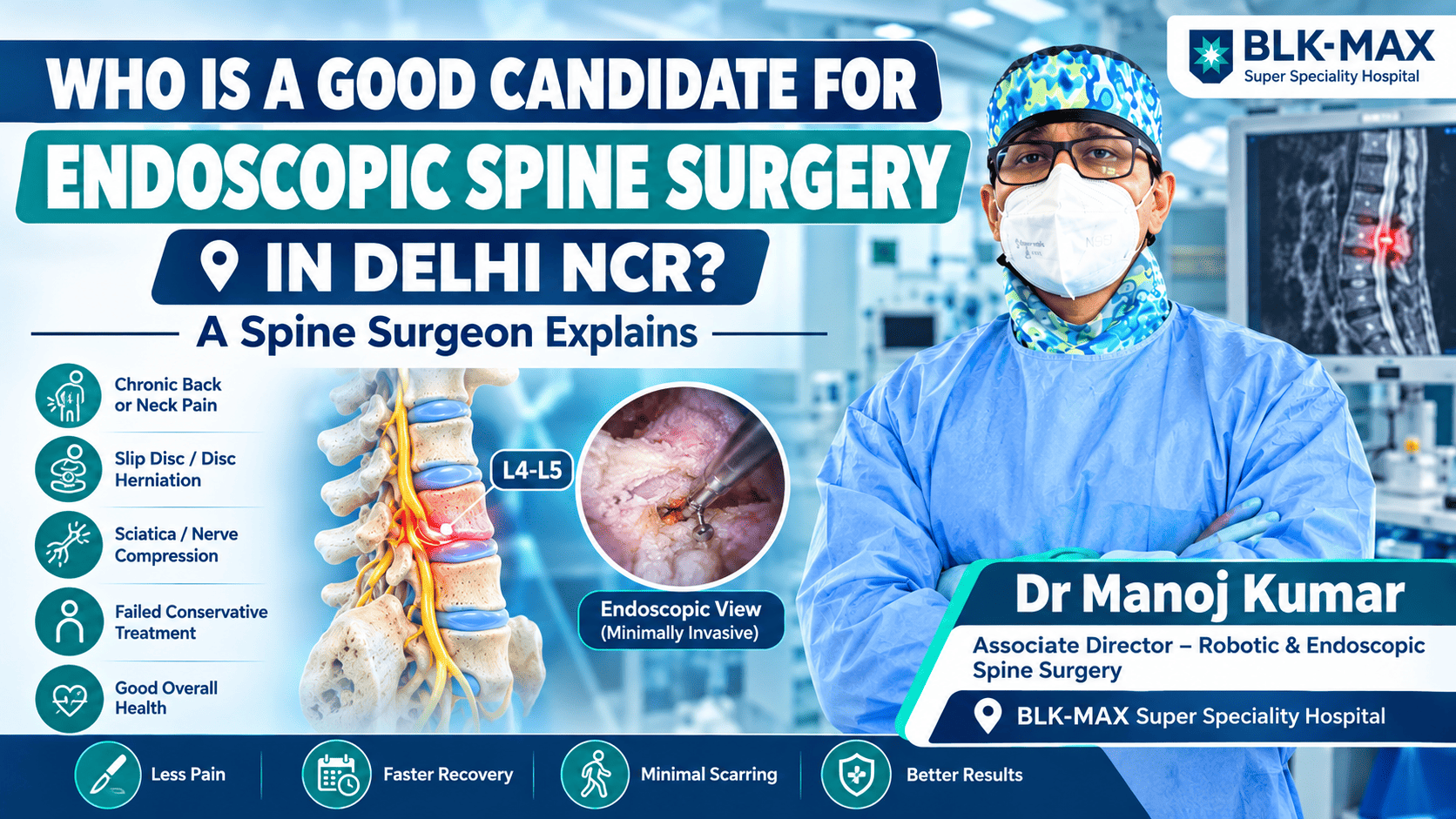
By Dr Manoj Kumar | Associate Director – Robotic & Minimally Invasive Spine Surgery, BLK-MAX Super Speciality Hospital, New Delhi
One of the most important conversations I have with patients in my Delhi NCR clinic isn’t about the surgery itself. It is about whether the surgery is right for them at all.
Endoscopic spine surgery is one of the most successful, minimally invasive, and quick-recovery surgical techniques for spinal disorders today. However, it is not a universal solution. Not every patient who comes in with an MRI showing a disk herniation or spinal stenosis is a good candidate. And not every patient who is advised “you need endoscopic surgery” has been thoroughly evaluated to determine whether that recommendation is true.
Endoscopic spine surgery is appropriate for people whose primary spinal problem is nerve compression caused by a herniated disk, a narrowed canal, a thickened ligament, or a bone spur, whose symptoms have not responded adequately to conservative treatment, and whose anatomy, health status, and clinical picture make the endoscopic approach the safest and most effective path to relief.
That definition sounds straightforward. In practice, it requires a thorough assessment that goes well beyond a single MRI scan. This article explains exactly who qualifies, who does not, and the questions every patient should ask before committing to endoscopic spine surgery in Delhi NCR.
Why Patient Selection Matters More Than the Technology
Before getting into the specific criteria, I want to make a point that I consider more important than anything else in this article.
In my experience, the single biggest predictor of a good outcome after endoscopic spine surgery is not the endoscopic system used, not the hospital, and not even the surgeon’s technical skill, although all of these matter. It is whether the patient was the right candidate for the procedure in the first place.
An endoscopic discectomy performed perfectly on a patient who actually needed spinal fusion will not produce a good result. An endoscopic decompression done on a patient whose pain is coming from a source other than the disc shown on their MRI will leave them no better than before surgery.
The technology is excellent. The outcomes in correctly selected patients are outstanding. But the selection is everything. A surgeon who performs endoscopic spine surgery on every patient who asks for it, without rigorous assessment, will have mediocre outcomes. A surgeon who selects carefully and operates on the right patients will have excellent outcomes.
Who Is a Good Candidate for Endoscopic Spine Surgery in Delhi NCR?
1. Patients With a Confirmed Disc Herniation Causing Nerve Compression
The most straightforward and most common ideal candidate is a patient with a lumbar or cervical disc herniation that is clearly compressing a specific nerve root, and whose symptoms match that compression precisely.
What this means in clinical terms: the patient has leg pain (sciatica) that follows the exact distribution of the nerve being compressed on the MRI. If the L4-L5 disc is herniated and compressing the L5 nerve root, the patient’s leg pain should follow the L5 dermatome, the outer shin, the top of the foot, and the big toe. If the symptoms and the imaging match perfectly, and conservative treatment has not provided adequate relief, this patient is an ideal candidate for endoscopic discectomy.
The precision of this symptom-to-imaging correlation is important. When a patient has diffuse back pain, bilateral leg symptoms, and an MRI that shows changes at multiple levels, without a single clearly dominant pain generator, the surgical plan becomes more complex and careful patient selection becomes even more critical.
2. Patients Whose Symptoms Have Not Responded to 6–8 Weeks of Conservative Treatment
Endoscopic spine surgery is not the first line of treatment. It is the proper alternative if true conservative treatment has been given a fair chance but has failed to produce enough relief.
Structured physiotherapy with a spine rehabilitation specialist, rather than general exercises, combined with appropriate medication management, activity moderation, and, in some situations, a guided epidural steroid injection. A patient who has been taking pain relievers for two weeks and describes it as “conservative treatment” has not given non-surgical management a fair chance.
However, “6–8 weeks” is not a rigid rule. If a patient has severe neurological symptoms, significant leg weakness, foot drop, or bladder symptoms, waiting 6–8 weeks is not appropriate regardless of how recently symptoms began. These patients need urgent surgical assessment and, if confirmed, early surgery.
3. Patients With Neurological Deficits That Are Recent and Still Recovering
A patient with weakness in the foot, numbness in the sole, or difficulty lifting the foot while walking, when these symptoms are recent (within the last 2–3 months) and have not yet progressed to complete loss of function, is often an excellent candidate for endoscopic decompression.
In these patients, the nerve is under active compression and losing function progressively. Removing the compression through endoscopic surgery allows the nerve to recover and the sooner the compression is removed, the more complete the recovery. Nerves that have been compressed for a short time recover better than nerves compressed for many months or years.
This is why I tell patients with any neurological weakness: do not wait too long. The window for optimal nerve recovery narrows with time.
4. Elderly Patients Who Cannot Safely Undergo General Anaesthesia
This is a group of candidates that many patients and families do not realise are among the best suited for endoscopic spine surgery.
Elderly patients, particularly those above 65, frequently have cardiac conditions, lung disease, diabetes, or kidney function issues that make general anaesthesia a meaningful risk. In traditional open spine surgery, general anaesthesia is unavoidable. In endoscopic spine surgery, many procedures, particularly lumbar discectomy and foraminal decompression, can be performed under local or spinal anaesthesia, completely bypassing the need for general anaesthesia and its associated risks.
For an 80-year-old patient with a herniated lumbar disc causing severe sciatica, who has a stent in his coronary artery and controlled diabetes, endoscopic surgery under local anaesthesia is not just a good option; it is frequently the only surgical option that is safe for him. And it works just as well.
5. Patients With Spinal Stenosis (Mild to Moderate)
Lumbar spinal stenosis, the narrowing of the spinal canal due to bone overgrowth, thickened ligaments, and degenerative changes, is another condition well-suited to endoscopic management, particularly when stenosis is at one or two levels and not accompanied by significant spinal instability.
Endoscopic laminotomy and endoscopic ligamentum flavum resection allow the surgeon to widen the narrowed canal and decompress the compressed nerve roots through the same 7–8 mm incision used for discectomy. The neural tissue is visualised in high definition through the endoscope, and the decompression is confirmed in real time.
Patients with mild to moderate single- or two-level lumbar stenosis who are experiencing neurogenic claudication, leg pain, and heaviness that increases with walking and improves with sitting or bending forward are good candidates for endoscopic decompression, particularly when the stenosis is not accompanied by vertebral slippage or significant instability.
6. Patients With Foraminal Stenosis
The foramen is the bony tunnel through which the nerve root exits the spinal canal. When this tunnel narrows due to bone spur formation, disc height loss, or facet joint overgrowth, the nerve root is compressed at the exit point, causing arm or leg pain that can be just as severe as that from a herniated disc.
Foraminal stenosis is an excellent indication for endoscopic spine surgery, particularly the transforaminal endoscopic approach, which accesses the compressed nerve directly through the natural anatomical corridor without disturbing surrounding structures. Patients with foraminal stenosis at one or two levels who have arm or leg pain corresponding to the affected nerve are strong candidates for endoscopic foraminoplasty.
7. Patients Seeking Revision Surgery After Previous Open Spine Surgery
This is a group that requires particularly careful selection, but when selected correctly, endoscopic surgery can be highly effective even in patients who have had previous open spine surgery at the same level.
Patients with recurrent disc herniation at a previously operated level, where scar tissue from the first surgery makes a repeat open procedure technically challenging and higher-risk, can often be approached endoscopically. The endoscopic approach creates a new working corridor that avoids the scar tissue from the previous surgery, reaching the recurrent disc herniation through a different angle.
Not every revision patient is suitable for the endoscopic approach; the extent of previous surgery, the degree of scar tissue, and the specific anatomy determine suitability. But in appropriately selected revision patients, endoscopic surgery offers outcomes comparable to primary surgery with lower complication rates than open revision.
8. Patients Who Want Fastest Return to Work and Normal Life
This is a practical but entirely valid reason to consider endoscopic over open surgery, when both are clinically appropriate.
A working professional who cannot afford 3–4 months of recovery, a mother of young children, a self-employed person whose income depends on physical activity, an athlete preparing for a competition for patients in these situations where time is a critical factor, the dramatically faster recovery of endoscopic surgery (2–4 weeks versus 3–4 months for open surgery) is itself a clinically relevant reason to choose the endoscopic route when both would achieve the same decompression.
Who Is NOT a Good Candidate for Endoscopic Spine Surgery?
Being honest about who should not have endoscopic surgery is just as important as identifying who should. Here are the clinical situations where a different surgical approach is more appropriate:
1. Patients Who Need Spinal Fusion
Endoscopic spine surgery allows for decompression. It removes tissue that is compressing a nerve. It does not fuse vertebrae, implant, or stabilise an unstable spine.
Endoscopic surgery is not appropriate for patients with spondylolisthesis (a slipped vertebra), significant spinal instability, entire disc collapse leading to vertebral instability, or disorders requiring multilevel fusion. These patients require robot-assisted or minimally invasive fusion surgery, which is a different procedure.
A patient with Grade 2 spondylolisthesis who is told they need “endoscopic surgery” should ask their surgeon to explain how this procedure addresses the instability, as decompression will not correct the underlying slip.
2. Patients With Severe Multi-Level Disease
Endoscopic surgery is most effective for one- or two-level pathology where the primary pain generator is clearly identified. Patients with severe degenerative changes across four or five spinal levels, where multiple levels are contributing to symptoms, are better served by a carefully planned open or minimally invasive multi-level approach that addresses all the relevant levels comprehensively.
3. Patients With Severe Spinal Deformity
Significant scoliosis (curvature of the spine), kyphosis (forward bending deformity), or post-traumatic spinal deformity alters the normal anatomy to a degree that makes the standard endoscopic approach technically difficult or impossible. These patients need surgeons and techniques specifically designed for deformity correction.
4. Patients With Active Spinal Infection or Tumour
Active infection in or around the spine (discitis, epidural abscess) and primary spinal tumours require different surgical approaches, usually open surgery that allows thorough debridement, tissue sampling, and, in the case of tumours, adequate resection margins. Endoscopic surgery is not appropriate as the primary approach in these situations.
5. Patients Whose Pain Is Not Clearly From a Structural Spinal Cause
This is probably the most important exclusion criterion, yet it is also the most often neglected.
Back pain and leg pain can have a variety of causes. Not all of these are structural spinal diseases that can be addressed with endoscopic surgery. Hip pathology, sacroiliac joint dysfunction, peripheral nerve entrapment (such as piriformis syndrome), and psychological or psychosocial discomfort can all produce symptoms similar to disk herniation or spinal stenosis. A patient with any of these disorders who undergoes endoscopic spine surgery simply based on an MRI finding, without a comprehensive clinical assessment proving the MRI finding as the true source of pain, would not benefit.
This is why every patient considering endoscopic spine surgery in Delhi NCR deserves a thorough clinical examination, not just an MRI review. The examination tells the surgeon whether the findings on the scan are actually causing the patient’s specific symptoms, and this correlation is the foundation of every good surgical decision.
The Assessment Every Candidate Should Undergo Before Endoscopic Spine Surgery
Before any patient is confirmed as a candidate for endoscopic spine surgery in Delhi NCR, a thorough pre-operative assessment should include:
Clinical history: Duration of symptoms, character of pain (leg pain vs back pain, constant vs positional, sharp vs dull), response to previous treatments, neurological symptoms, bladder and bowel function, impact on daily life and work.
Clinical examination: Straight leg raise test, neurological assessment (power, reflexes, sensation in both legs), walking evaluation, and spine range of motion. The examination results should agree with the MRI results.
MRI of the spine: Essential. Shows the disc, nerve compression, canal dimensions, and soft tissue detail. An MRI older than 6 months should be repeated if symptoms have changed.
CT scan: Valuable in older patients with significant bony changes, for planning the endoscopic approach, and for assessing bone quality before any fusion is considered.
Standing X-rays in flexion and extension: Identifies dynamic instability, which happens when a spine seems stable on a lying-down MRI but shows vertebral slippage on a standing X-ray. This discovery significantly modifies the surgical plan.
Blood investigations: Routine pre-operative bloods, HbA1c in diabetic patients, clotting profile in patients on anticoagulants.
Anaesthesia assessment: Particularly important in elderly patients or those with significant medical comorbidities, determines whether local, spinal, or general anaesthesia is safest.
Questions to Ask Your Surgeon Before Endoscopic Spine Surgery
If your surgeon has recommended endoscopic spine surgery in Delhi NCR, these are the questions that will help you confirm you are the right candidate:
- Based on my MRI and examination, are my symptoms clearly coming from the level you plan to operate on?
- Have I genuinely exhausted conservative treatment, or are there non-surgical options I have not yet tried?
- Is my problem purely decompression, or do I also have instability that endoscopic surgery cannot address?
- What is your personal success rate for this specific procedure in patients with my diagnosis?
- Am I suitable for local or spinal anaesthesia, or will I need general anaesthesia?
- What is the risk that I will need open surgery if the endoscopic approach is not sufficient?
- What specific outcome should I realistically expect: complete pain resolution, or significant improvement?
A surgeon who answers these questions with specific, honest, individualised answers, rather than generic reassurances, is a surgeon whose assessment you can trust.
Frequently Asked Questions — Endoscopic Spine Surgery Candidacy
Who is a good candidate for endoscopic spine surgery?
A good candidate is a patient with a confirmed structural spinal problem, disc herniation, foraminal stenosis, spinal stenosis, or recurrent disc herniation, whose symptoms clearly correspond to the MRI findings, who has not responded adequately to 6–8 weeks of conservative treatment, and who does not require spinal fusion or multi-level reconstruction. Elderly patients, patients wanting fast recovery, and patients who cannot safely undergo general anaesthesia are among the strongest candidates.
Can elderly patients have endoscopic spine surgery?
Yes, elderly patients are among the strongest candidates for endoscopic spine surgery. The procedure can be performed under local or spinal anaesthesia, involves minimal blood loss, causes very little physiological stress, and allows walking the same day, all of which reduce the risks that are highest in elderly patients undergoing major open surgery.
Is endoscopic spine surgery suitable for severe spinal stenosis?
Endoscopic spine surgery is suitable for mild to moderate spinal stenosis at one or two levels without significant instability. Severe multi-level stenosis, or stenosis accompanied by spinal instability or spondylolisthesis, may require a different approach, either open decompression or robotic-assisted fusion combined with endoscopic decompression.
Can patients who have had previous spine surgery have endoscopic surgery?
Yes, in selected patients. Recurrent disc herniation at a previously operated level can often be addressed endoscopically, using a different approach angle that avoids the scar tissue from the previous surgery. The suitability depends on the extent of previous surgery, degree of scar tissue, and specific anatomy, assessed individually.
What conditions are not suitable for endoscopic spine surgery?
Conditions not suitable for endoscopic spine surgery include spinal instability requiring fusion, spondylolisthesis Grade 2 and above, severe multi-level degenerative disease, significant spinal deformity, active spinal infection or tumour, and pain that is not clearly originating from a structural spinal cause confirmed on clinical examination.
How do I know if I am a candidate for endoscopic spine surgery in Delhi NCR?
The only way to know with certainty is through a thorough assessment by an experienced spine surgeon, including a detailed clinical history, neurological examination, MRI review, and in many cases a CT scan and standing X-rays. An MRI alone is not sufficient to confirm candidacy.
Does endoscopic spine surgery require general anaesthesia?
Not always. Many endoscopic spine procedures, particularly lumbar discectomy and foraminal decompression, can be performed under local or spinal anaesthesia. This is one of the significant advantages of endoscopic surgery, particularly for elderly patients and those with medical conditions that increase the risk of general anaesthesia.
What happens if I am not a candidate for endoscopic spine surgery?
If endoscopic surgery is not appropriate for your condition, you may be a candidate for minimally invasive fusion surgery (with robotic guidance), microscopic spine surgery, open spine surgery, or continued non-surgical management depending on your specific diagnosis. A thorough assessment by an experienced spine surgeon will identify the most appropriate option for your individual condition.
If you’ve been told you may need endoscopic spine surgery, or if you’re unsure if your symptoms and MRI results qualify, the best place to start is with a thorough, honest evaluation from a surgeon who has experience with both surgical and non-surgical spine therapy.
Dr Manoj Kumar is an associate Robotic & Endoscopic spine surgeon at BLK Max Hospital in Delhi. He has extensive experience doing endoscopic spine surgery for disc herniation, spinal stenosis, foraminal stenosis, sciatica, and revision spine surgery. He assesses each patient individually, giving an honest opinion on whether surgery is genuinely essential or if non-surgical care still has more to offer.
Patients from Delhi, Noida, Gurgaon, Faridabad, Greater Noida, and across India attend his clinic regularly. The first step is always the same: an honest conversation about your specific condition, your MRI, your symptoms, and your life circumstances.
Book your consultation:
- Website: bestspinesurgeonindelhincr.com
- Available at: BLK Max Hospital, Delhi NCR
- Call: +91 7048942016
Written for patient education. Not a substitute for personalised medical advice. Please consult a qualified spine surgeon for assessment of your specific condition and imaging.