
Robotic Spine Surgery in Delhi NCR vs Traditional Surgery — An Expert Spine Surgeon Explains Which Is Better
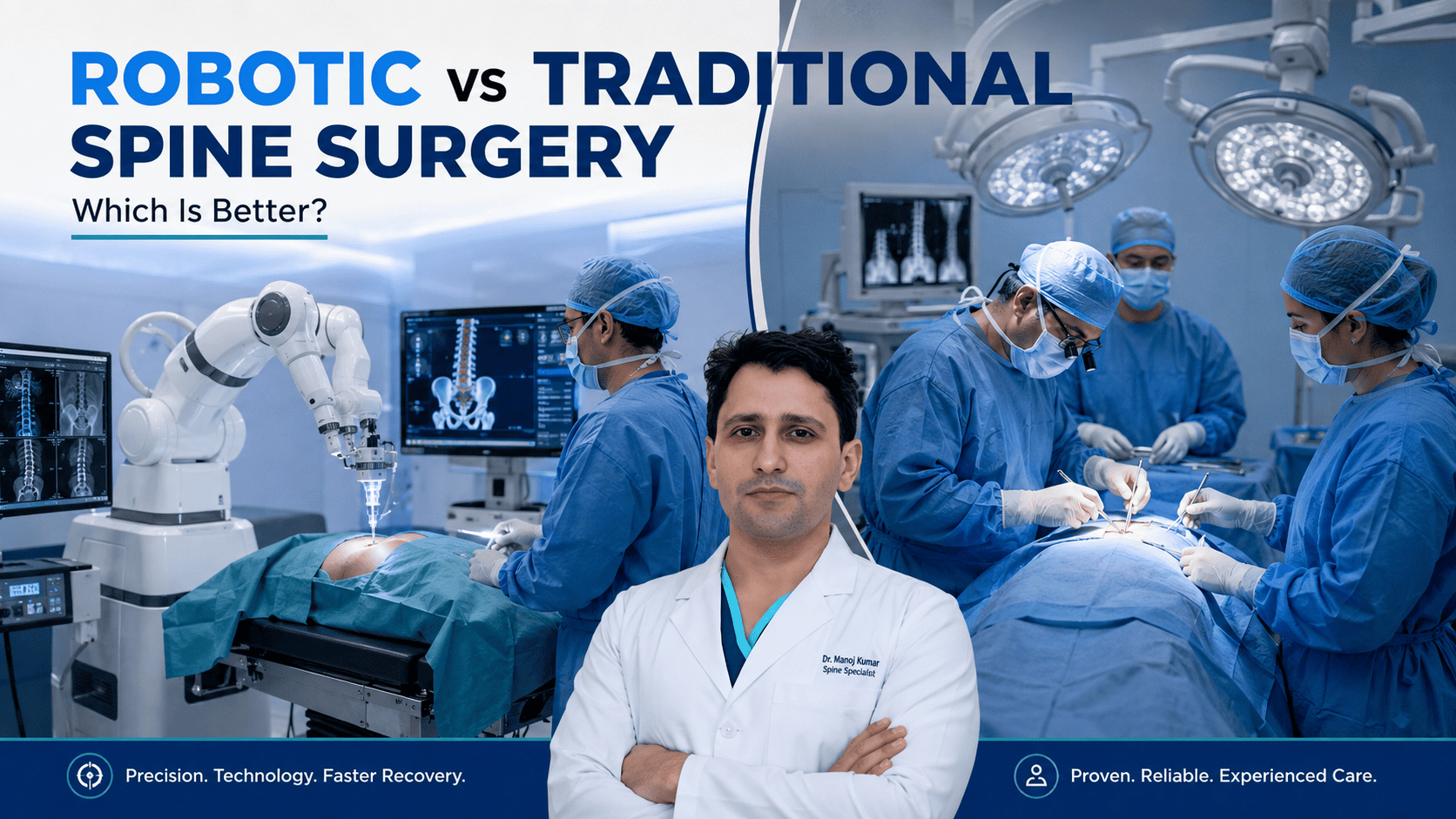
By Dr Manoj Kumar | Associate Director – Robotic & Minimally Invasive Spine Surgery, BLK-MAX Super Speciality Hospital, New Delhi
If you have been told you need spine surgery and someone mentioned “robotic,” your first question is probably the same one most of my patients ask when they sit across from me: “Doctor, is robotic spine surgery in Delhi NCR actually better than regular surgery, or is it just more expensive?”
It is a fair question. And you deserve a straight, honest answer, not a marketing pitch.
In Delhi-NCR, robotic spine surgery offers distinct and measurable advantages over traditional open spine surgery, particularly regarding implant accuracy, complication rates, radiation exposure, and recovery time. However, it is not a magic solution for every spinal condition; indeed, a properly performed traditional surgery will always prove superior to an ill-chosen robotic procedure.
This article explains exactly when robotic spine surgery is the better choice, what it genuinely offers over traditional surgery, what it cannot do, and how to decide which approach is right for your condition. Written from clinical experience, not from a sales brochure.
What Is Robotic Spine Surgery?
Robotic spine surgery does not mean that a robot operates. I want to clarify this right from the start, as this misconception often causes unnecessary fear among patients.
During robotic spine surgery, the surgeon has complete control of the procedure. The robotic system serves as a sophisticated navigation and positioning tool. It directs the surgeon’s instruments to the precise place specified in the pre-surgery plan by combining pre-operative CT scan data, intra-operative 3D imaging, and real-time navigation.
Consider this a spinal GPS. The surgeon chooses the trajectory, and the robotic system guarantees that the tools follow it precisely (submillimetre accuracy).
What robotic spine surgery is used for: It is primarily used in procedures that require the placement of pedicle screws, the metal anchors that attach spinal rods during fusion surgery. Procedures include TLIF (Transforaminal Lumbar Interbody Fusion), PLIF (Posterior Lumbar Interbody Fusion), ALIF, and correction of spondylolisthesis or spinal deformity.
What robotic spine surgery is not used for: Simple decompression procedures, like removing a herniated disc or treating isolated sciatica, do not typically require robotic assistance. These are better handled with endoscopic or microscopic techniques.
Robotic Spine Surgery in Delhi NCR vs Traditional Surgery - The Real Differences
1. Screw Placement Accuracy — Where Robotic Surgery Wins Decisively
In any fusion spine surgery, the most technically demanding and consequential step is placing pedicle screws. These screws must pass through a narrow bony channel in the vertebra called the pedicle. A misplaced screw, even by 2–3 millimetres, can injure a nerve, cause persistent pain, or require revision surgery.
In traditional freehand surgery, screw placement accuracy depends entirely on the surgeon’s experience, intraoperative fluoroscopy readings, and anatomical landmarks. In experienced hands, freehand accuracy is around 85–92%.
With robotic guidance, screw placement accuracy rises to 97–99%. This is not a small improvement; it is the difference between 1 in 10 screws having some degree of malposition versus fewer than 1 in 50.
For patients, this means lower risk of nerve injury, lower risk of revision surgery, and more durable long-term outcomes.
2. Radiation Exposure — Significantly Lower With Robotic Surgery
Traditional spine surgery relies heavily on fluoroscopy, a live X-ray machine used repeatedly throughout the procedure to confirm instrument position. Both the patient and the surgical team are exposed to this radiation across what can be a 2–4 hour procedure.
Robotic spine surgery, particularly when combined with intraoperative navigation, dramatically reduces or in some cases eliminates the need for repeated fluoroscopy. A single pre-operative CT scan and intraoperative 3D image capture replace dozens of individual X-ray shots.
For the patient, this means meaningfully lower cumulative radiation exposure, a significant benefit for younger patients, patients requiring multi-level surgery, or patients who may need future spine procedures.
3. Incision Size and Muscle Damage — Robotic Surgery Preserves More
Robotic spine surgery is almost always performed through minimally invasive, small incisions, even for complex multi-level fusion procedures that would traditionally require a large open approach.
In traditional open fusion surgery, the back muscles must be extensively retracted, pulled, and held aside for the duration of the procedure. This prolonged retraction causes muscle injury that contributes significantly to post-operative back pain and a prolonged recovery.
Robotic-guided minimally invasive fusion uses small tubular retractors placed through muscle, dilating rather than cutting. The robotic arm guides instruments precisely through these small corridors. The result is less blood loss, less muscle trauma, and less post-operative pain.
4. Blood Loss — Robotic Surgery Is Consistently Lower
In a traditional open multi-level lumbar fusion, blood loss can range from 400 mL to over 1,000 mL in complex cases. Blood transfusions are sometimes required.
Robotic-assisted minimally invasive fusion surgery typically involves blood loss of 100–250 mL even in multi-level procedures, a reduction that matters enormously for elderly patients, patients with anaemia, patients on anticoagulants, and patients with cardiac conditions.
5. Recovery Time — Robotic Spine Surgery Patients Recover Faster
|
Recovery Milestone |
Robotic Spine Surgery |
Traditional Open Surgery |
|
Walking after surgery |
Same day or Day 1 |
Day 2–4 |
|
Hospital discharge |
2–3 days |
5–8 days |
|
Return to desk work |
3–5 weeks |
8–12 weeks |
|
Return to physical activity |
6–10 weeks |
4–6 months |
|
Full functional recovery |
3–4 months |
6–12 months |
The faster recovery in robotic spine surgery is not primarily about the robotic system itself; it is about the minimally invasive approach that robotic guidance makes possible in procedures that would otherwise require open surgery.
Ready to get expert clarity on your condition?
👉 Book an Appointment with Dr. Manoj Kumar to discuss your symptoms and treatment options.
Where Traditional Surgery Still Holds Its Own
Honesty requires saying this clearly: traditional spine surgery, open or microscopic, remains the better or equally effective choice in several serious situations.
Simple disc herniations and sciatica: Endoscopic or microscopic discectomy is the gold standard for a single-level lumbar disc herniation that causes sciatica, rather than robotic surgery. When no implants are needed, robotic guidance increases costs and complexity without meaningful benefit.
Emergency spine surgery: Acute traumatic injuries, epidural abscesses, or tumours needing emergency decompression are treated using standard methods that prioritise speed and direct access.
Patients with anatomy not suitable for robotic navigation: Certain patients, such as those with extensive past spinal hardware or complex anatomy, may not be suitable candidates for robotic guidance.
Robotic Spine Surgery Success Rate in Delhi NCR
At high-volume spine surgery centres in Delhi NCR, the success rate of robotic spine surgery for lumbar fusion procedures, measured as significant pain relief, functional improvement, and patient satisfaction at one year, is consistently between 88% and 95%.
For comparison, traditional open fusion surgery at equivalent centres achieves success rates of 80–90%. The improvement with robotic surgery is attributable primarily to better screw placement, lower complication rates, and better preservation of spinal anatomy.
Revision surgery rates– the need to re-operate due to implant failure or misplacement- are approximately 2–4% with robotic-assisted surgery compared to 6–10% with traditional freehand fusion over five years. This is perhaps the most compelling long-term advantage of robotic spine surgery.
Robotic Spine Surgery Cost in Delhi NCR - Is It Worth It?
Robotic spine surgery costs more in Delhi NCR than traditional spine surgery, mainly because of the robotic system’s capital cost, additional imaging, and specialised disposable components used per case.
Approximate cost comparison in Delhi NCR:
| Procedure | Traditional Surgery | Robotic Surgery |
|
Single-level TLIF (Lumbar Fusion) |
₹2,50,000 – ₹4,00,000 | ₹4,00,000 – ₹6,50,000 |
| Two-level Lumbar Fusion | ₹3,50,000 – ₹5,50,000 | ₹5,50,000 – ₹8,50,000 |
| Multi-level Fusion (3+ levels) | ₹5,00,000 – ₹8,00,000 | ₹7,00,000 – ₹12,00,000 |
| Correction of Spondylolisthesis | ₹3,00,000 – ₹5,00,000 | ₹4,50,000 – ₹7,00,000 |
Is the higher cost justified? When you factor in the total cost of care, lower probability of revision surgery, shorter hospital stay, faster return to work, and reduced post-operative physiotherapy, robotic spine surgery is often cost-comparable to traditional surgery over a 2–3 year period.
Most major health insurance policies in India now cover robotic spine surgery when medically indicated and pre-authorised. Confirm coverage with your insurer before planning surgery.
Robotic Spine Surgery Recovery Time — Week by Week
Days 1–2: Surgery is completed under general anaesthesia. Most patients are sitting up and taking short walks within 18–24 hours. Discharge typically happens on Day 2–3.
Weeks 1–2: Walking is encouraged from Day 1, 10 to 15 minutes, three to four times daily. A back brace is worn during ambulation for most fusion patients. Pain is manageable with oral medication.
Weeks 3–6: Most patients doing desk or sedentary work return to professional activity during this period. Physiotherapy begins, with gentle strengthening and flexibility exercises supervised by a spine physiotherapist.
Weeks 6–12: Driving resumes. Activity levels increase significantly. Patients feel 60–75% of their expected full recovery.
Months 3–6: Full functional recovery for the majority of patients. Follow-up imaging confirms fusion at treated levels.
Who Is the Right Candidate for Robotic Spine Surgery in Delhi NCR?
Robotic spine surgery is most beneficial for:
- Patients requiring lumbar fusion for degenerative disc disease, spondylolisthesis, or failed conservative treatment
- Patients with multilevel disease (two or more levels requiring surgery)
- Patients with significant obesity where anatomy is less clear on imaging
- Revision spine surgery cases where previous hardware makes anatomy more complex
- Elderly patients with osteoporosis where precise screw placement is critical
- Patients who want to minimise the risk of revision surgery and maximise long-term implant durability
Full Comparison - Robotic vs Traditional Spine Surgery
|
Factor |
Robotic Spine Surgery |
Traditional Open Surgery |
|
Screw placement accuracy |
97–99% |
85–92% |
|
Incision size |
2–4 cm (minimally invasive) |
8–15 cm |
|
Blood loss |
100–250 mL |
400–1,000 mL |
|
Radiation exposure |
Low |
High (repeated fluoroscopy) |
|
Hospital stay |
2–3 days |
5–8 days |
|
Return to work |
3–5 weeks |
8–12 weeks |
|
Revision surgery rate (5 yr) |
2–4% |
6–10% |
|
Success rate |
88–95% |
80–90% |
|
Cost in Delhi NCR |
₹4L – ₹12L |
₹2.5L – ₹8L |
|
Best suited for |
Fusion, multilevel, complex cases |
Simple decompression, emergencies |
Frequently Asked Questions - Robotic Spine Surgery in Delhi NCR vs Traditional Spine Surgery
Is robotic spine surgery better than traditional surgery?
For fusion and implant-based procedures, yes, robotic spine surgery delivers 97–99% screw accuracy versus 85–92% for traditional surgery, lower blood loss, faster recovery, and a revision rate of 2–4% versus 6–10% over five years. For simple decompression like discectomy, endoscopic surgery is preferred over robotic surgery.
What is the success rate of robotic spine surgery in India?
At experienced centres in Delhi NCR, the success rate of robotic spine surgery is 88–95% for fusion procedures at one year, consistently higher than traditional open fusion surgery at 80–90%.
How much does robotic spine surgery cost in Delhi NCR?
Robotic spine surgery cost in Delhi NCR ranges from ₹4,00,000 to ₹12,00,000 depending on the procedure, levels involved, hospital, and implants required. Single-level robotic TLIF typically costs ₹4–6.5 lakhs.
How long is recovery after robotic spine surgery?
Patients walk within 24 hours and are discharged in 2–3 days. Return to desk work in 3–5 weeks. Full recovery in 3–4 months, significantly faster than 6–12 months for traditional open fusion surgery.
Is robotic spine surgery safe for elderly patients?
Yes, robotic spine surgery is particularly well-suited to elderly patients. Smaller incisions cause less blood loss, precise screw placement is critical in osteoporotic bone, and faster recovery reduces risks associated with prolonged immobility.
Is robotic spine surgery available in Delhi NCR?
Yes. Robotic spine surgery is available at BLK Max Hospital, Max Super Specialty, Fortis, and Apollo in Delhi NCR. Dr. Manoj Kumar performs robotic spine procedures at BLK Max Hospital, Delhi.
Does insurance cover robotic spine surgery in India?
Most major health insurance policies in India cover robotic spine surgery when medically necessary and pre-authorised by the insurer. Your spine surgeon will provide the documentation needed for pre-authorisation.
What is the difference between robotic and endoscopic spine surgery?
Robotic spine surgery uses a robotic guidance system to assist implant placement during fusion procedures. Endoscopic spine surgery uses a tiny camera to decompress nerves through a 7–10 mm incision without implants. They serve different purposes and are sometimes combined in the same patient.
Consult Dr. Manoj Kumar - Robotic Spine Surgery, Delhi NCR
If you are considering robotic spine surgery in Delhi NCR for degenerative disc disease, spondylolisthesis, spinal stenosis with instability, or revision of a previous spine surgery, the first step is an accurate assessment of your MRI and clinical findings.
Dr Manoj Kumar is a senior spine surgeon at BLK Max Hospital, Delhi, with extensive experience in robotic spine surgery, endoscopic spine surgery, and minimally invasive spinal procedures. He treats patients from Delhi, Noida, Gurgaon, Faridabad, Greater Noida, and across India.
Book a consultation:
- Visit: bestspinesurgeonindelhincr.com
- Call/WhatsApp: +91-7048942106
- Available at: BLK Max Hospital, Delhi | Clinic appointments available in Delhi NCR