
Spine Surgery vs Spinal Injection in Delhi NCR — Which One Actually Gives Lasting Relief?
By Dr Manoj Kumar | Associate Director – Robotic & Minimally Invasive Spine Surgery, BLK-MAX Super Speciality Hospital, New Delhi
Every week, at least a dozen patients walk into my clinic in Delhi NCR carrying the same story. They have been living with back pain or leg pain for months, sometimes years. Someone has already suggested a spinal injection. Someone else has mentioned surgery. A third person has told them to avoid surgery at all costs. And now they are sitting in front of me, genuinely unsure which advice to follow or who to believe.
It is among the most common and difficult decisions in spinal care. And the reason it’s baffling isn’t that patients aren’t intelligent; rather, most of what they read online is prejudiced toward one side or the other. Injection clinics explain non-surgical treatment options. The surgical approaches explain the injection’s limitations. Neither gives the patient the full picture.
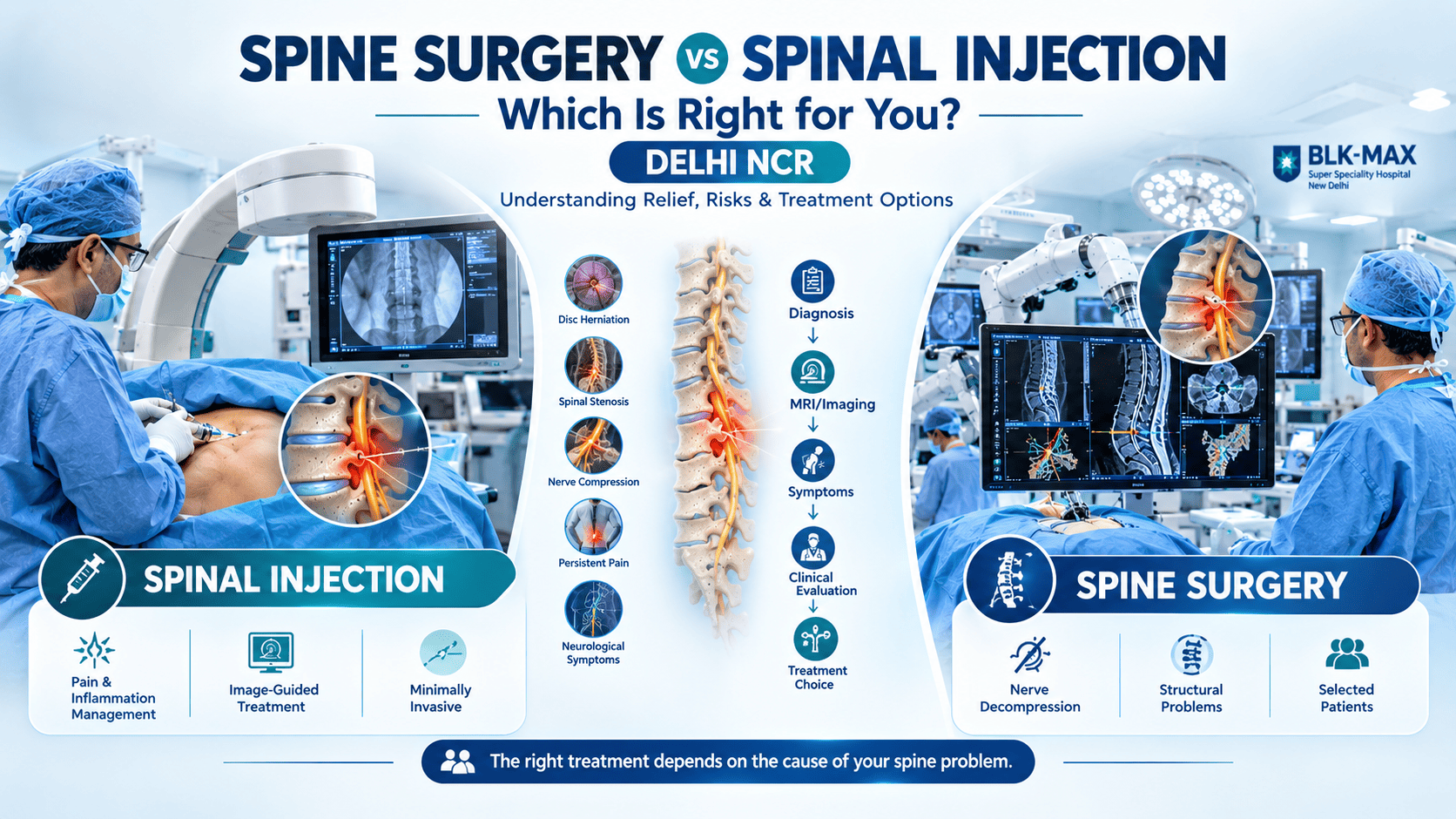
Here is the full picture: spinal injections and spine surgery are not competing treatments; they are tools designed for different jobs at different stages of the same problem. The question is never really “injection or surgery?” The real question is: “Where in the progression of your spinal condition are you right now, and what does that stage actually need?”
I have performed thousands of spine surgeries and referred hundreds of patients for injections first. In this article, I will tell you exactly when an injection is the right choice, when surgery is the right choice, when an injection buys you meaningful time, and when it delays surgery so long that the nerve damage becomes permanent.
What a Spinal Injection Actually Does and What It Does Not
Before comparing the two, it is important to understand what a spinal injection is actually doing inside your spine, because most patients have a significant misconception about this.
A spinal injection, most commonly an epidural steroid injection or a nerve root block, delivers a combination of a corticosteroid (an anti-inflammatory medication) and a local anaesthetic directly into the space around the compressed or irritated nerve. The steroid reduces the inflammation surrounding the nerve. The local anaesthetic provides immediate pain relief while the steroid takes effect.
What an injection does well: It minimizes nerve discomfort. It breaks the cycle of pain and muscle spasms. It allows a patient who was previously unable to participate in physical therapy to do so. It can offer significant pain relief for weeks or months. And, in a subset of people whose pain is mostly caused by inflammation around the nerve rather than mechanical compression, it can provide truly long-term relief.
What an injection does not do: It does not remove a herniated disc. It does not widen a narrowed spinal canal. It does not correct a slipped vertebra. It does not repair a collapsed disc. It does not stabilise an unstable spine. Whatever structural problem is compressing your nerve, disc, bone spur, slipped vertebra, or thickened ligament, it is still there after the injection. Every single time.
This distinction is the most important thing to understand in the entire injection-versus-surgery debate.
What Spine Surgery Actually Does
Spine surgery, whether endoscopic, robotic-assisted, or minimally invasive, addresses the structural problem directly.
A herniated disc pressing on the sciatic nerve is removed. A narrowed spinal canal is widened. A slipped vertebra is realigned and fused into a stable position. A bone spur compressing a nerve root is drilled away. The cause of the compression is eliminated, not suppressed, not managed, not temporarily reduced. Eliminated.
This is why surgery, when done correctly for the right patient at the right time, gives lasting relief. Not because it is more aggressive, but because it fixes the actual problem rather than managing the body’s response to it.
Spinal Injection vs Spine Surgery — The Complete Comparison
|
Factor |
Spinal Injection |
Spine Surgery |
|
What it treats |
Nerve inflammation |
Structural compression or instability |
|
Fixes the root cause? |
No |
Yes |
|
Duration of relief |
Weeks to months (variable) |
Long-term to permanent |
|
Procedure time |
15–30 minutes |
45 minutes to 3 hours |
|
Anaesthesia |
Local |
Local, spinal, or general |
|
Hospital stay |
Day procedure (go home same day) |
1–5 days depending on procedure |
|
Recovery |
1–3 days |
2 weeks to 5 months |
|
Cost in Delhi NCR |
₹8,000 – ₹25,000 per injection |
₹1.2L – ₹12L depending on procedure |
|
Can be repeated? |
Yes — typically 2–3 times per year |
Usually once (revision if needed) |
|
Risk level |
Very low |
Low to moderate |
|
Success for right patient |
60–75% significant relief |
88–95% significant relief |
|
Suitable for elderly |
Excellent |
Excellent (minimally invasive) |
|
Treats instability? |
No |
Yes |
|
Covered by insurance |
Yes |
Yes |
When a Spinal Injection Is the Right Choice
In my practice, I recommend a spinal injection and genuinely mean it as the right first step in the following situations:
1. The Pain Is Acute and Recent (Less Than 6–8 Weeks)
When a disc herniates acutely, with sudden onset of severe leg pain, usually following a specific movement or lifting incident, the nerve is intensely inflamed. In this phase, a significant proportion of patients improve on their own over 6–12 weeks as the body’s natural healing process reabsorbs part of the disc material and the nerve inflammation settles.
A targeted epidural steroid injection in this early phase accelerates that natural healing process. It reduces inflammation, provides enough pain relief for the patient to stay mobile, and in many patients bridges them through the acute phase without needing surgery at all.
2. The Structural Problem Is Mild to Moderate
Not every herniated disc on an MRI needs to be removed surgically. The size and location of the herniation, the degree of nerve compression, and the severity of symptoms together determine whether surgery is necessary. In patients with mild to moderate disc herniation and predominantly inflammatory symptoms, burning nerve pain, tingling, sensitivity, an injection often provides relief adequate to allow the body to manage the rest.
3. The Patient Has Significant Medical Comorbidities
A patient with poorly controlled diabetes, severe cardiac disease, recent surgery, or active systemic illness may not be a safe candidate for surgery in the short term. In these patients, a spinal injection provides meaningful pain management while the medical condition is optimised, and surgery is reconsidered once the patient is a safer surgical candidate.
4. As a Diagnostic Tool
A nerve root block injection serves a dual purpose; it both treats and diagnoses. If a patient has pain at multiple spinal levels and imaging is not conclusive about which level is the primary pain generator, a targeted nerve root block at a specific level tells us definitively: if the pain resolves with the injection, that is the level causing it. This information is invaluable in planning the right surgical approach.
5. The Patient Wants to Exhaust Non-Surgical Options First
This is a completely valid and respected reason. Many patients, particularly younger patients, patients with professional or family responsibilities that make a recovery period difficult right now, or patients who have understandable concerns about surgery, want to try the most conservative effective option first. I respect this completely and support it, provided the patient understands the condition’s trajectory and the signs that would indicate it is time to move to surgery.
When Spine Surgery Is the Right Choice
In my experience, continuing with injections when surgery is actually needed is one of the most common and most harmful patterns I see in spine care. Patients arrive at my clinic after two, three, sometimes four injections spread over 18 months, with nerve damage that has progressed significantly further than when they first presented.
Surgery becomes the clearly right choice when:
1. Neurological Deficits Are Present or Worsening
Weakness in the leg or foot, difficulty lifting the foot while walking (foot drop), inability to stand on tiptoe, and weakness climbing stairs are not pain symptoms. It is a sign that the compressed nerve is losing function. An injection reduces inflammation. It cannot restore nerve function that is being actively lost due to mechanical compression. When neurological deficits are present, surgery is required, and the sooner, the better. Every week of delay with active neurological loss is a week of potentially permanent damage.
2. Bladder or Bowel Symptoms Are Present
This is a surgical emergency without exception. Difficulty urinating, inability to control the bladder or bowel, or numbness in the groin or inner thigh (saddle anaesthesia) indicates cauda equina syndrome, compression of the bundle of nerve roots at the base of the spine. This requires emergency surgical decompression within hours, not days. No injection treats this.
3. Injections Have Provided Only Temporary Relief Twice or More
If a patient has had two well-placed epidural steroid injections and the relief lasted only 4–6 weeks each time before the pain returned fully, the injection is telling us something important: the structural problem is significant enough that reducing inflammation is not adequate treatment. The disc, bone, or ligament causing the compression needs to be removed or corrected. Continuing with a third and fourth injection at this stage delays the inevitable while the nerve remains under compression.
4. Pain Has Not Improved After 3 Months of Conservative Treatment
When back pain and leg pain persist beyond 3 months despite a genuine trial of physiotherapy, medications, activity modification, and an injection, the condition has declared itself as one that will not resolve without structural intervention. Waiting further does not improve the odds; it increases the risk of permanent nerve damage and makes surgery technically more complex.
5. The Structural Problem Is Severe on Imaging
Certain MRI findings make surgery the right first recommendation, not injections. A large central disc herniation with severe canal compression, a Grade 2 or above spondylolisthesis, severe multilevel stenosis with significant neurological compromise, or a completely collapsed disc with cord compression in the neck- these are conditions where the structural problem is too significant for injection therapy to meaningfully address.
6. Quality of Life Is Severely Impacted
A patient who cannot walk more than 50 meters, cannot sleep through the night, has stopped working, and requires heavy painkillers to function is not a patient for whom “let us try another injection” is the appropriate response. Surgery, when planned, well-prepared, and professionally conducted, restores this patient’s life in a way that no injection could.
The Most Dangerous Pattern I See in My Clinic
I want to be honest about something that I see regularly, and that causes real harm.
It is the pattern of repeated injections given to a patient who needed surgery 12 months ago.
The injection provides 6 weeks of relief. The pain comes back. Another injection. Another 6 weeks. The pain comes back worse. A third injection. The patient now has progressive foot weakness. They finally come for surgery.
At this point, the nerve has been compressed for 18 months longer than necessary. The surgery goes well, the compression is relieved, but the nerve recovery is incomplete because nerves that are compressed for too long suffer permanent axonal damage that does not fully reverse even after decompression.
The patient asks me: “Will my foot weakness get better after surgery?”
My honest answer: “Some of it will. All of it might not. And if you had come 18 months ago, the answer would have been yes, all of it.”
This is not an argument against injections. Injections are excellent when used for the right patient at the right time. This is an argument against using injections as a substitute for surgery when surgery is genuinely what the patient needs.
One pattern that works well in clinical practice, and that patients rarely hear about, is using an injection and surgery in sequence, not as alternatives.
A patient with severe acute sciatica from a large disc herniation is in too much pain to lie still on an operating table comfortably, too inflamed for surgery to go smoothly, and too distressed to make a calm, informed decision.
A targeted epidural injection in this situation reduces the acute inflammation, provides enough pain relief for the patient to think clearly, and makes the subsequent surgery, performed 2–4 weeks later once the acute phase has settled, technically easier and the recovery smoother.
In this sequence, the injection and the surgery are not competing. They are partners.
Cost is a real and valid consideration. Here is an honest breakdown:
Spinal Injection Cost in Delhi NCR
| Type of Injection | Approximate Cost |
| Epidural steroid injection (lumbar) | ₹8,000 – ₹18,000 |
| Nerve root block (single level) | ₹10,000 – ₹20,000 |
| Facet joint injection | ₹8,000 – ₹15,000 |
| Caudal epidural injection | ₹6,000 – ₹12,000 |
| Platelet-rich plasma (PRP) injection | ₹15,000 – ₹35,000 |
Spine Surgery Cost in Delhi NCR
| Procedure | Approximate Cost |
| Endoscopic discectomy (slip disc) | ₹1,20,000 – ₹2,50,000 |
| Endoscopic laminectomy (stenosis) | ₹1,80,000 – ₹3,50,000 |
| Robotic TLIF (spondylolisthesis) | ₹4,50,000 – ₹7,00,000 |
| Minimally invasive fusion (2 levels) | ₹6,00,000 – ₹9,50,000 |
The Real Cost Calculation
Three shots at ₹15,000 each over 18 months total ₹45,000. Physiotherapy, drugs, scans, and follow-up visits add up to a total conservative management cost of ₹80,000 – ₹1,50,000 over 18 months for patients who require surgery. When the eventual surgical cost is factored in, the total is much more than if the correct selection was made at the 3-month mark.
This is hardly a reason to rush to surgery. It is an argument for making the correct option at the appropriate time rather than postponing a necessary procedure indefinitely because each injection provides only momentary alleviation, thus delaying the decision.
After a Spinal Injection
- Procedure takes 15–30 minutes under fluoroscopy guidance
- Patient rests for 30–60 minutes post-procedure and goes home the same day
- Mild soreness at the injection site for 24–48 hours
- Full effect of the steroid develops over 3–5 days
- Normal activity resumes within 1–3 days
- No formal physiotherapy rest period required
After Endoscopic Spine Surgery
- Procedure takes 45–90 minutes
- Walking within 4–6 hours of surgery
- Discharge in 1–2 days
- Return to desk work in 2–3 weeks
- Full recovery in 4–8 weeks
After Robotic Fusion Surgery
- Procedure takes 2–3 hours
- Walking within 24 hours
- Discharge in 2–4 days
- Return to desk work in 4–6 weeks
- Full recovery in 3–5 months
Frequently Asked Questions — Spine Surgery vs Spinal Injection
Which gives more lasting relief spinal injection or spine surgery?
Spine surgery gives more lasting relief when the underlying problem is structural, a herniated disc, narrowed canal, or unstable vertebra. Spinal injections provide temporary relief by reducing nerve inflammation but do not remove or correct the structural cause. For the right patient, surgery delivers permanent resolution. For the right patient at the right stage, an injection provides meaningful relief without the need for surgery at all.
How many spinal injections can you have before surgery?
Most spine specialists recommend a maximum of 2–3 epidural steroid injections per year at any single spinal level. If two injections have provided only temporary relief of 4–6 weeks each, continuing with further injections and delaying surgery is rarely in the patient's best interest — especially if neurological symptoms are present.
Is spinal injection safer than spine surgery?
Spinal injection carries a lower procedural risk than surgery, it is a 20-minute day procedure with very rare complications. However, "safer" in isolation is a misleading comparison. If a patient needs surgery and receives repeated injections instead, the nerve damage that accumulates during that delay is itself a risk, one that is often permanent. The safest path is the right treatment at the right time.
What is the cost of spinal injection in Delhi NCR?
Spinal injection cost in Delhi NCR ranges from ₹6,000 to ₹35,000 depending on the type of injection, epidural steroid, nerve root block, facet joint, or PRP injection. Most are covered by health insurance when medically indicated.
Can a spinal injection cure a herniated disc?
No. A spinal injection cannot remove or reabsorb a herniated disc. It reduces the inflammation around the nerve the disc is pressing on, which relieves pain. The disc itself remains herniated. In some patients, particularly those with small to moderate herniations and recent onset of symptoms, the body partially reabsorbs the disc over time, this is a natural process, not caused by the injection.
When should I choose surgery over spinal injection?
Choose surgery, or at least consult a spine surgeon urgently, when: neurological weakness is present or worsening, bladder or bowel function is affected, two or more injections have provided only temporary relief, pain has persisted beyond 3 months of conservative treatment, or your MRI shows severe structural compression.
Is spinal injection or surgery better for sciatica?
For recent-onset sciatica (less than 6–8 weeks) with no neurological deficit, an epidural steroid injection is a reasonable and often effective first step. For sciatica that has persisted beyond 3 months, involves leg weakness or numbness, or has not responded to one or two injections, endoscopic spine surgery delivers faster, more reliable, and more lasting relief.
Are spinal injections and spine surgery covered by insurance in India?
Yes, both spinal injections and spine surgery are covered by most major health insurance policies in India when medically indicated. Pre-authorisation is required for surgery. Injections performed in a hospital or imaging-guided facility are generally covered under OPD or IPD benefits depending on your specific policy.
If you are trying to decide between a spinal injection and spine surgery, or if you have already had injections that are no longer working, the most important thing you can do is get an honest assessment from a spine surgeon who offers both options and has no financial reason to favour one over the other.
Dr Manoj Kumar is a senior spine surgeon at BLK Max Hospital, Delhi NCR, with extensive experience in both surgical and non-surgical spine management. He regularly works alongside pain management specialists for injection therapy and performs endoscopic, robotic, and minimally invasive spine surgery for patients across Delhi, Noida, Gurgaon, Faridabad, and Greater Noida.
At your consultation, you will receive a clear, unbiased assessment of your MRI and clinical condition and an honest recommendation about whether you are at the injection stage, the surgery stage, or somewhere in between.
Book your consultation:
- Website: bestspinesurgeonindelhincr.com
- Available at: BLK Max Hospital, Delhi NCR