
Robotic TLIF Surgery for Degenerative Disc Disease in Delhi: A Patient's Guide
By Dr Manoj Kumar | Associate Director – Robotic & Minimally Invasive Spine Surgery, BLK-MAX Super Speciality Hospital, New Delhi
If you or a loved one has been living with persistent lower back pain and a doctor has mentioned “degenerative disc disease” and “TLIF surgery,” you are probably trying to understand what these terms actually mean, whether surgery is really necessary, and what a procedure like robotic TLIF surgery for degenerative disc disease in Delhi might involve. This guide is written to help you understand the condition, the surgical option, and the questions worth asking before making any decision, not to push you toward surgery, but to help you have a more informed conversation with your spine specialist.
What Is Degenerative Disc Disease?
Degenerative disc disease (DDD) is not a “disease” in the traditional sense; rather, it reflects the normal wear and tear that occurs in the intervertebral discs, the soft cushions between the bones (vertebrae) of your spine, as you age. Over time, these disks may lose water content, thin, develop tiny tears, or lose their ability to absorb shock efficiently.
Everyone goes through this process at some point in their lives as they age. Many folks have no obvious symptoms at all. Others may have pain, stiffness, or nerve-related symptoms, especially if disc changes modify the space available for nearby nerves.
What Symptoms Can Degenerative Disc Disease Cause?
Symptoms vary considerably from person to person, but commonly reported ones include:
- Chronic low back pain that may worsen with sitting, bending, or lifting
- Pain that improves with walking or changing positions
- Stiffness, especially after periods of inactivity
- Pain, numbness, or tingling radiating into the buttocks, thighs, or legs (if a nerve is affected)
- Muscle weakness in the legs in more advanced cases
Not everyone with disc degeneration on an X-ray or MRI has symptoms, and the severity of symptoms does not always match the severity of imaging findings. This is one reason a thorough clinical evaluation matters more than imaging alone.
Ready to get expert clarity on your condition?
👉 Book an Appointment with Dr. Manoj Kumar to discuss your symptoms and treatment options.
When Might Surgery Be Considered?
Surgery is generally not the first option for degenerative disc disease. Most spine specialists recommend starting with conservative treatments, which may include physiotherapy, activity modification, weight management, medications, and sometimes targeted injections.
Surgery may be discussed when:
- The symptoms are significant and have not responded favorably to a reasonable course of non-surgical treatment.
- There is evidence of nerve compression that results in pain, numbness, or weakness.
- The imaging findings correspond to the patient’s complaints.
- The impact on daily function and quality of life is profound.
The decision to proceed with surgery is individualized and depends on a detailed assessment by a qualified spine surgeon.
What Is TLIF Surgery?
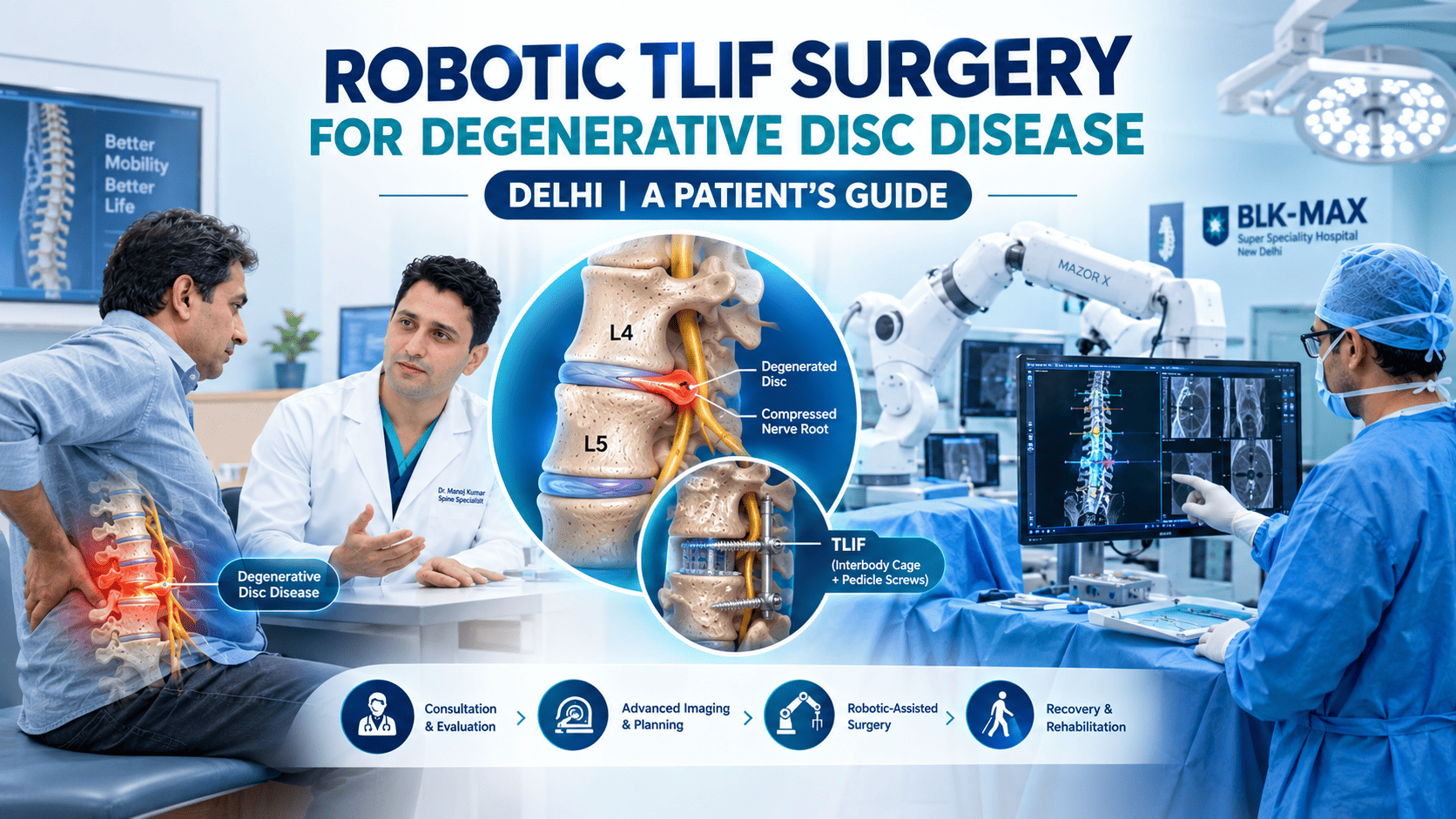
The term TLIF refers to Transforaminal Lumbar Interbody Fusion. It is a type of spinal fusion surgery used to treat degenerative disk disease, spondylolisthesis, and other disorders of the lower (lumbar) spine.
To put it simply, TLIF entails removing the damaged or degenerated disc material and replacing it with a spacer (cage), which is often paired with bone graft material, to assist the two neighboring vertebrae in fusing over time. Screws and rods are commonly utilized to support the spine during fusion. The purpose is to alleviate pain produced by an unstable or degenerative disc section and, where applicable, relieve pressure on surrounding nerves.
What Is Robotic-Assisted TLIF Surgery?
Robotic-assisted TLIF surgery refers to the use of robotic and navigation technology to assist the surgeon during specific steps of the procedure, most commonly, the precise placement of pedicle screws that stabilize the spine.
It is important to understand that robotic assistance is a tool that supports the surgeon, not a replacement for surgical judgment or skill. The surgeon plans the procedure, makes the surgical decisions, and performs the operation; the robotic and navigation system helps guide instrument placement with the aim of greater precision based on the patient’s own pre-operative imaging.
How Robotic Assistance May Be Used During TLIF
Depending on the system and the surgeon’s protocol, robotic assistance in TLIF may be used for:
- Pre-operative surgical planning using CT or other imaging
- Real-time intraoperative navigation
- Guided placement of pedicle screws
- Assisting with alignment and trajectory planning
The exact role of robotic technology can vary by case, hospital, and surgeon preference, and not every step of every TLIF procedure necessarily involves robotic guidance.
A patient may be considered a potential candidate for TLIF if they have symptomatic degenerative disc disease or related spinal instability that has not responded to appropriate conservative treatment, and where imaging confirms a structural problem that fusion could reasonably address. Candidacy also depends on overall health, spinal anatomy, and the presence or absence of other medical conditions.
When TLIF May Not Be Appropriate
TLIF is not suitable for every patient with back pain. It may not be recommended when:
- Symptoms have not been sufficiently treated with conservative treatment
- Pain is not clearly associated with the disc level being evaluated for surgery.
- The patient has certain medical problems that considerably increase the surgical risk.
- Imaging does not identify a clear structural source of the symptoms.
Only a qualified spine surgeon, after direct examination and review of imaging, can determine whether TLIF, robotic-assisted or otherwise, is appropriate for a specific patient.
While exact technique varies by surgeon and case, a TLIF procedure generally involves:
- General anaesthetic administration, positioning the patient, and using imaging/navigation to plan the surgical strategy.
- A back incision to access the afflicted spinal section.
- Damaged disc material is removed.
- Placement of a spacer/cage, often with bone graft, in the disc space.
- Screws and rods are inserted to stabilise the segment, which can be helped by a robot.
- The incision was closed.
The specific steps, duration, and technique will be explained by your surgical team based on your individual case.
Before any decision about surgery, patients typically undergo a detailed clinical evaluation, relevant imaging, and a discussion of the risks, benefits, and alternatives. Patients are usually advised on medication adjustments, fasting instructions, and any tests needed to assess fitness for anaesthesia and surgery. This process allows both the patient and surgical team to make an informed, shared decision.
Recovery after TLIF surgery varies from patient to patient and depends on factors such as age, overall health, the extent of surgery, and adherence to post-operative instructions. In general, recovery involves a hospital stay, a period of restricted activity, and gradual return to daily function, often supported by physiotherapy. Fusion of the bone itself takes time, often several months, even though pain relief may occur earlier for some patients. Your surgical team will provide a recovery plan specific to your case; general timelines should not be assumed to apply to every patient.
For appropriately selected patients, TLIF surgery, including robotic-assisted approaches, may offer potential benefits such as:
- Reduction in pain related to disc-level instability or nerve compression
- Improved spinal stability
- Potentially more precise screw placement with robotic/navigation assistance in suitable cases
These are potential outcomes, not guarantees. Surgical results vary between individuals, and no responsible surgeon can promise a specific outcome.
As with any spine surgery, TLIF carries risks. These may include, but are not limited to:
- Infection
- Bleeding
- Nerve damage.
- Risks of Anaesthesia
- Non-union (Incomplete fusion)
- Hardware-related complications
- Chronic or recurring discomfort
- General surgical hazards include blood clots.
Robotic assistance is intended to support precision during certain steps, but it does not eliminate surgical risk. Your surgeon should discuss risks specific to your case in detail before you consent to surgery.
In conventional (freehand or fluoroscopy-guided) TLIF, the surgeon relies primarily on anatomical landmarks, experience, and intraoperative imaging to guide screw placement. In robotic-assisted TLIF, a pre-operative surgical plan based on the patient’s imaging is used alongside a robotic/navigation system to help guide instrument trajectory during surgery.
The choice between conventional and robotic-assisted techniques depends on the surgeon’s assessment, the patient’s anatomy, hospital resources, and clinical judgment about what is most appropriate for that specific case; not every patient or every case requires robotic assistance.
Surgeons typically assess a combination of factors, including the patient’s history, physical examination findings, response to prior conservative treatment, imaging results, and overall health. Surgery is generally considered only when there is a clear structural explanation for the symptoms and a reasonable expectation that surgical correction could help.
Depending on the clinical picture, a spine surgeon may recommend investigations such as:
- X-rays of the lumbar spine, including flexion-extension images to check stability.
- MRI to assess disc, nerve, and soft tissue details
- CT scan, especially helpful for surgical planning with robotic/navigation systems.
- Nerve conduction investigations in specific instances
The specific tests required depend on individual clinical findings.
Before proceeding with any surgery, it can help to ask:
- What is causing my specific symptoms, based on my examination and imaging results?
- What non-surgical options have I yet to try?
- Why is TLIF preferred over alternative approaches?
- Will robotic aid be used in my case, and if so, why?
- What are the realistic dangers and potential problems for someone with my health history?
- What is the average recuperation process, and what limits should I be prepared for?
- What if I decide not to get surgery right now?
Many patients naturally search for the robotic TLIF surgery cost in Delhi. It is not possible to state a single accurate figure, because cost depends on multiple factors, including:
- The case’s complexity and the number of spinal levels involved.
- Whether robotic/navigation technology is deployed and to what extent.
- Hospital room type and stay duration
- Pre-operative assessments and consultations
- Costs associated with implants and instruments
- Postoperative rehabilitation requirements
- Any additional medical care required for coexisting conditions
Because these factors vary from patient to patient, the only reliable way to get an accurate cost estimate is to consult the hospital directly after a clinical evaluation.
If you are exploring treatment options, it is worth taking time to evaluate both the surgeon and the hospital carefully. Some points worth considering include:
- A surgeon’s requisite training and experience in spine surgery, including knowledge of robotic-assisted treatments where applicable.
- Whether robotic/navigation technology is genuinely relevant for your particular application, rather than assuming it is always necessary.
- Hospital infrastructure includes operating rooms, intensive care units, and post-operative nursing support.
- The preoperative examination includes a thorough discussion of your symptoms, imaging, and choices.
- Post-operative monitoring and rehabilitation services, including physiotherapy planning
- Transparent discussion of the benefits, risks, options, and prices, with no pressure to decide right away.
Patients in Delhi researching this procedure may come across Dr Manoj Kumar, Associate Director – Robotic and Endoscopic Spine Surgery, BLK-Max Hospital, Delhi, among the spine specialists practising in the city who work with robotic spine surgery and endoscopic spine surgery techniques. As with any surgeon, patients are encouraged to have a direct consultation to discuss their specific condition, review their imaging, and understand whether robotic-assisted TLIF or another treatment approach is appropriate for their case.
Spine surgery, including TLIF, involves working close to the nerves and spinal cord, and outcomes can be influenced significantly by surgical expertise, hospital infrastructure, and post-operative care quality. Choosing a qualified, appropriately trained spine surgeon in Delhi and a hospital with adequate facilities for spine surgery and recovery is an important part of the decision-making process, alongside understanding that no surgeon or technology can guarantee a specific outcome.
Certain symptoms warrant prompt medical attention rather than waiting for a routine appointment, including:
- Unexpected loss of bladder or bowel control.
- Numbness in the inner thighs or groin (saddle numbness)
- Leg weakness that rapidly worsens.
- Severe, unremitting agony, not eased by rest or medication.
These can be signs of a serious nerve-related emergency and require immediate medical evaluation.
Frequently Asked Questions
What is the difference between TLIF and robotic TLIF surgery?
TLIF is the surgical procedure itself. "Robotic TLIF" refers to the use of robotic and navigation technology to assist the surgeon during certain steps, most often screw placement, within the same overall procedure.
Is robotic TLIF surgery painless?
No surgery is entirely painless. Patients typically experience some post-operative discomfort, which is managed with pain control measures. Individual pain experiences vary.
How long does recovery after TLIF surgery take?
Recovery timelines vary by patient and case complexity. Initial recovery may take some weeks, while bony fusion generally continues over several months. Your surgeon can give a timeline specific to your situation.
Is robotic TLIF surgery safe?
Like all spine surgery, robotic TLIF carries risks, and no procedure can be called completely risk-free. Robotic assistance aims to support precision in certain surgical steps, but risks such as infection, bleeding, or nerve injury still exist and should be discussed with your surgeon.
Who is a good candidate for robotic TLIF surgery?
Patients with symptomatic degenerative disc disease or related instability that has not responded to conservative treatment, and where imaging confirms a matching structural cause, may be evaluated as potential candidates. This is determined case-by-case.
How much does robotic TLIF surgery cost in Delhi?
Cost varies based on case complexity, hospital, technology used, and individual patient needs. A personalized estimate should be obtained directly from the hospital after clinical evaluation.
Can degenerative disc disease be treated without surgery?
Yes, many patients are managed successfully with conservative treatments such as physiotherapy, medication, and lifestyle changes. Surgery is generally considered only when conservative treatment has not adequately relieved significant symptoms.
What tests are needed before robotic TLIF surgery?
Common investigations include X-rays, MRI, and often CT imaging for surgical planning, along with routine pre-operative fitness assessments. Exact requirements depend on individual findings.
Does robotic assistance guarantee a better outcome than conventional TLIF?
No. Robotic assistance is intended to support precision during specific surgical steps, but outcomes depend on many factors, including patient-specific anatomy, overall health, and surgical judgment. No technology guarantees a particular result.
How do I choose the right spine surgeon for TLIF in Delhi?
Consider the surgeon's relevant training and experience, willingness to discuss risks and alternatives transparently, and the hospital's infrastructure for spine surgery and post-operative care. A direct consultation is the best way to evaluate fit for your specific case