
Is Robotic Spine Surgery Better Than Traditional Surgery? An Expert Explains
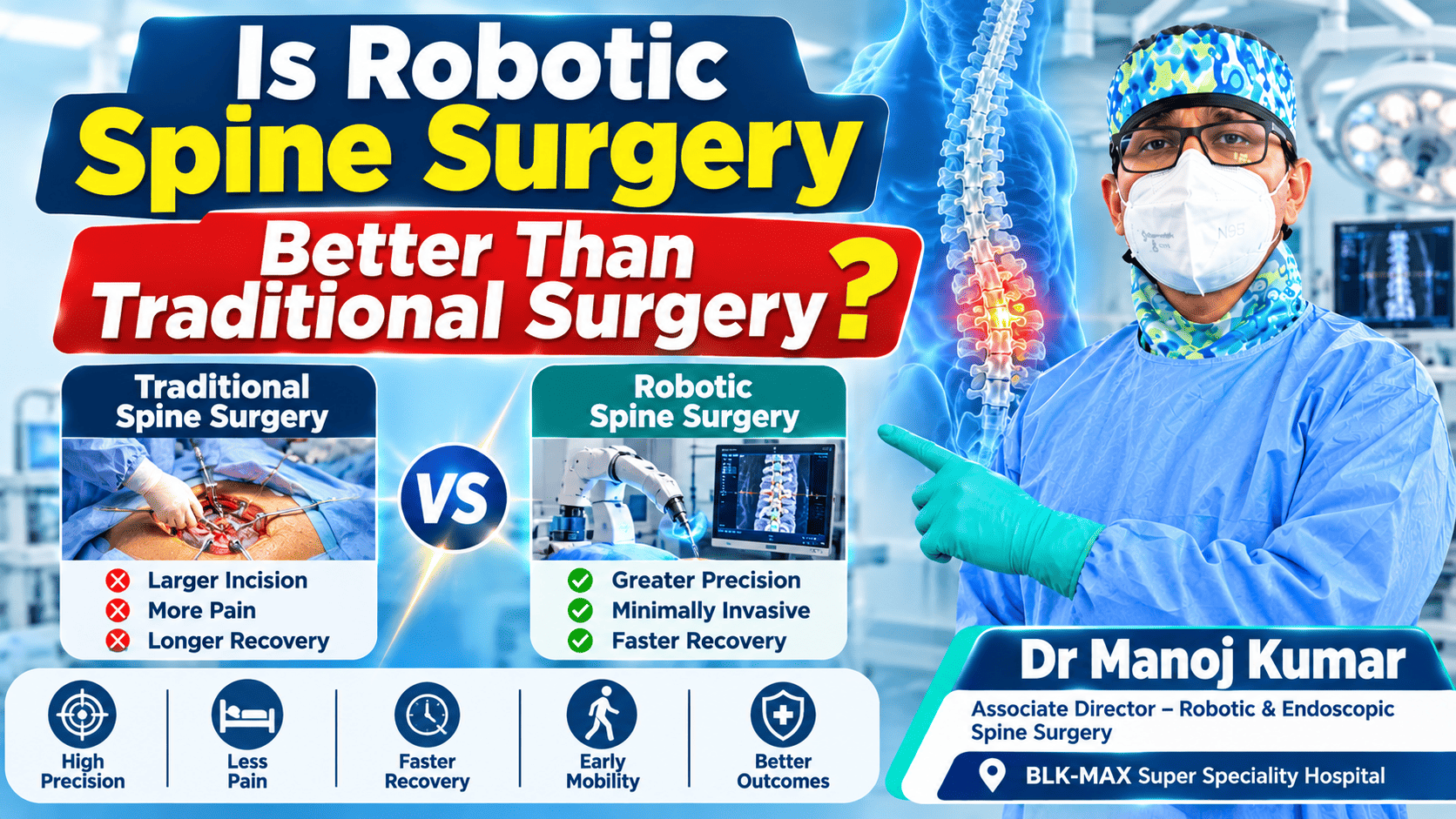
By Dr Manoj Kumar | Associate Director – Robotic & Minimally Invasive Spine Surgery, BLK-MAX Super Speciality Hospital, New Delhi
Quick Answer
Robotic spine surgery is generally more precise than traditional open surgery for procedures that use screws and implants, and it often means smaller incisions, less blood loss, and a shorter hospital stay. It is not better for every patient. For simpler problems such as a single-level disc herniation, endoscopic or other minimally invasive surgery may work just as well at lower cost. The right choice depends on your diagnosis, spinal anatomy, and overall health.
What Is Robotic Spine Surgery?
Robotic spine surgery does not mean a robot operates on you on its own. The surgeon performs the operation and makes every decision. The robotic system acts as a high-precision guidance tool.
Before surgery, a CT scan of your spine is loaded into planning software, which builds a 3D map of the vertebrae. The surgeon plans where each screw or implant should go. During surgery, the system tracks the spine in real time and guides the instruments along the planned path.
At BLK-Max Super Speciality Hospital, Pusa Road, New Delhi, robotic-assisted spine surgery is performed with the Excelsius GPS® spine surgical robot. Dr. Manoj Kumar co-authored a study of 150 robot-assisted TLIF procedures at the hospital, published in the Max Medical Journal in September 2024. Dr. Manoj Kumar is Associate Director of Robotic and Minimally Invasive Spine Surgery at the hospital, and his website describes a robotic-assisted minimally invasive TLIF he performed for degenerative disc disease.
Robotic vs Traditional Open Spine Surgery
|
Factor |
Robotic-Assisted Surgery |
Traditional Open Surgery |
|
Incision |
Small incisions, often through the skin in a few places |
Larger single incision along the spine |
|
Screw and implant accuracy |
Planned on CT and guided in real time |
Depends on surgeon landmarks and X-ray checks |
|
Blood loss |
Usually lower |
Usually higher |
|
Hospital stay |
Often shorter |
Often longer |
|
Pain after surgery |
Often less, because less muscle is disturbed |
Often more |
|
Radiation during surgery |
Depends on the system and technique |
Repeated X-ray checks are common |
|
Cost |
Higher |
Lower |
|
Availability |
Limited to selected hospitals |
Widely available |
|
Complex or revision cases |
Helpful when anatomy is distorted |
Possible, but more demanding |
What BLK-Max’s own data shows: In the hospital’s study of 150 patients, 696 pedicle screws were placed with robotic assistance, and 98.27% (684 of 696) were in a clinically acceptable position on postoperative CT scans. The authors cite earlier literature reporting higher problem rates with freehand (10–20%) and C-arm-guided (5–10%) screw placement. This was a single-centre study with no conventional-surgery comparison group, so it supports the accuracy of the robot but does not prove it is better than other methods. Source: Girdhar P, Kumar M, Kanamarlapudi GS, Max Medical Journal, September 2024.
When Robotic Surgery Has a Clear Advantage
Robotic guidance is most useful in operations where screws and implants must be placed accurately in difficult conditions:
- Multi-level spinal fusion, where small errors can add up across several vertebrae.
- Revision surgery, where scar tissue from a previous operation hides the normal landmarks.
- Patients with osteoporosis, where weak bone leaves little room for error in screw placement.
- Patients with higher body weight, where reaching the spine through open surgery requires larger incisions.
- Minimally invasive fusion procedures such as TLIF, where a small incision limits what the surgeon can see directly.
When Traditional or Endoscopic Surgery Is Still the Better Choice
Robotic surgery is not always necessary, and a responsible surgeon will tell you so.
- Single-level disc herniation with sciatica: Endoscopic discectomy removes the part of the disc pressing on the nerve through a very small opening and does not involve screws.
- Decompression without fusion: When no implants are needed, robotic guidance adds little.
- Simple cervical disc surgery: Standard techniques often give excellent results.
- Cost or access limits: An experienced surgeon using conventional techniques can still achieve very good outcomes.
Pros and Cons of Robotic Spine Surgery
Advantages
- Detailed pre-operative planning on your own CT scan
- More accurate implant placement in many studies (see the BLK-Max study cited above)
- Smaller incisions and less damage to surrounding muscle
- Potentially faster recovery
- Useful in complex and revision cases
Limitations
- Higher cost than conventional surgery
- Not available at every hospital
- Extra setup time in the operating theatre
- Not needed for many simple procedures
- Insurance may not pay separately for the robotic component
Who Is a Good Candidate?
You may be a candidate for robotic-assisted surgery if you have:
- Degenerative disc disease needing fusion
- Spondylolisthesis (a vertebra slipping forward)
- Spinal stenosis that needs both decompression and fusion
- A previous spine surgery that needs to be revised
- Weak bone quality or a complex spinal shape
- A condition affecting more than one spinal level
Only a spine surgeon who has examined you and reviewed your MRI and X-ray reports can tell you which approach is right for you.
Recovery After Robotic Spine Surgery
Recovery depends on the operation performed, your age, your general health, and how closely you follow your rehabilitation plan. In general:
- First days: Most patients are encouraged to stand and walk with support soon after surgery.
- First two weeks: Short, frequent walks. No bending, twisting, or lifting. Wound care and a first follow-up visit.
- Weeks 3 to 6: Gradual increase in activity. Physiotherapy usually begins. Many patients with desk jobs begin to return to work.
- After 6 weeks: Follow-up imaging to check healing, with a gradual return to more demanding activity as advised.
- Months: Fusion takes time to complete. Your surgeon will confirm when you can return to full activity or sport.
What Does Robotic Spine Surgery Cost in Delhi NCR?
The cost varies with the number of spinal levels treated, the implants used, the hospital room category, and the length of stay. Robotic procedures generally cost more than conventional open surgery because of the technology and the disposable items involved.
An exact estimate is given after your consultation, once your scans are reviewed and the number of spinal levels and implants is decided.
Most health insurance policies cover the surgical procedure. Coverage for the robotic component can differ by insurer, so check with your insurance provider before surgery.
Frequently Asked Questions
Is robotic spine surgery better than traditional surgery?
For operations that need screws and implants, robotic guidance can improve accuracy and may reduce blood loss and recovery time. For simple disc problems, endoscopic or standard minimally invasive surgery can be equally effective. The better option depends on your condition.
Does the robot perform the surgery by itself?
No. The surgeon controls every step of the operation. The robot provides real-time guidance and helps the surgeon follow a plan made before surgery.
Is robotic spine surgery safe?
All surgery carries risks, including infection, bleeding, nerve injury, anaesthesia complications, and blood clots. Robotic guidance is intended to reduce errors in implant placement, but it does not remove these general risks. In the BLK-Max study of 150 robot-assisted TLIF patients, no screw was placed entirely outside the pedicle (grade 3), and 1.7% of screws had a grade 2 breach (2 to 4 mm outside the pedicle).
What is the success rate of robotic spine surgery in India?
The published BLK-Max figure measures screw placement accuracy, not overall surgical success: 98.27% of 696 screws in 150 robot-assisted TLIF patients were in a clinically acceptable position. That study did not report pain relief or fusion rates.
How long is the recovery?
Many patients walk soon after surgery and return to light activity within weeks, but full healing of a fusion takes months. Your surgeon will give you a timeline based on your operation.
How much does it cost in Delhi NCR?
The cost depends on the number of spinal levels treated, the implants used, and the room category. An exact estimate is given after your consultation and scan review.
Who is not a good candidate for robotic surgery?
Patients with a simple, single-level disc herniation, or those who need decompression without implants, may not benefit enough from robotic guidance to justify the extra cost. Your surgeon will advise you after reviewing your scans.
Is robotic spine surgery available in Delhi NCR?
Dr. Manoj Kumar practices at BLK Max Super Speciality Hospital, Delhi. The hospital's Ortho Spine Surgery department performs robotic-assisted spine surgery with the Excelsius GPS® robot at its Pusa Road campus. Dr. Kumar sees patients at BLK Max Super Specialty Hospital, Rajendra Place, OPD No. 4, Ground Floor, Room 56, Delhi 110005 (Monday to Saturday, 9 AM to 5 PM). Call or WhatsApp +91 8588964108.
Does insurance cover robotic spine surgery?
The core procedure is usually covered. The robotic component may not be separately reimbursed, so ask your insurer and request pre-authorisation before surgery.
If you have been advised to have spine surgery, or you are unsure whether you need it, bring your MRI and X-ray reports for an expert opinion. Book online, by call, or via WhatsApp at +91 8588964108. Address: BLK Max Super Specialty Hospital, Rajendra Place, OPD No. 4, Ground Floor, Room 56, Delhi 110005.