
How Many Days Hospital Stay After Endoscopic Spine Surgery in India?
By Dr Manoj Kumar | Associate Director – Robotic & Minimally Invasive Spine Surgery, BLK-MAX Super Speciality Hospital, New Delhi
It is usually the third or fourth question a patient asks me, right after “will this cure my pain?” and “what are the risks?” The question that the patient’s family in the waiting room is equally desperate to know:
“Doctor, how many days will I need to stay in hospital after endoscopic spine surgery?”
It is a practical question. People have jobs, children, parents, responsibilities that do not pause for surgery. And the answer, when I give it, is the one that consistently produces the most visible relief on a patient’s face.
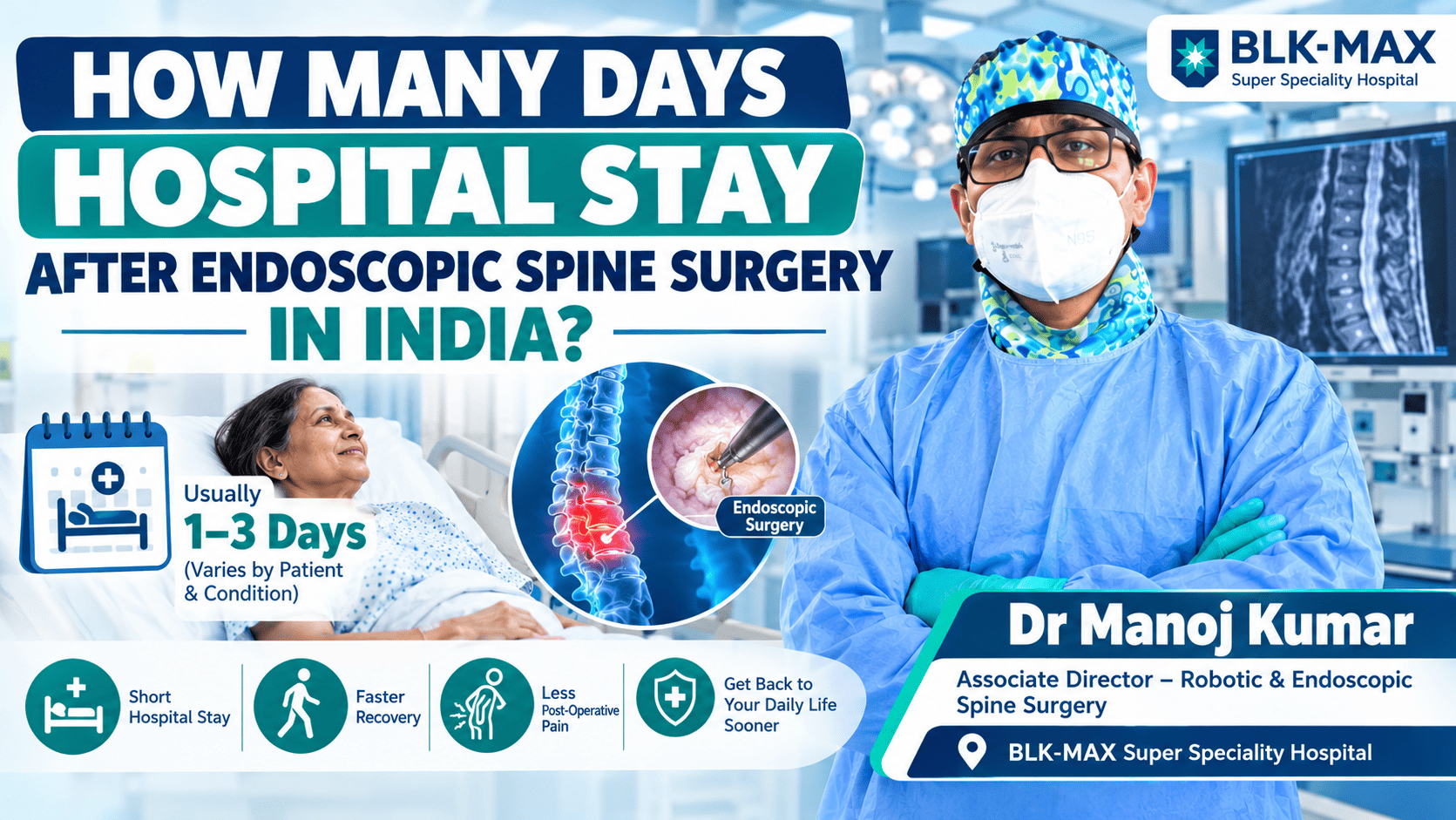
The majority of patients in India stay in the hospital for only one or two days after having endoscopic spinal surgery. Many people who get a basic endoscopic discectomy for a slipped disk or sciatica are released the same morning. Some day surgery patients return home that evening. Even patients receiving more challenging endoscopic therapies, such as biportal endoscopic surgery or multilayer decompression, are rarely admitted for more than three days.
This is the most important difference between endoscopic spine surgery and regular open spine surgery, in which hospital stays of 5 to 8 days are usual and stays of 10 days or more are not uncommon after challenging procedures.
However, the number of days a patient stays is dictated by a variety of factors, including the type of endoscopic surgery performed, the anesthesia used, the patient’s age and medical condition, and the rate at which they recover. This article goes over everything in depth, so you can confidently arrange everything — your leave from work, your family’s preparations, and your journey if you’re coming from outside of Delhi.
Planning Endoscopic Spine Surgery in Delhi NCR?
Get a personalised assessment of your spine condition, expected hospital stay, and recovery plan.
Book a Consultation with Dr. Manoj Kumar at BLK-Max Hospital, New Delhi.
Why Endoscopic Spine Surgery Requires Such a Short Hospital Stay
To understand why the hospital stay after endoscopic spine surgery is so much shorter than after open surgery, it helps to understand what makes a spine surgery patient need to stay in hospital at all.
After traditional open spine surgery, patients need extended hospital stays for five reasons: managing severe post-operative pain that requires intravenous medications, monitoring for significant blood loss that may require transfusion, waiting for the return of normal bowel and bladder function after prolonged general anesthesia and large-dose narcotic pain management, wound care for a large incision, and ensuring the patient can walk safely and independently before
Endoscopic spine surgery addresses each of these disorders at its base.
The incision measures 7-8 mm and only requires a single stitch or adhesive strip. Blood loss is between 20 and 30 milliliters, or less than a tablespoon. Post-operative discomfort is minor and controlled with oral tablets rather than intravenous drugs. The surgery often employs local or spinal anesthesia rather than general anesthesia, resulting in a quicker return to full consciousness, no anesthetic hangover, and no protracted paralytic ileus. And because the back muscles are softly dilated rather than sliced and retracted, patients can stand and walk within hours, not days, of the treatment.
When none of the five traditional reasons for extended hospital stay are present, there is no clinical reason to keep the patient in hospital longer than necessary. They recover faster at home than in a hospital bed, and every spine surgeon who performs endoscopic procedures knows this.
Hospital Stay After Endoscopic Spine Surgery — By Procedure Type
The specific number of days in hospital varies depending on which endoscopic spine procedure was performed. Here is an honest and procedure-specific guide:
Endoscopic Lumbar Discectomy (Slip Disc / Sciatica)
Typical hospital stay: 1 day (overnight)
This is the most popular endoscopic spine procedure. The operation takes 45-75 minutes. The patient can walk within 2-4 hours of the operation. After an overnight observation period, the patient can be discharged the next morning. Same-day discharge after 4-6 hours of postoperative monitoring is possible in chosen individuals who are younger, healthy, live close to the hospital, and have appropriate home assistance.
The overnight stay is mostly for observation: confirming that the patient’s neurological status is stable or improving, treating the first night’s discomfort with drugs, ensuring that the patient is eating, drinking, and walking independently, and issuing discharge instructions to the family.
Endoscopic Foraminoplasty (Foraminal Stenosis)
Typical hospital stay: 1 to 2 days
Endoscopic foraminoplasty involves the narrowed nerve exit tunnel and follows a post-operative course similar to discectomy. Most patients are discharged on Day 1 or Day 2. The slightly longer stay in some patients reflects the more complex nature of the decompression and the need to confirm neurological recovery at the foramen before discharge.
Endoscopic Laminotomy / Laminectomy (Spinal Stenosis)
Typical hospital stay: 2 days
Endoscopic decompression for spinal stenosis, involving removal of the thickened ligamentum flavum and any bone overgrowth narrowing the canal, is a slightly more involved procedure than discectomy. Most patients stay 2 days. This allows time to confirm that the neurogenic claudication symptoms (the leg heaviness and walking limitation that characterise spinal stenosis) have improved, and that the patient is mobilising safely and confidently before going home.
Biportal Endoscopic Spine Surgery (BESS)
Typical hospital stay: 2 to 3 days
Unlike uniportal endoscopy, biportal endoscopy employs two tiny ports, one for the camera and one for the tools. It opens up a larger surgical field and is utilized for more difficult decompressions. The slightly longer hospital stay of 2-3 days reflects the intricacy of the procedure and the need to ensure proper decompression and neurological recovery before discharge.
Endoscopic Cervical Disc Surgery (Neck Disc)
Typical hospital stay: 1 to 2 days
Endoscopic cervical spine surgery for a cervical disc herniation causing arm pain or neck pain follows a similarly short hospital course. The unique consideration in cervical procedures is confirming that arm pain and neurological symptoms (numbness, weakness in the hand or fingers) are improving before discharge. Most patients go home on Day 1 or Day 2.
Endoscopic TLIF / Endoscopic-Assisted Fusion
Typical hospital stay: 3 to 4 days
When endoscopic techniques are combined with spinal fusion, such as in an endoscopic or minimally invasive TLIF for spondylolisthesis, the hospital stay is longer than for pure decompression procedures, reflecting the more complex physiology of fusion surgery. Even so, 3–4 days for a minimally invasive fusion compares very favourably with 6–10 days for traditional open fusion.
Hour-by-Hour Timeline — What Happens During Your Hospital Stay
Understanding exactly what happens during those 1–2 days helps patients and families prepare much more effectively than a simple “you will stay 1–2 days.” Here is the actual timeline for a standard endoscopic lumbar discectomy at a hospital in Delhi NCR:
Day of Surgery — Morning
Admission to the hospital. Pre-operative nursing assessment, consent confirmation, IV line placement, and pre-operative medication. The patient is taken to the operating theatre typically within 1–2 hours of admission. Final position check and anaesthesia administration.
Day of Surgery — During Surgery
45–75 minutes of endoscopic surgery. The patient is taken to the recovery room immediately after the procedure ends. Vital signs are monitored closely. Most patients under local or spinal anaesthesia are alert within 15–30 minutes of the procedure ending. Patients under general anaesthesia typically recover full consciousness within 30–60 minutes.
Day of Surgery — Recovery Room (First 2–3 Hours)
Monitoring of blood pressure, pulse, oxygen saturation, and urine output. Pain assessment: most patients describe post-operative pain as mild to moderate at the incision site, with dramatic reduction in the leg pain that brought them to surgery. Intravenous fluids are maintained until oral intake is confirmed.
Day of Surgery — 3 to 6 Hours After Surgery
First assisted walking attempt under physiotherapy supervision. Most patients take their first steps 3–4 hours after the procedure. This is not a formality; early ambulation is medically important for preventing blood clots, maintaining muscle tone, and reducing post-operative stiffness.
Oral fluids and then solid food are introduced once the patient is alert and tolerating sitting. The intravenous line is removed. The patient is moved to the ward room.
Day of Surgery — Evening and Night
The patient rests in the ward. Oral pain medications are given. The nursing team checks neurological status, sensation, and power in both legs at regular intervals. Most patients sleep reasonably comfortably. Family members may stay with the patient overnight in most Delhi NCR hospitals.
Day 1 After Surgery — Morning
The patient is evaluated by both the surgeon and the physiotherapist. The wound is examined; the 7-8 mm incision usually appears clean and requires only a new dressing. The neurological examination confirms stability or improvement. In the corridor, the patient walks by himself or with limited support.
The discharge criteria are evaluated: Is the patient able to walk without assistance? Is pain under control with oral medication? Is the wound completely clean and dry? Is the patient consuming food and beverages normally? Has a responsible adult escort confirmed plans for safe transportation and home care?
If all criteria are met, the majority of patients undergoing straightforward endoscopic discectomy are discharged on Day 1 morning or early afternoon.
At Discharge
The patient is given oral pain relievers for 5-7 days, an antibiotic course if necessary, discharge instructions on safe movements and activity restrictions, a physiotherapy guide for home exercises in Week 1, a follow-up appointment for a wound review on Days 10-14, and contact information in case of any immediate concerns.
Traveling home by car is completely safe. Air travel within India for patients who have traveled from another city for surgery is typically approved within 48-72 hours, depending on the surgeon’s precise instructions.
How Long Will You Need to Stay in Hospital After Spine Surgery?
Your hospital stay depends on your diagnosis, the procedure required, your overall health, and your recovery.
Discuss your MRI findings with a spine specialist to understand your treatment options and expected recovery timeline.
Factors That Can Extend the Hospital Stay Beyond 2 Days
While the standard stay after endoscopic spine surgery is 1–2 days, certain patient-specific or procedure-specific factors can result in a longer stay. Being aware of these helps set realistic expectations:
1. Age and Medical Comorbidities
Patients above 70 years of age, patients with significant heart or lung conditions, and patients with poorly controlled diabetes may need an extra day of monitoring to ensure full physiological stability after surgery. This is precautionary, not a sign of surgical complication.
2. Procedure Complexity
Multi-level endoscopic decompression (two or three levels operated in the same session) or combined endoscopic decompression with fusion requires longer post-operative monitoring than single-level discectomy.
3. Post-operative Nausea or Vomiting
General anaesthesia, particularly in patients who are sensitive to anaesthetic agents, can cause prolonged nausea that delays the return to oral intake and independent ambulation. In these patients, the hospital stay may extend by an additional day while nausea is managed.
4. Urinary Retention
Some patients, particularly elderly men with pre-existing prostate enlargement, experience temporary difficulty passing urine after spinal surgery. This is managed with a short-term catheter and typically resolves within 24–48 hours, which may extend the hospital stay by one day.
5. Insufficient Home Support
A medically fit patient who lives alone, has no family member available to assist at home, or is travelling a very long distance (over 6–8 hours) may be kept one extra day to ensure a safer transition to home recovery. This is a practical decision, not a clinical one.
6. Unexpected Intraoperative Findings
In rare cases, intraoperative findings such as a larger disc fragment than anticipated, a dural tear requiring additional management, or a more complex anatomical situation may require additional post-operative monitoring beyond the standard stay.
Hospital Stay After Endoscopic Surgery vs Open Spine Surgery — The Complete Comparison
|
Procedure |
Endoscopic Surgery Stay |
Open Surgery Stay |
|
Lumbar discectomy (slip disc) |
1 day |
3–5 days |
|
Spinal stenosis decompression |
2 days |
5–7 days |
|
Cervical disc surgery |
1–2 days |
3–5 days |
|
Lumbar fusion (TLIF) |
3–4 days |
7–10 days |
|
Multi-level decompression |
2–3 days |
6–8 days |
|
Revision spine surgery |
3–4 days |
7–12 days |
The reduction in hospital stay is not merely a convenience; it carries real clinical and financial significance:
Clinically: Every additional day in a hospital is a day of exposure to hospital-acquired infections, a day of reduced mobility compared to home ambulation, a day of institutional food rather than normal nutrition, and, for elderly patients, a meaningful risk of delirium and functional decline.
Financially: Hospital room charges in Delhi NCR range from ₹3,000 per day in a standard room to ₹15,000–₹25,000 per day in a private suite at a tertiary care hospital. A 4-day reduction in hospital stay represents a saving of ₹12,000–₹1,00,000 depending on the room category chosen, a direct cost saving that partially offsets the slightly higher surgical cost of the endoscopic technique compared to open surgery.
Planning Your Hospital Stay — Practical Guide for Patients and Families
What to Bring to Hospital
- All original reports, MRI films, blood test reports, ECG, previous prescriptions
- A list of all medications currently being taken
- Comfortable loose clothing, loose pyjamas, and a front-opening shirt or kurta are ideal for the day after surgery
- Personal toiletries for an overnight stay
- Phone charger and any reading material
- Insurance card and pre-authorisation documents if using health insurance
What to Arrange Before Admission
- A trustworthy adult to accompany you home on discharge—driving home after spine surgery is not safe on discharge day.
- Home arrangements during the first week—someone to help with meals, meds, and short walks if you live alone.
- If traveling from outside Delhi, reserve a hotel or guest home within 15-20 minutes of the hospital for 2-3 nights after discharge, rather than attempting long-distance travel on the discharge day.
- Inform your employer— 2-3 weeks of leave from a desk job is often needed, and 8-12 weeks for physically intensive work.
What to Avoid Before Admission
- Eating or drinking after midnight the night before surgery (for general or spinal anaesthesia)
- Applying creams, lotions, or nail polish on the day of surgery
- Wearing jewellery or contact lenses to the hospital
- Taking blood-thinning medications: confirm with your surgeon which medications to stop and when
Cost of Hospital Stay After Endoscopic Spine Surgery in Delhi NCR
Understanding the hospital stay cost separately from the surgical cost helps patients plan their budget more accurately:
|
Hospital Room Category |
Per Day Rate (Delhi NCR) |
|---|---|
|
General ward |
₹2,000 – ₹4,000 |
|
Twin-sharing room |
₹4,000 – ₹8,000 |
|
Standard private room |
₹6,000 – ₹12,000 |
|
Deluxe private room |
₹10,000 – ₹18,000 |
|
Suite |
₹18,000 – ₹30,000 |
A 1-2-day stay in a standard private room after an endoscopic lumbar discectomy costs between ₹6,000 and ₹24,000. Most hospitals include this in their overall surgery package; however, it may be charged separately depending on the hospital’s billing system.
Insurance coverage: Room charges during the hospital stay for endoscopic spine surgery are covered under most inpatient health insurance policies in India, subject to the room rent limit in your specific policy. Patients with a room rent sub-limit should confirm this with their insurer before choosing a room category.
Want to Understand the Cost of Endoscopic Spine Surgery in Delhi NCR?
The total cost can vary depending on the procedure, hospital room category, investigations, implants if required, and length of stay.
Contact the team to discuss your case and understand the likely treatment costs.
Frequently Asked Questions — Hospital Stay After Endoscopic Spine Surgery
How many days of hospital stay are needed after endoscopic spine surgery in India?
Most patients need just 1 to 2 days of hospital stay after endoscopic spine surgery in India. Endoscopic lumbar discectomy for slipped disc or sciatica typically requires an overnight stay with discharge on Day 1. More complex procedures such as biportal endoscopic surgery or endoscopic-assisted fusion may require 2–4 days.
Can endoscopic spine surgery be done as day surgery in India?
Yes, in selected patients, endoscopic lumbar discectomy can be performed as day surgery, with the patient going home 4–6 hours after the procedure. Day surgery candidates are typically younger, medically healthy, have good home support, and live within a short distance of the hospital.
Why is the hospital stay shorter after endoscopic vs open spine surgery?
The shorter stay reflects the minimally invasive nature of the procedure: a 7–8 mm incision causes minimal blood loss, mild post-operative pain managed with oral medications, early walking within hours, and no need for intravenous narcotic pain management or extended wound care.
When can I travel home after endoscopic spine surgery in India?
Most patients can travel home by car on Day 1 or Day 2 after discharge. Air travel within India is typically safe after 48–72 hours post-discharge. Long-distance travel, more than 4–6 hours, should ideally be avoided on the day of discharge itself.
What happens if I need to stay longer than expected after endoscopic spine surgery?
Extended stays beyond the expected 1–2 days are usually due to age-related monitoring needs, anaesthesia-related nausea, temporary urinary retention, or insufficient home support. These are manageable situations, not signs of surgical complications, and your surgeon will always prioritise your safety over an arbitrary discharge timeline.
Can I sleep normally after endoscopic spine surgery during the hospital stay?
Yes, most patients sleep reasonably comfortably on the night after endoscopic spine surgery. The incision soreness is mild and well-managed with oral medications. Many patients report sleeping better than they have in months because the severe pre-operative leg pain and sciatica that disturbed their sleep is now significantly reduced or gone.
Is a private room necessary after endoscopic spine surgery in India?
A private room is not medically necessary after uncomplicated endoscopic spine surgery. A twin-sharing or general ward bed is clinically adequate for the 1–2 day recovery period. Private room choice is a comfort preference and has financial implications, particularly for patients with insurance room rent limits.
How much does the hospital stay cost after endoscopic spine surgery in Delhi NCR?
Hospital room costs in Delhi NCR range from ₹2,000 per day in a general ward to ₹30,000 per day in a suite. For a 1–2 day stay in a standard private room, the room component costs approximately ₹12,000–₹24,000. This is typically included in the overall surgical package or covered under inpatient health insurance.
Concerned about hospital stay after endoscopic spine surgery? Dr. Manoj Kumar, Associate Director – Robotic & Endoscopic Spine Surgery at BLK-Max Super Speciality Hospital, New Delhi, can assess your condition and discuss suitable treatment options.
Whether you are experiencing a slipped disc, sciatica, spinal stenosis, or a cervical disc problem, the first step is a proper clinical evaluation.
Contact Us Now: +91 7048942016
Discuss your symptoms, MRI findings, and expected recovery timeline with the team.
Treatment recommendations and hospital stay depend on individual clinical assessment.