
Endoscopic vs Robotic Spine Surgery in Delhi NCR - Which Is Right for You?
By Dr Manoj Kumar | Associate Director – Robotic & Minimally Invasive Spine Surgery, BLK-MAX Super Speciality Hospital, New Delhi
Most patients who come to my clinic in Delhi NCR carrying an MRI report have already spent hours on their phone researching. By the time they sit in front of me, they have read about endoscopic spine surgery on one website and robotic spine surgery on another, and they are more confused leaving those pages than they were before they opened them.
The confusion is understandable. Both sound modern. Both sound safe. And both are being advertised at hospitals across Delhi, Noida, Gurgaon, and Faridabad as the latest and best in spine care. What those websites rarely explain clearly is that endoscopic spine surgery and robotic spine surgery solve two completely different problems, and giving a patient the wrong one, even perfectly executed, will not fix what is actually wrong with their spine.
I perform both. And the single most important thing I do before deciding which one a patient needs is not to look at the technology available; it is to look carefully at what their spine actually needs done.
Here is what I have learned from doing this every week: the patients who recover well and stay recovered are the ones whose surgery matched their diagnosis precisely. Not the ones who had the most advanced technology. Not the ones who chose the more expensive option. The ones whose surgeon took the time to understand the difference and chose accordingly.
This article explains that difference in plain language, so that when you walk into your consultation, you already know the right questions to ask.
First - What Each Surgery Actually Does
Before comparing them, it is important to understand what each technique is designed to do. This is where most patients get confused, because both are called “minimally invasive” and both use advanced technology.
What Is Endoscopic Spine Surgery?
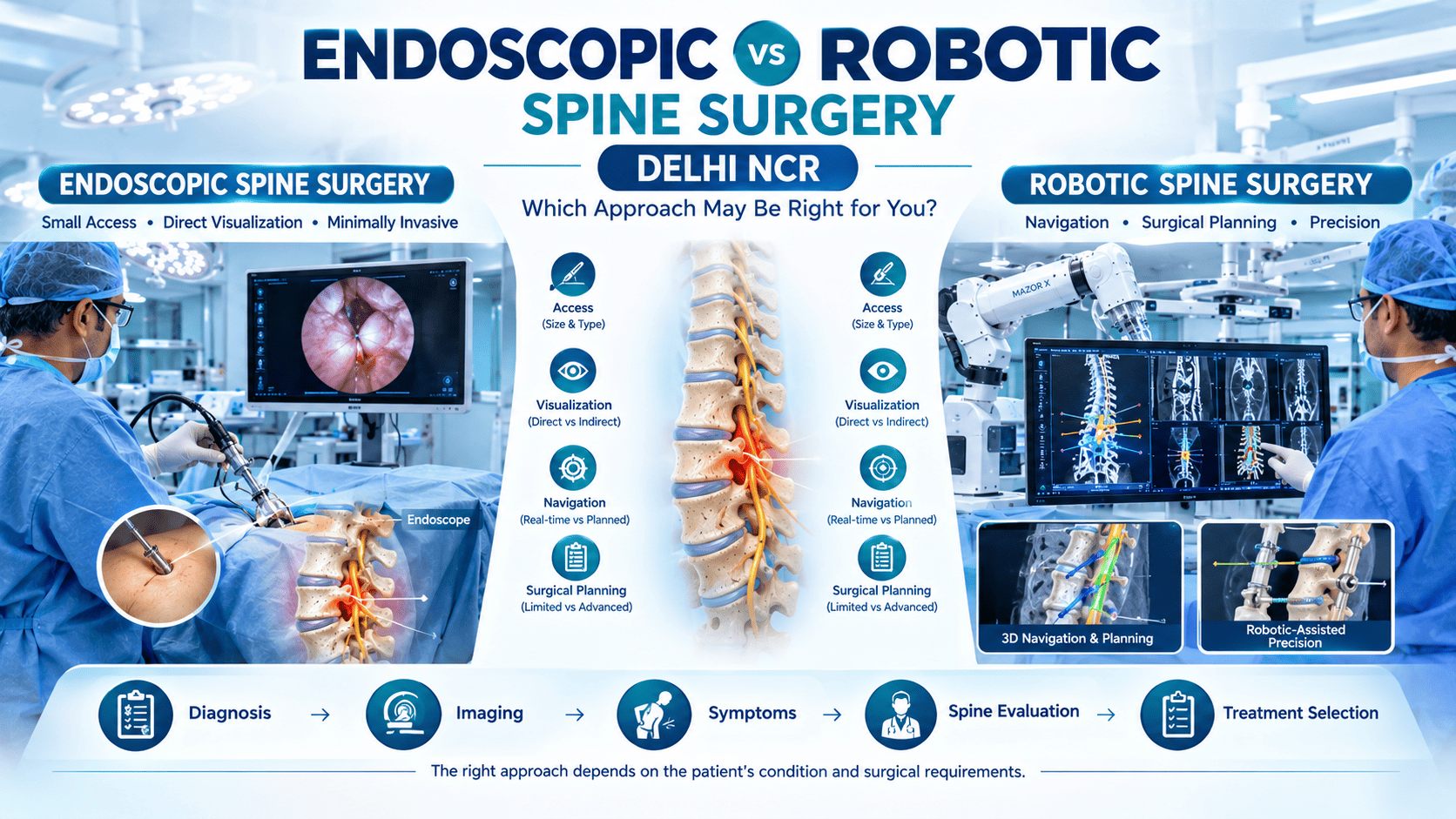
Endoscopic spine surgery is a decompression technique. It is used to relieve pressure on a compressed nerve or the spinal cord by removing the tissue causing that compression, a herniated disc, a bone spur, a thickened ligament, or a narrowed foramen.
A 7-10 millimetre incision is used to provide the therapy. A small tube known as a working cannula is inserted through this incision and guided to the affected spine level. The surgeon passes a high-definition endoscope, a camera that provides a magnified, real-time picture on a monitor, and miniature surgical instruments down this tube.
None of the bones is joined together. No metal implants are present. The spine’s natural movement has been completely maintained. The goal is to eliminate whatever is pinching the nerve and restore normal nerve function.
What Is Robotic Spine Surgery?
Robotic spine surgery is a fusion and stabilisation technique. It is used when the spine is unstable, either because a vertebra has slipped (spondylolisthesis), because a disc has collapsed causing instability, because multiple levels have degenerated, or because a previous surgery has destabilised the spine.
The robotic system does not decompress nerves directly. It guides the surgeon to place pedicle screws, titanium anchors inserted into the vertebrae, with sub-millimetre accuracy, based on a pre-operative plan mapped onto the patient’s own CT scan. These screws are connected by rods, and a bone graft or interbody cage is placed between the vertebrae to promote fusion, fusing two or more vertebrae into a single, stable unit.
The robotic system is the navigation platform. The fusion is the goal.
The Core Difference in One Sentence
Endoscopic spine surgery removes what is compressing your nerve. Robotic spine surgery stabilises the vertebrae that have become unstable.
These are different problems requiring different solutions. A patient with a herniated disc and sciatica needs decompression: endoscopic surgery. A patient with spondylolisthesis and spinal instability needs stabilisation: robotic fusion. A patient with both conditions may need both techniques, sometimes in the same operation.
Conditions Treated — Endoscopic vs Robotic Spine Surgery
Conditions Best Treated With Endoscopic Spine Surgery in Delhi NCR
|
Condition |
Why Endoscopic Is Preferred |
|
Lumbar disc herniation (Slip disc) |
Removes herniated disc fragment compressing the nerve; no fusion needed |
|
Sciatica due to disc compression |
Decompresses the inflamed nerve root directly |
|
Cervical disc herniation |
Removes disc pressing on spinal cord or arm nerve |
|
Lumbar foraminal stenosis |
Opens the narrowed nerve exit channel |
|
Lumbar spinal stenosis (mild–moderate) |
Removes thickened ligament and bone spurs compressing the nerve canal |
|
Cervical spinal stenosis |
Decompresses the spinal cord in the neck |
|
Recurrent disc herniation |
Re-decompresses without the risks of open revision surgery |
|
Synovial cyst causing nerve compression |
Removes cyst through minimally invasive approach |
Conditions Best Treated With Robotic Spine Surgery in Delhi NCR
|
Condition |
Why Robotic Is Preferred |
|
Spondylolisthesis (Grade 1–2) |
Stabilises and fuses the slipped vertebra with precision screw placement |
|
Degenerative disc disease with instability |
Fuses the collapsed, unstable disc level |
|
Failed back surgery syndrome |
Revision fusion with accurate navigation through altered anatomy |
|
Lumbar stenosis with instability |
Decompression combined with fusion for unstable spine |
|
Adjacent segment disease |
Extends fusion to the level above or below a previous fusion |
|
Spinal deformity (mild scoliosis) |
Multi-level fusion with robotic accuracy across complex anatomy |
|
Multilevel degenerative disease |
Two- or three-level fusion with consistent precision at each level |
|
Post-traumatic instability |
Stabilises fractures or ligamentous injuries requiring surgical fixation |
Conditions Where Both Are Used Together
Some patients have both nerve compression and spinal instability, the most common example being lumbar stenosis with spondylolisthesis. In these patients, the nerve must be decompressed (endoscopic), and the spine must be stabilised (robotic fusion). At high-volume spine centres in Delhi NCR, these procedures are performed together in a single anaesthetic; the patient benefits from both techniques simultaneously.
Comparison — Endoscopic vs Robotic Spine Surgery
|
Factor |
Endoscopic Spine Surgery |
Robotic Spine Surgery |
|
Primary purpose |
Nerve decompression |
Spinal fusion and stabilisation |
|
Implants used |
None |
Pedicle screws, rods, cages |
|
Incision size |
7–10 mm |
2–4 cm (2–3 small cuts) |
|
Anaesthesia |
Local, spinal, or general |
General |
|
Hospital stay |
1–2 days |
2–4 days |
|
Blood loss |
Under 30 ml |
100–300 ml |
|
Return to desk work |
2–3 weeks |
4–6 weeks |
|
Full recovery |
4–8 weeks |
3–5 months |
|
Spine movement preserved? |
Yes — fully |
No — fused levels are fixed |
|
Success rate |
88–95% |
88–95% |
|
Cost in Delhi NCR |
₹1.2L – ₹3.5L |
₹4.5L – ₹12L |
|
Best for |
Disc herniation, sciatica, stenosis |
Spondylolisthesis, instability, fusion |
|
Suitable for elderly |
Excellent (local anaesthesia option) |
Excellent (minimally invasive) |
|
Insurance coverage |
Yes |
Yes (when medically indicated) |
Cost Comparison — Endoscopic vs Robotic Spine Surgery in Delhi NCR
Cost is one of the most important practical considerations for patients and their families. Here is an honest and detailed cost comparison:
Endoscopic Spine Surgery Cost in Delhi NCR
|
Procedure |
Approximate Cost |
|
Endoscopic discectomy (slip disc / sciatica) |
₹1,20,000 – ₹2,50,000 |
|
Endoscopic foraminoplasty (foraminal stenosis) |
₹1,50,000 – ₹2,80,000 |
|
Endoscopic laminectomy (spinal stenosis) |
₹1,80,000 – ₹3,50,000 |
|
Biportal endoscopic surgery |
₹2,00,000 – ₹3,50,000 |
Robotic Spine Surgery Cost in Delhi NCR
|
Procedure |
Approximate Cost |
|
Single-level robotic TLIF (spondylolisthesis) |
₹4,50,000 – ₹7,00,000 |
|
Two-level robotic fusion |
₹6,00,000 – ₹9,50,000 |
|
Robotic fusion with decompression |
₹5,50,000 – ₹8,50,000 |
|
Revision robotic fusion |
₹7,00,000 – ₹12,00,000 |
Why Is Robotic Surgery More Expensive?
The higher cost of robotic spine surgery reflects the capital cost of the robotic navigation system (which runs into several crores), single-use robotic components consumed per case, intraoperative CT imaging, titanium implants (screws, rods, and interbody cages), and longer operating time.
Endoscopic surgery uses no implants; the procedure involves only the endoscope, working cannula, and disposable instruments. This is the primary driver of its significantly lower cost.
Both procedures are covered by most major health insurance policies in India when medically indicated and pre-authorised. Endoscopic surgery is almost universally approved. Robotic surgery approval depends on the insurer and requires detailed pre-authorisation documentation from your surgeon.
Recovery Comparison — Endoscopic vs Robotic Spine Surgery
Recovery timelines differ significantly between the two procedures, primarily because robotic fusion is a larger physiological undertaking (bone must grow and fuse across the operated levels), while endoscopic surgery simply removes tissue and allows the nerve to recover.
Endoscopic Spine Surgery Recovery Timeline
Day 1: Walking within 4–6 hours of surgery. Discharge on Day 1 or Day 2.
Week 1: Short walks, gentle activity. Leg or arm pain typically improves significantly within days as the nerve decompresses.
Weeks 2–4: Return to desk work. No driving for 2 weeks. Physiotherapy introduced gently.
Weeks 4–8: Return to full activity including driving, light exercise, and most physical tasks.
Months 2–3: Complete functional recovery for the large majority of patients.
Robotic Spine Surgery Recovery Timeline
Days 1–3: Walking within 18–24 hours. Discharge on Day 2–4. A back brace is fitted before discharge.
Weeks 1–3: Walking encouraged frequently. Brace worn at all times when upright. Sitting restricted to 20–30 minutes at a stretch.
Weeks 4–8: Formal physiotherapy begins. Return to desk work at Week 4–6. Driving from Week 6.
Months 2–4: Progressive increase in activity. Patients feel 60–75% of expected full recovery.
Months 4–6: Full functional recovery. Fusion confirmed on imaging at 6 months.
Both endoscopic spine surgery and robotic spine surgery achieve success rates of 88–95% in well-selected patients at experienced centres in Delhi NCR. However, “success” means different things for each:
Endoscopic spine surgery success is primarily measured by resolution of leg or arm pain (radicular pain), restoration of normal sensation and strength, and ability to return to normal activity without restriction.
Robotic spine surgery success is measured by significant reduction in back and leg pain, confirmed solid fusion on CT imaging at 6–12 months, restoration of walking ability and independence, and long-term durability of the construct, including a low rate of revision surgery (2–4% at 5 years with robotic guidance versus 6–12% with traditional freehand fusion).
Both techniques, when applied to the correct diagnosis in appropriately selected patients, achieve excellent and durable outcomes.
This is a question patients rarely ask, but it is one of the most important ones.
If a patient with spinal instability undergoes only endoscopic decompression: The nerve compression may be relieved initially, but the underlying instability continues. The slip or instability progresses, symptoms return, and the patient eventually needs fusion surgery anyway, now as a more complex revision procedure.
If a patient with a simple disc herniation undergoes robotic fusion: The nerve compression is treated, but the patient has lost movement at the fused level permanently, has metal implants in their spine for life, has a much longer and harder recovery, has spent significantly more money, and carries a lifelong risk of adjacent segment disease, a condition where the levels above and below the fusion wear out faster because of the increased stress placed on them.
Correct patient selection is the most important factor in spine surgery outcomes, more important than the technology used: A robotic system in the wrong hands or for the wrong patient does not produce good results. An endoscope in expert hands for the right patient produces outstanding results. The technology amplifies what is already there, it does not replace surgical judgment.
The answer to “endoscopic vs. robotic spine surgery, which is right for me?” depends on four things:
1. Your Primary Problem — Compression or Instability?
- Is your main problem a disc pressing on a nerve, bone spurs narrowing the canal, or a thickened ligament compressing your spinal cord? → Endoscopic decompression is likely the right approach.
- Is your main problem a vertebra that has slipped, an unstable spine, a disc that has completely collapsed, or a previous surgery that has failed? → Robotic fusion is likely the right approach.
- Do you have both compression and instability? → A combined approach may be needed.
2. Your MRI and CT Findings
Your imaging tells the surgeon what your symptoms alone cannot. An MRI shows disc herniations, nerve compression, and canal narrowing. A CT scan shows bone quality, joint degeneration, and the degree of instability. A standing X-ray in flexion and extension shows dynamic instability that disappears on a lying-down MRI. All three together give the complete picture.
3. Your Age and Medical Fitness
- Younger patients (below 50): Spine movement preservation is a high priority — endoscopic surgery is strongly preferred wherever decompression alone can achieve the goal.
- Older patients (above 60) with instability: Robotic fusion is very well tolerated, and the minimally invasive approach makes it safer than traditional open surgery even in elderly patients with medical comorbidities.
- Patients with heart or lung conditions: Endoscopic surgery under local or spinal anaesthesia avoids general anaesthesia entirely — a major advantage.
4. Your Surgeon’s Honest Assessment
A surgeon trained and experienced in both techniques is best placed to give you an unbiased recommendation. A surgeon who performs only one of the two will always see the world through that lens. At your consultation, ask directly: “Could my condition be treated with the less invasive option? What would I be giving up if we chose that route?”
Yes, and in Delhi NCR, combined endoscopic decompression and robotic fusion is increasingly performed in a single procedure for patients who have both nerve compression and spinal instability at the same level.
The most common scenario is lumbar stenosis with spondylolisthesis, where the slip causes instability (requiring fusion) and the narrowed canal causes nerve compression (requiring decompression). In experienced hands, the endoscopic decompression and robotic fusion are performed sequentially in the same operating session, sparing the patient a second anaesthetic and a second recovery.
Frequently Asked Questions — Endoscopic vs Robotic Spine Surgery Delhi NCR
What is the difference between endoscopic and robotic spine surgery?
Endoscopic spine surgery removes tissue (disc, bone, ligament) that is compressing a nerve, using a camera and instruments through a 7–10 mm incision, no implants are placed. Robotic spine surgery uses a robotic navigation system to guide precise placement of screws and fusion implants to stabilise an unstable spine. They treat different problems and are sometimes used together.
Which is better - endoscopic or robotic spine surgery?
Neither is universally better, the right choice depends on your diagnosis. Endoscopic surgery is better for nerve compression conditions (slip disc, sciatica, spinal stenosis). Robotic surgery is better for instability conditions (spondylolisthesis, degenerative instability, failed previous surgery). In patients with both, a combined approach is used.
Is endoscopic spine surgery cheaper than robotic surgery in Delhi NCR?
Yes — significantly. Endoscopic spine surgery in Delhi NCR costs ₹1.2–3.5 lakhs. Robotic spine surgery costs ₹4.5–12 lakhs. The difference reflects the use of titanium implants and the robotic navigation system in fusion surgery, which endoscopic surgery does not require.
What is the recovery time for endoscopic vs robotic spine surgery?
Endoscopic surgery: walking the same day, discharge in 1–2 days, return to desk work in 2–3 weeks, full recovery in 4–8 weeks. Robotic fusion surgery: walking in 24 hours, discharge in 2–4 days, return to desk work in 4–6 weeks, full recovery in 3–5 months.
Can endoscopic spine surgery treat spondylolisthesis?
Endoscopic surgery can relieve the nerve compression caused by spondylolisthesis, but it cannot correct the underlying instability (the vertebral slip). For Grade 1 spondylolisthesis with purely nerve compression symptoms and no instability, endoscopic decompression may provide adequate relief. For Grade 2 or above, or when instability is the primary problem, fusion surgery (robotic-guided) is required.
Is robotic spine surgery better than endoscopic for elderly patients?
Both are well-suited to elderly patients, but for different reasons. Endoscopic surgery can be done under local anaesthesia — ideal for elderly patients who cannot safely undergo general anaesthesia. Robotic fusion, when fusion is genuinely needed, is far safer for elderly patients than traditional open surgery because of smaller incisions, lower blood loss, and earlier mobilisation.
Are both endoscopic and robotic spine surgeries available in Delhi NCR?
Yes — both endoscopic spine surgery and robotic spine surgery are available at leading hospitals in Delhi NCR, including BLK Max Hospital, Max Super Specialty, Fortis, and Apollo Delhi. Not all hospitals have both capabilities, confirm before booking.
Which spine surgery has the higher success rate - endoscopic or robotic?
Both achieve success rates of 88–95% in appropriately selected patients at experienced centres. Success depends far more on correct patient selection and surgeon experience than on which of the two technologies is used.
Can I have both endoscopic and robotic surgery in the same operation?
Yes — for patients with both nerve compression and spinal instability (such as lumbar stenosis with spondylolisthesis), endoscopic decompression and robotic fusion can be combined in a single procedure in the same operating session at experienced spine centres in Delhi NCR.
How do I find the best spine surgeon for endoscopic or robotic surgery in Delhi NCR?
Look for a surgeon who is trained and regularly performing both techniques — not one who specialises exclusively in one. A surgeon proficient in both is best placed to recommend the right approach for your specific condition without a bias toward the technique they happen to perform most.
The decision between endoscopic and robotic spine surgery, or a combination of both, should never be made by the patient alone based on online research. It requires a thorough clinical assessment, a detailed review of your MRI and CT findings, and an honest conversation with a surgeon experienced in both approaches.
Dr Manoj Kumar is an Associate Director – Robotic and Endoscopic Spine Surgery at BLK Max Hospital, Delhi, with extensive experience in both endoscopic spine surgery and robotic spine surgery. He performs single-level endoscopic procedures, complex multi-level robotic fusions, and combined procedures, and always recommends the least invasive approach that safely achieves the best outcome for each patient.
Patients from Delhi, Noida, Gurgaon, Faridabad, Greater Noida, and across India are seen regularly at his clinic. International patients seeking spine surgery in Delhi NCR are also welcome.
Book your consultation:
- Website: bestspinesurgeonindelhincr.com
- Available at: BLK Max Hospital, Delhi NCR