Endoscopic Spine Surgery for Slip Disc in Delhi - Success Rate, Recovery and What to Expect
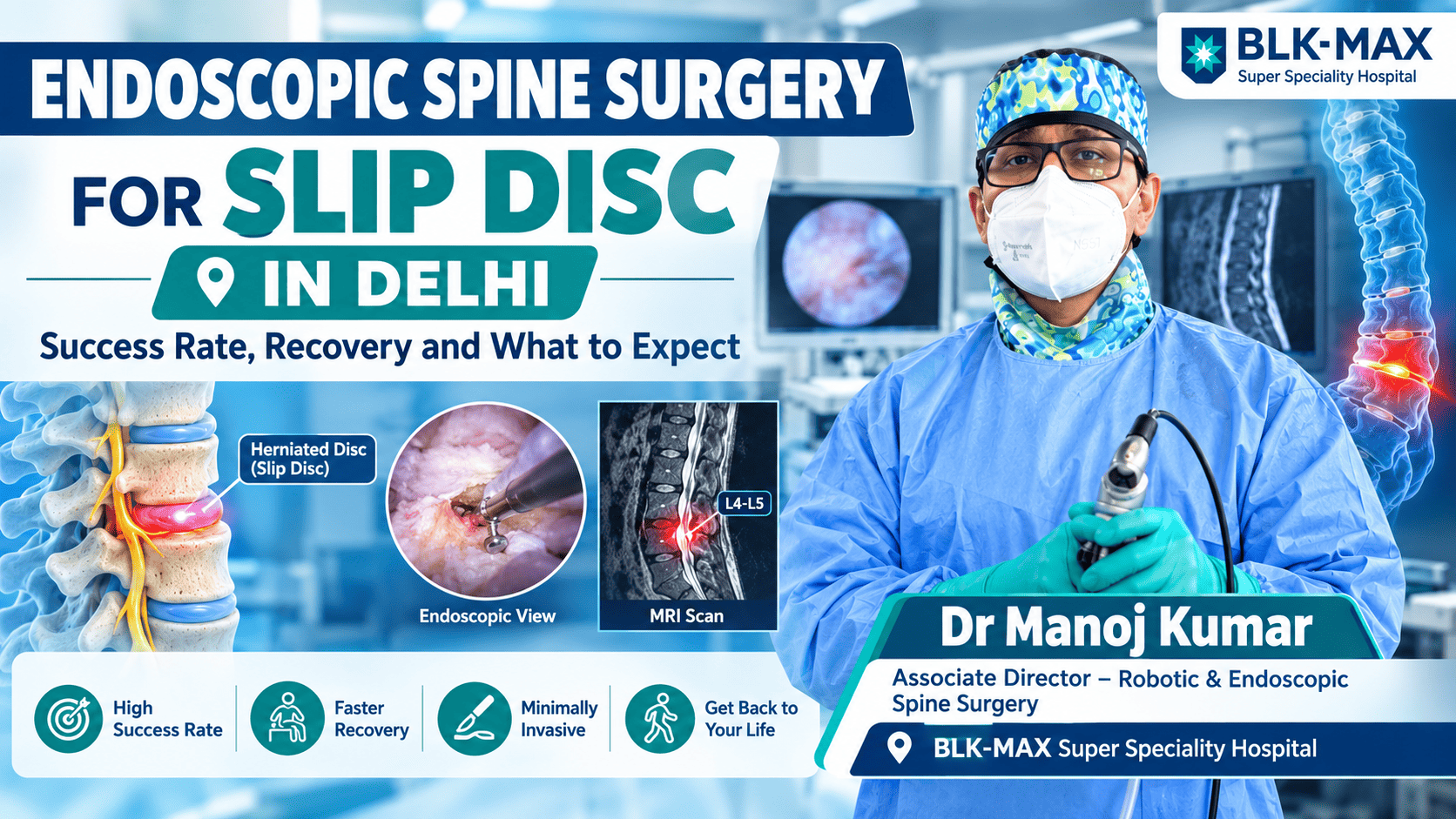
By Dr Manoj Kumar | Associate Director – Robotic & Minimally Invasive Spine Surgery, BLK-MAX Super Speciality Hospital, New Delhi
Slip disc is the diagnosis on more MRI reports coming through my clinic in Delhi than almost any other spinal condition. And yet, despite how common it is, I find that most patients sitting in front of me have a fundamental misunderstanding about what a slipped disc actually is, what it means for their future, and, most importantly, whether the surgery they have been told they need is actually necessary, and if it is, what kind.
Let me begin with the patient’s most pressing question: “Doctor, if I need surgery for my slipped disc, what is the success rate, what will the surgery actually involve, and what should I expect afterwards?”
Endoscopic spine surgery for a slipped disc in Delhi has a 90-95% success rate in carefully selected patients, making it the most effective, minimally invasive option with a quick recovery for lumbar and cervical disc herniations. Most patients walk the same day, return home within 24-48 hours, and resume normal activities in 3-6 weeks.
But success does not happen by accident. It depends on the right diagnosis, the right patient selection, the right surgeon, and a clear understanding of what the procedure involves and what recovery genuinely looks like. That is what this article gives you, from the surgeon who performs it.
What Is a Slip Disc And When Does It Actually Need Surgery?
The term “slip disc” is widely used but technically imprecise. What most patients call a slip disc is medically a lumbar disc herniation, a condition in which the soft inner core of an intervertebral disc pushes through a weakness in the disc’s outer wall and presses against a nerve root or the spinal cord.
The discs in the spine act as shock absorbers between the vertebrae. Each disc has a tough outer ring called the annulus fibrosus and a gel-like inner core called the nucleus pulposus. When the outer ring weakens, due to age, injury, repetitive strain, or prolonged poor posture, the inner core can bulge outward or rupture through the outer wall entirely.
When this herniated disc material presses against a nerve, it creates two problems simultaneously: mechanical compression of the nerve and chemical inflammation of the nerve from contact with the disc material. Together, these produce the classic symptoms: severe shooting pain down one leg (sciatica), numbness or tingling in the foot or toes, and in more severe cases, weakness in the leg or foot.
Not Every Slip Disc Needs Surgery
This is something I say to every patient who comes to me with a slip disc diagnosis: the presence of a herniation on your MRI does not automatically mean you need surgery. In fact, a significant proportion of patients with lumbar disc herniations improve meaningfully with 6–12 weeks of well-structured conservative management, physiotherapy focused on core stabilisation, targeted pain management, activity modification, and in selected cases, a guided epidural steroid injection.
Surgery becomes the right conversation when:
- Leg pain (sciatica) is severe, constant, and has not responded to 6–8 weeks of proper conservative treatment
- Neurological symptoms are present, weakness in the foot or leg, numbness in the sole or toes
- Bladder or bowel function is affected (this is a surgical emergency)
- The patient’s quality of life is severely impacted, unable to sleep, work, or walk normally
- Imaging shows a large central herniation with significant nerve compression
When these criteria are met, endoscopic spine surgery for slip disc in Delhi is the treatment that gives the most reliable and fastest path back to a normal life.
What Is Endoscopic Spine Surgery for Slip Disc?
Endoscopic spine surgery for slip disc, technically called percutaneous endoscopic lumbar discectomy (PELD) or transforaminal endoscopic discectomy, is a minimally invasive procedure in which the herniated disc material pressing on the nerve is removed through an incision of just 7–8 millimetres.
Here is how it works in plain language.
Under local or spinal anaesthesia, a thin needle is first placed at the affected disc level under live X-ray guidance (fluoroscopy). Over this needle, a series of progressively larger dilators are passed to gently separate, not cut, the muscle fibres. A working cannula (a hollow tube approximately 7mm in diameter) is then positioned at the herniated disc level. Through this cannula, the surgeon passes a high-definition endoscope, a thin camera with a light source that transmits a magnified real-time view of the disc, nerve, and surrounding structures to a monitor.
Through the same working cannula, miniaturised surgical instruments are passed alongside the endoscope. Using these instruments, the surgeon identifies and removes the herniated disc fragment that is compressing the nerve. The nerve is visualised throughout the procedure; the surgeon watches it decompress in real time as the disc material is removed.
The entire procedure takes 45–75 minutes. The incision is closed with a single stitch or a small adhesive strip. No muscles are cut. No bones are removed. The spine’s natural structure is entirely preserved.
Endoscopic Slip Disc Surgery vs Traditional Open Discectomy — Why Endoscopic Wins
Many patients ask me why endoscopic surgery is preferred over traditional open discectomy, a procedure that has been performed successfully for decades. Here is an honest comparison:
|
Factor |
Endoscopic Discectomy |
Open Discectomy |
|
Incision size |
7–8 mm |
4–6 cm |
|
Muscle cutting |
None (dilation only) |
Significant retraction |
|
Anaesthesia |
Local/spinal/general |
General |
|
Blood loss |
Less than 20 ml |
100–300 ml |
|
Hospital stay |
1–2 days |
3–5 days |
|
Post-op pain |
Mild |
Moderate to severe |
|
Return to desk work |
2–3 weeks |
6–8 weeks |
|
Full recovery |
4–6 weeks |
3–4 months |
|
Infection risk |
Under 0.5% |
2–4% |
|
Success rate |
90–95% |
85–92% |
|
Suitable for local anaesthesia |
Yes |
No |
|
Preserves spine motion |
Yes |
Yes |
The advantages of endoscopic surgery are not marginal; they are substantial. The smaller incision, preserved muscle anatomy, lower infection risk, and dramatically faster recovery mean that most patients who are candidates for open discectomy are better served by endoscopic discectomy performed by an experienced surgeon.
The one caveat, and I say this honestly, is that endoscopic discectomy requires a significantly higher level of surgical skill and training than open discectomy. The working space is small, the instruments are miniaturised, and the procedure is performed through a camera rather than direct vision. An endoscopic discectomy performed by an experienced, high-volume surgeon produces outstanding results. The same procedure in less experienced hands produces inferior outcomes. This is why choosing the right surgeon matters as much as choosing the right technique.
Endoscopic Slip Disc Surgery Success Rate in Delhi — The Real Numbers
Patients seeking endoscopic spine surgery for scoliosis in Delhi often ask, what are the chances this will actually work?”
Here’s my honest response, replete with actual numbers.
In Delhi’s competent endoscopic spine surgical centres with dedicated endoscopic training, the success rate for endoscopic lumbar discectomy is high.
Within 6-12 weeks of surgery, 90-95% of patients experience significant and long-term relief from leg discomfort (sciatica), the most prevalent complaint in slipped disc cases.
Breaking this down further by outcome measure:
|
Outcome Measure |
Success Rate |
|
Significant leg pain relief (sciatica resolved) |
90–95% |
|
Back pain improvement |
75–85% |
|
Neurological recovery (numbness/tingling) |
85–92% |
|
Return to full normal activity |
88–94% |
|
Patient satisfaction at 1 year |
88–93% |
|
No need for revision surgery at 5 years |
93–97% |
What Affects the Success Rate?
Success is not uniform across all patients. Several factors influence how well a patient does after endoscopic slip disc surgery:
Positive factors — better outcomes:
- Duration of symptoms less than 6 months before surgery
- Predominantly leg pain rather than back pain
- Clear single-level disc herniation on MRI correlating with clinical symptoms
- No significant neurological deficit (or deficit present for less than 3 months)
- Patient is physically active and otherwise healthy
- Surgery performed by a high-volume endoscopic surgeon
Factors that reduce success rate:
- Very long duration of untreated nerve compression (more than 12–18 months)
- Predominantly back pain rather than leg pain (back pain has a more complex origin)
- Severe and longstanding neurological deficit — foot drop or complete numbness present for over 6 months
- Obesity combined with poor core muscle strength
- Multiple levels of disc disease where the primary pain generator is not clearly identified
- Psychological factors — severe depression or anxiety significantly affect recovery perception
What to Expect Before, During and After Endoscopic Slip Disc Surgery in Delhi
Before Surgery — Preparation
Pre-operative assessment: Your surgeon will review your MRI, conduct a detailed clinical examination, and correlate your symptoms with your imaging. Blood tests, an ECG, and an anaesthesia assessment are performed routinely.
Fasting: You will be asked to fast for 6 hours before surgery if general anaesthesia is planned, or 4 hours if local or spinal anaesthesia is being used.
Medications: Inform your surgeon about all medications you are taking, particularly blood thinners (aspirin, clopidogrel, warfarin), anti-inflammatory medications, and diabetes medications. Most blood thinners are stopped 5–7 days before surgery.
Admission: Most patients are admitted on the morning of surgery. A pre-operative physiotherapy assessment is done in many centres to establish a baseline for post-operative comparison.
During Surgery — What Happens in the Operating Theatre
You will be positioned lying face down (prone) on a specially cushioned operating table that supports the spine in a neutral position without compressing the abdomen.
If local or spinal anaesthesia is being used, you will be awake but completely comfortable; most patients describe this experience as a pressure sensation without pain. If general anaesthesia is preferred, you will be completely asleep.
The operating surgeon marks the skin entry point using fluoroscopy (live X-ray), places the working cannula, positions the endoscope, and begins removing the herniated disc material. You may be asked during the procedure (if under local anaesthesia) whether your leg pain has improved; this immediate feedback helps the surgeon confirm complete nerve decompression.
Most patients under local anaesthesia feel their leg pain reduce or disappear on the operating table before the procedure is even completed. This is one of the most rewarding moments in endoscopic spine surgery for both the patient and the surgeon.
The procedure takes 45–75 minutes. The cannula is removed, the incision is closed, and you are moved to the recovery area.
Immediately After Surgery — Recovery Room
- Most patients are alert and oriented within 15–30 minutes of the procedure ending.
- Leg pain is typically significantly reduced or completely gone immediately after surgery.y
- Mild soreness at the small incision site is normal and managed with simple oral painkillers.
- You will be encouraged to sit up and take your first steps within 2–4 hours.
- Intravenous fluids are discontinued within a few hours once you are tolerating oral intake.
Day 1 After Endoscopic Slip Disc Surgery
- Walking is strongly encouraged, short walks of 5–10 minutes, 3–4 times during the day.
- Most patients notice the dramatic difference between pre-operative leg pain and the mild incision-site discomfort they feel now
- Physiotherapy begins with gentle breathing exercises and ankle pump movements to prevent blood clots.s
- A urinary catheter, if placed, is removed.
- Most patients eat normally and sleep comfortably on the night after surgery.
Going Home — Day 1 or Day 2
The majority of patients undergoing endoscopic slip disc surgery in Delhi are discharged on Day 1 or Day 2 after surgery. Before discharge, your physiotherapist will teach you:
- Safe movements — how to get up from bed, sit, and stand without straining the operated disc
- Walking programme — distance and frequency targets for the first 2 weeks
- Posture correction — positions to avoid that increase disc pressure
- Warning signs — what symptoms to report immediately
Week 1: Home Recovery Begins
The most vital physical activity is short walks. Walk for 10-15 minutes, four times per day. Avoid sitting for more than 20 to 30 minutes at a time. Avoid leaning forward, lifting anything heavier than 1-2 kg, and twisting your back. Sleep on your side with your knees resting on a pillow. Mild residual numbness or tingling in the leg is typical and normally fades over a few days to weeks as the nerve heals.
Week 2: Gradual Increase
Walking distance increases to 20–30 minutes. Most patients find they need less pain medication by the end of Week 2. A follow-up visit with your surgeon confirms the wound has healed and assesses neurological recovery.
Weeks 3–4: Return to Light Activity
Formal physiotherapy begins, core strengthening, flexibility work, and posture correction exercises. Most patients doing sedentary desk work return to professional activity at Week 2–3. Driving is permitted from Week 3 in most patients, subject to the surgeon’s assessment.
Weeks 4–6: Return to Normal Life
Walking distance is unrestricted. Light exercise, swimming, stationary cycling, and gentle yoga are introduced. Most patients feel 80–85% of their expected full recovery by the end of Week 6.
Weeks 6–12: Complete Recovery
By week 8, the vast majority of patients had returned to normal activity. A further MRI or X-ray in 6- 8 weeks confirms nerve decompression. Patients in physically demanding employment (construction, fieldwork, or heavy lifting) are cleared to return to work after 8-12 weeks of physical therapy.
This is something I discuss with every patient before surgery because it prevents a great deal of unnecessary worry post-operatively.
After endoscopic discectomy, even when the surgery is technically perfect, the disc fragment is completely removed, the nerve is fully decompressed, and there are no complications, some patients continue to have residual numbness, tingling, or mild leg discomfort for weeks to months afterwards.
This is not surgical failure. It is nerve recovery, and it follows its own timeline.
A nerve that has been crushed for months has swelling inside its sheath, disrupted blood flow, and microscopic damage along its length. Removing the compression, which surgery does immediately, allows healing to begin, but the nerve will return gradually. Fine tingling sensations, moderate numbness in the soles or toes, and occasional shooting pains are all normal signs of nerve repair, which usually recovers fully within 3-6 months.
The most important difference is that leg discomfort (sciatic shooting pain down the leg) should improve rapidly or go away within a few days of surgery. Back pain, numbness, and tingling can continue for weeks to months. If your leg pain persists or worsens after surgery, contact your surgeon straight away.
Yes, disc re-herniation is possible after endoscopic discectomy, and patients deserve an honest answer about this risk.
The recurrence rate after endoscopic lumbar discectomy is approximately 3–7% within 5 years. This means that in the large majority of patients, 93–97%, the operated disc does not re-herniate and surgery does not need to be repeated.
Factors that increase the risk of recurrence:
- Smoking — significantly impairs disc healing and increases re-herniation risk
- Obesity — increased mechanical load on the operated disc
- Return to very heavy physical work too early (before 8–12 weeks)
- Large original disc herniation involving more than 50% of the disc volume
- Young age with very soft disc material (more likely to re-herniate than fibrotic disc in older patients)
If re-herniation does occur, it is usually at the same level and the same side. A repeat endoscopic procedure is technically possible and is performed successfully in most cases, though the scar tissue from the first surgery makes the second procedure technically more demanding.
|
Procedure |
Approximate Cost in Delhi NCR |
|
Endoscopic lumbar discectomy (single level) |
₹1,20,000 – ₹2,50,000 |
|
Biportal endoscopic discectomy |
₹1,80,000 – ₹3,00,000 |
|
Endoscopic cervical discectomy |
₹1,50,000 – ₹2,80,000 |
|
Endoscopic discectomy with foraminoplasty |
₹1,80,000 – ₹3,20,000 |
What the cost includes: Surgeon fee, anaesthesia, operating theatre charges, hospital stay (1–2 days), post-operative physiotherapy sessions during hospital stay, dressings, and discharge medications.
What may be additional: Pre-operative investigations (blood tests, ECG, MRI if not done), post-discharge physiotherapy sessions, and follow-up imaging at 6–8 weeks.
Insurance coverage: Most major group health insurance and individual health insurance policies in India cover endoscopic slip disc surgery when medically indicated and pre-authorised. Cashless facilities are available at empanelled hospitals. Your surgeon’s team will assist with the pre-authorisation documentation.
Read More About Endoscopic Spine Surgery Cost in Delhi: https://bestspinesurgeonindelhincr.com/blog/endoscopic-spine-surgery-cost-in-delhi-ncr/
The single most important factor in your outcome after endoscopic slip disc surgery is not the hospital, not the equipment, and not the cost; it is the surgeon performing the procedure.
Endoscopic spine surgery has a higher learning curve than any other type of spine surgery. The difference in outcomes between a surgeon who has performed 50 and 500 endoscopic operations is large and well documented. Before deciding on surgery, consult your surgeon directly:
- How many endoscopic lumbar discectomies have you personally performed?
- What is your personal recurrence rate and revision surgery rate?
- Can you show me your surgical videos or patient outcome data?
- Do you perform this procedure regularly, meaning multiple times per week, or only occasionally?
- If the endoscopic approach encounters a complication, what is your plan?
A surgeon who answers these questions with specific numbers and without defensiveness is a surgeon whose hands you can trust your spine to.
Frequently Asked Questions — Endoscopic Slip Disc Surgery in Delhi
What is the success rate of endoscopic spine surgery for slip disc in Delhi?
At experienced centres in Delhi NCR, the success rate of endoscopic spine surgery for slip disc is 90–95% for relief of leg pain (sciatica) and 88–93% for overall patient satisfaction at one year. The success rate depends significantly on correct patient selection and surgeon experience.
How long does endoscopic slip disc surgery take?
Endoscopic lumbar discectomy takes 45–75 minutes in experienced hands. The patient is walking within 2–4 hours of the procedure ending and is discharged on Day 1 or Day 2.
Is endoscopic slip disc surgery done under local anaesthesia?
Yes, endoscopic slip disc surgery can be performed under local anaesthesia, spinal anaesthesia, or general anaesthesia. Local anaesthesia is a significant advantage for elderly patients, patients with cardiac or respiratory conditions, and patients who wish to avoid the risks of general anaesthesia.
How long is recovery after endoscopic slip disc surgery in Delhi?
Walking begins on the day of surgery. Discharge on Day 1–2. Return to desk work in 2–3 weeks. Return to full normal activity in 4–6 weeks. Return to heavy physical work in 8–12 weeks. This is 3–4 times faster than recovery after traditional open discectomy.
Can a slipped disc come back after endoscopic surgery?
Yes, disc re-herniation occurs in approximately 3–7% of patients within 5 years. Risk factors include smoking, obesity, very heavy physical work, and large original disc herniations. The majority of patients (93–97%) do not experience recurrence.
What is the cost of endoscopic slip disc surgery in Delhi NCR?
Endoscopic slip disc surgery cost in Delhi NCR ranges from ₹1,20,000 to ₹3,20,000 depending on the specific procedure, hospital, and number of levels involved. Most major health insurance policies cover this procedure when medically indicated and pre-authorised.
How do I know if my slipped disc needs surgery or can be treated without surgery?
Surgery is needed when leg pain (sciatica) has not responded to 6–8 weeks of conservative treatment, when neurological weakness is present (foot drop, leg weakness), when bladder or bowel function is affected, or when quality of life is severely impacted. If none of these apply, a structured conservative management programme should be tried first.
Is endoscopic slip disc surgery available in Delhi NCR?
Yes, endoscopic spine surgery for slip disc is performed at several major hospitals in Delhi NCR, including BLK Max Hospital, Max Super Specialty, Fortis, and Apollo Delhi. Choose a centre where the surgeon performs this procedure regularly and has dedicated endoscopic training.
What happens if I do not treat my slip disc with surgery when it is needed?
Continuing to delay surgery when it is genuinely needed leads to prolonged nerve compression, which increases the risk of permanent nerve damage, including permanent numbness, lasting weakness, or in severe cases, irreversible foot drop. Nerves that are compressed for too long do not fully recover even after successful decompression.
If you have been living with leg pain, sciatica, back pain, or neurological symptoms from a slipped disc, and conservative treatment has not given you lasting relief, endoscopic spine surgery may be the precise solution your spine needs.
Dr Manoj Kumar is a senior spine surgeon at BLK Max Hospital, Delhi, with extensive dedicated experience in endoscopic spine surgery for slip disc, sciatica, spinal stenosis, and cervical disc herniation. He has helped hundreds of patients from across Delhi, Noida, Gurgaon, Faridabad, Greater Noida, and across India return to a full, pain-free life through expertly performed endoscopic procedures.
At your consultation, you will receive an honest assessment of your MRI findings and clinical condition, a clear explanation of whether surgery is genuinely needed, and, if it is, a precise surgical plan tailored to your specific anatomy.
Book your consultation:
- Website: bestspinesurgeonindelhincr.com
- Available at: BLK Max Hospital, Delhi NCR