Degenerative Disc Disease Treatment in Delhi - Can It Be Cured?
If you have been waking up with a stiff back, struggling to sit through a workday, or feeling that persistent ache travel down your leg, you are not alone. Millions of people across Delhi NCR live with the daily discomfort of degenerative disc disease, a condition that quietly worsens over time when left unaddressed. The good news is that with the right spine specialist, the right diagnosis, and a personalized treatment plan, most patients experience meaningful relief and return to active, pain-free lives.
One of the most prevalent causes for adults to visit a back pain expert in Delhi is degenerative disc disease. Nevertheless, it is commonly misinterpreted. Many patients come to the clinic feeling their spine is “too far gone to fix,” while others put off treatment in the hopes that the discomfort will go away on its own. Neither strategy is advantageous. This article discusses what degenerative disc disease is, if it can be cured, and what your treatment choices are at a top spine clinic in Delhi NCR.
What Is Degenerative Disc Disease?
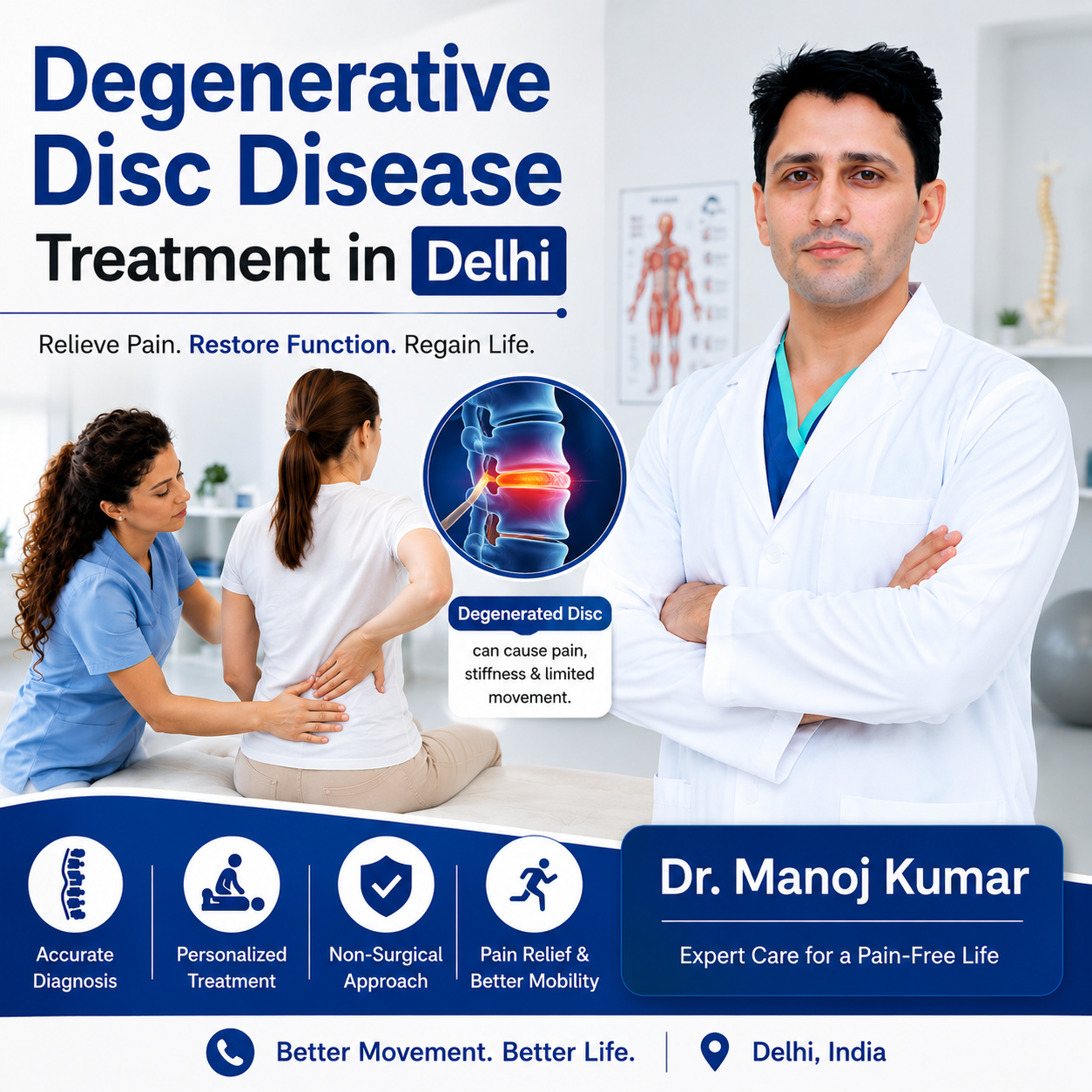
Degenerative disc disease (DDD) is not a disease in the traditional sense, it is a condition that describes the natural wear and breakdown of the intervertebral discs in your spine. These discs are the soft, cushion-like structures that sit between each vertebra. They absorb shock, allow movement, and maintain the height and flexibility of your spine.
These discs lose water content, thin out, and crack or bulge with time, which might be caused by injury, posture, or genetics. When this happens, the disc is no longer able to properly cushion the vertebrae. Related to DDD, discomfort, stiffness, and movement issues are caused by the consequent friction, inflammation, and nerve compression.
Degenerative disc disease can affect any section of the spine, however it is most typically found in the lumbar and cervical spines. When it occurs in the lower back, it is known as lumbar degenerative disc disease. When it affects the neck, it is referred to as cervical degenerative disc disease.
Common Symptoms of Degenerative Disc Disease
Symptoms vary depending on which part of the spine is affected and how advanced the degeneration is. Common signs include:
- Chronic or intermittent lower back pain worsens with sitting, bending, or lifting.
- Neck pain, stiffness, and headaches.
- Radiating pain down the arms or legs (sign of nerve compression).
- Sciatica is a severe, searing pain that spreads from the lower back to the buttocks and into the leg.
- Numbness or tingling in the hands or feet.
- Muscle weakness in the arms and legs.
- Pain that improves with movement but increases with extended rest or sitting.
Importantly, some people with significant disc degeneration visible on imaging have little to no pain, while others with milder degeneration experience severe symptoms. This is why a proper clinical evaluation by an experienced spine specialist is essential before beginning any treatment.
What Causes Disc Degeneration?
Several factors contribute to the breakdown of spinal discs:
- Age: The most crucial factor to consider. After the third decade of life, discs lose moisture and flexibility.
- Genetic predisposition: A family history of spinal disorders raises the risk.
- Sedentary lifestyle: Prolonged sitting, especially with poor posture, puts persistent stress on the lumbar discs.
- Repetitive physical strain: Jobs or hobbies that require heavy lifting, bending, or twisting can accelerate disc damage.
- Previous spinal injuries: Trauma from accidents or sports injuries can trigger or hasten deterioration.
- Obesity: Carrying excess weight puts undue tension on the lower back.
- Smoking: Decreases blood flow and oxygen to the disc tissue, hastening degeneration.
Understanding your individual risk factors helps guide the most effective treatment and prevention strategy.
Can Degenerative Disc Disease Be Cured?
Direct answer: Degenerative disc disease cannot be fully reversed, the structural changes to disc tissue are permanent. However, the pain and functional limitations caused by DDD can be effectively managed, reduced, and in many cases resolved with the right treatment. Most patients achieve excellent quality of life with non-surgical or minimally invasive care.
This is one of the most critical distinctions to recognise before starting treatment. The purpose is not to restore the disc to its original youthful state, as contemporary medicine cannot do so. The goal is to ease nerve compression, reduce inflammation, stabilise the spine, strengthen supporting muscles, and allow you to live without major pain or handicap.
Many patients who are first informed they may require surgery receive long-term relief with physiotherapy, focused exercises, lifestyle modifications, and minimally invasive procedures. Surgery is reserved for cases where conservative treatment has failed or if neurological function is threatened.
So while a complete anatomical cure is not yet possible, degenerative disc disease is highly treatable, and the majority of patients who receive structured, evidence-based care in Delhi report a dramatic improvement in their daily lives.
How Is Degenerative Disc Disease Diagnosed?
An accurate diagnosis requires more than an X-ray. At a dedicated spine care centre in Delhi NCR, the diagnostic process typically includes:
- Complete clinical history, including pain pattern, duration, aggravating and relieving factors, occupation, and lifestyle.
- Evaluate your reflexes, muscle strength, sensitivity, and range of motion.
- MRI is the gold standard for imaging disc degeneration, herniation, nerve compression, and spinal canal anomalies.
- X-ray or CT scan: Useful for tracking bone changes, disc height loss, and spinal alignment.
- Nerve conduction tests (NCS/EMG) are used when nerve damage is suspected.
Based on these findings, Dr. Manoj Kumar develops a graded treatment plan that matches the severity and location of your condition, avoiding unnecessary surgery while ensuring that patients who need intervention receive it promptly.
Degenerative Disc Disease Treatment in Delhi
Treatment for degenerative disc disease in Delhi has advanced significantly over the past decade. Patients now have access to a full spectrum of care, from conservative therapies to world-class minimally invasive and surgical options, without needing to travel abroad.
Non-Surgical Treatments
Non-surgical treatment is the initial and frequently only option for the vast majority of patients.
Anti-inflammatory medicines (NSAIDs), muscle relaxants, and neuropathic pain treatments (e.g., pregabalin or duloxetine) are routinely used to treat acute pain and inflammation. These are not long-term remedies, but they do help to open up a window for effective rehabilitation.
Physiotherapy: and Spinal Rehabilitation: Structured physiotherapy is the foundation of non-surgical DDD management. A spine physiotherapist creates a program that incorporates core strengthening exercises, posture correction, manual treatment, and flexibility training. This relieves pressure on damaged discs, better supports the spine, and can significantly reduce or eliminate chronic pain over weeks to months.
Spine rehabilitation programmes in Delhi NCR are now highly structured, with patient-specific protocols based on MRI findings and functional assessments.
Lifestyle modifications: Ergonomic modifications at home and at work, weight control, quitting smoking, and dietary changes all help to decrease disc degeneration and reduce symptoms. Patients who make lifestyle modifications in addition to receiving therapeutic therapy consistently report improved outcomes.
Low-impact workouts like walking, swimming, and yoga serve to keep discs hydrated (by the pumping mechanism of movement), strengthen paraspinal muscles, and keep them flexible. During the recuperation process, high-impact activities and heavy lifting are reduced or avoided.
Pain Management Procedures: For patients with severe or persistent pain who are not yet candidates for surgery, interventional pain management offers targeted relief. Options include epidural steroid injections, facet joint injections, and nerve root blocks. These procedures are image-guided for precision and provide relief that allows patients to engage more effectively with physiotherapy.
Advanced Lumbar Disc Treatment in Delhi
For lumbar degenerative disc disease, the most common form, advanced lumbar disc treatment in Delhi now includes:
- Intradiscal therapies: Procedures that target the disc itself to decrease pain signals and promote healing.
- Platelet-Rich Plasma (PRP) injections: Emerging therapies that use the patient’s own growth factors to support disc tissue.
- Radiofrequency ablation (RFA): It is a minimally invasive therapy that stops pain impulses from damaged nerves.
These advanced options are particularly useful for patients who have not responded adequately to standard physiotherapy and medication but wish to avoid surgery.
Minimally Invasive Spine Procedures
Minimally invasive spinal surgery (MISS) is a significant advancement in spine care. Unlike open surgery, these procedures use small incisions, specialised devices, and intraoperative imaging to produce the same or better results with substantially less stress to the surrounding tissue.
Key benefits of minimally invasive spine procedures include:
- little incisions (typically less than 2 cm).
- Significantly less blood loss.
- Lower chance of infection.
- A shorter hospital stay (typically 1-2 days).
- Quicker return to normal activities.
- Reduced post-operative pain.
Procedures available in Delhi include endoscopic spine surgery, percutaneous disc decompression, and minimally invasive spinal fusion.
Surgical Treatment Options
Surgery is considered when conservative treatment has been tried for at least 6–12 weeks without adequate relief, or when there is evidence of progressive neurological deficit such as worsening weakness, loss of bladder or bowel control, or severe functional impairment.
Microdiscectomy: A precise surgical procedure that involves removing a portion of a herniated disc that is pressing on the nerve. It is performed using microscopic guidance and has a high success rate for radiculopathy (nerve pain in the arm or leg) with a quick recovery.
Endoscopic Spine Surgery: The most advanced and least intrusive type of disc surgery. Using an endoscope and specialised instruments, the surgeon removes disc debris or bone spurs that are compressing nerves through a very small incision. Patients are usually discharged on the same day or within 24 hours.
Artificial Disc Replacement: Rather than fusing two vertebrae, a deteriorating disc is replaced with an artificial implant that allows for normal spinal movement. This is particularly relevant for younger, more active patients with cervical and lumbar disc degeneration.
Spinal Fusion: When disc degeneration causes substantial instability or spondylolisthesis, fusing two or more vertebrae eliminates the painful motion in that segment. Modern fusion therapies that use less invasive procedures produce better results and recover faster than traditional open fusion.
When Should You Consult a Spine Specialist?
Do not wait until the pain becomes unbearable. Seek a consultation with a spine doctor in Delhi if you experience:
- Back or neck pain that lasts longer than 4-6 weeks
- Pain extending into the arms and legs
- Limb numbness or tingling.
- Muscle weakness in the legs or arms
- Pain that disturbs sleep or daily activities.
- Any lack of bladder or bowel control (which requires rapid emergency examination)
Early consultation allows for early intervention, and the sooner a structured treatment plan begins, the better your long-term outcomes.
Why Patients Choose Dr. Manoj Kumar for Degenerative Disc Disease Treatment
Patients from across Delhi NCR, including Noida, Gurgaon, Faridabad, and Ghaziabad, seek Dr. Manoj Kumar’s expertise for degenerative disc disease, slip disc, spondylitis, and complex spine conditions. Here is what sets his practice apart:
- Comprehensive evaluation: Before any therapy recommendations are made, each patient is given a complete clinical and imaging evaluation.
- Non-surgical first approach: Dr. Manoj Kumar believes in pursuing all effective conservative treatments before suggesting surgery.
- Access to advanced techniques: Patients can choose from endoscopic spine surgery to artificial disc replacement.
- Patient education: Every appointment aims to help patients understand their illness, options, and realistic outcomes so that they can make fully informed decisions.
- Multidisciplinary care: Treatment strategies combine spinal surgery knowledge with physiotherapy, pain management, and rehabilitation to address the disease thoroughly.
- Experience with cervical and lumbar disease: Whether your DDD affects the neck or the lower back, Dr Manoj Kumar’s knowledge extends equally to both regions.
Patients dealing with chronic back pain, sciatica, herniated disc, slip disc, or spondylitis in Delhi consistently find that an accurate diagnosis and a personalised plan makes a significant difference to their recovery.
Degenerative Disc Disease Treatment Cost in Delhi
Treatment costs in Delhi vary significantly depending on the severity of the condition, the type of treatment required, and the facility chosen. The following is a general reference:
|
Treatment Type |
Approximate Cost Range (INR) |
|
Initial consultation |
₹500 – ₹1,500 |
|
MRI spine (one region) |
₹3,000 – ₹8,000 |
|
Physiotherapy (per session) |
₹500 – ₹1,500 |
|
Epidural steroid injection |
₹8,000 – ₹25,000 |
|
Endoscopic spine surgery |
₹1,50,000 – ₹3,50,000 |
|
Microdiscectomy |
₹1,20,000 – ₹2,50,000 |
|
Artificial disc replacement |
₹2,50,000 – ₹5,00,000 |
|
Spinal fusion (minimally invasive) |
₹2,00,000 – ₹4,50,000 |
Note: These are rough ranges. The actual cost is determined by your unique condition, the hospital or clinic location, implant options, and insurance coverage. Following the examination, a thorough cost estimate is presented in consultation.
Most therapies for degenerative disc disease, particularly non-surgical approaches, are substantially less expensive in Delhi than in Western countries, making it an attractive destination for patients looking for high-quality spine care at a fraction of international pricing.
Recovery and Long-Term Spine Care
Recovery timelines vary with treatment type. For non-surgical sufferers, meaningful improvement is typically seen within 6–12 weeks of a routine physical therapy rehabilitation program. For those whose current procedures are minimally invasive strategies, many move to desk work within 1–2 weeks and further physical leisure within 4–6 weeks
Long-term spine health after treatment requires:
- Consistent exercise: Make core strength, flexibility, and low-impact aerobic activity a permanent part of your regimen.
- Ergonomic awareness: Workstation design, lifting movements, and sleep posture all have an effect on spinal stress over time.
- Weight management: Maintaining a healthy body weight decreases the strain on the lumbar discs.
- Regular follow-up: A periodic evaluation with your spine specialist allows you to detect any abnormalities that need to be addressed early on.
- Avoiding smoking: Critical for long-term disc and bone health.
The goal of long-term spine care is not just absence of pain, it is the restoration of full function, confidence in physical activity, and the prevention of future deterioration.
Frequently Asked Questions (FAQs)
Can degenerative disc disease heal naturally?
Mild disc degeneration can stabilise and become asymptomatic with the right lifestyle changes and exercise. However, the structural disc changes do not reverse naturally. The aim of treatment is to manage symptoms, restore function, and prevent further deterioration, most patients achieve this without surgery.
Is surgery always necessary for degenerative disc disease?
No. The majority of patients, over 80%, find adequate relief through non-surgical treatments including physiotherapy, medications, lifestyle changes, and interventional procedures. Surgery is considered only when conservative treatment fails or neurological function is at risk.
How long does treatment for degenerative disc disease take?
Non-surgical treatment typically shows meaningful improvement in 6–12 weeks. Complete rehabilitation may take 3–6 months. Minimally invasive surgical patients often return to daily activities within 2–4 weeks. Recovery time varies based on severity and the individual's commitment to rehabilitation.
Which exercises help degenerative disc disease?
Low-impact exercises including walking, swimming, yoga, and targeted core strengthening (McKenzie exercises, bird-dog, pelvic tilts) are highly beneficial. These should be guided by a physiotherapist familiar with your specific MRI findings to avoid aggravating the condition.
What is the cost of degenerative disc disease treatment in Delhi?
Non-surgical treatment (physiotherapy and medications) may cost ₹5,000–₹30,000 over a course of treatment. Minimally invasive procedures range from ₹1,50,000 to ₹3,50,000. Surgical options range higher. Costs vary by institution and treatment complexity. Detailed estimates are provided after consultation.
Can I avoid surgery for degenerative disc disease?
Most patients can. A structured non-surgical programme, committed to consistently for 3–6 months, resolves symptoms in the majority of cases. However, patients with progressive neurological deficits or severe functional impairment may need earlier surgical consideration. Your spine specialist will advise based on your specific case.
Which doctor is best for degenerative disc disease in Delhi?
A spine surgeon or spine specialist with expertise in both non-surgical and surgical management of spinal disorders is the most appropriate doctor for degenerative disc disease. Look for a specialist who evaluates you thoroughly before recommending any procedure, has experience with both conservative and advanced treatments, and operates within a multidisciplinary care framework.
Is degenerative disc disease permanent?
The structural changes to discs are permanent. However, the symptoms, pain, stiffness, nerve irritation, are highly treatable. Many patients with significant disc degeneration visible on MRI become fully asymptomatic with appropriate treatment. Permanence of the condition does not mean permanence of pain or disability.
What is the success rate of treatment for degenerative disc disease?
Non-surgical treatment relieves symptoms in approximately 80–90% of patients with appropriate commitment to rehabilitation. Minimally invasive procedures have high success rates in carefully selected patients. Endoscopic spine surgery carries success rates of 85–95% for radiculopathy caused by disc herniation. Your surgeon will discuss realistic outcomes based on your specific findings.
Can physiotherapy help degenerative disc disease?
Yes, physiotherapy is one of the most effective treatments for DDD. A supervised programme of core strengthening, postural correction, manual therapy, and flexibility training reduces spinal loading, decreases nerve irritation, and significantly improves function and pain levels in the majority of patients.
What is the difference between slip disc and degenerative disc disease?
Degenerative disc disease refers to the overall aging and breakdown of a spinal disc. A slip disc (herniated or prolapsed disc) occurs when the inner nucleus of the disc bulges or ruptures outward, often as a consequence of degeneration. They are related conditions, DDD often precedes or causes disc herniation.
Is cervical degenerative disc disease different from lumbar DDD?
Cervical DDD affects the neck and can cause neck pain, headaches, and symptoms radiating into the arms. Lumbar DDD affects the lower back and can cause back pain and sciatica. Both share similar underlying mechanisms but are managed with region-specific approaches. A cervical disc treatment doctor in Delhi will tailor the plan to your cervical spine findings.
How do I know if my back pain is from degenerative disc disease?
Characteristic features include chronic or recurrent lower back or neck pain, pain that worsens with sitting or bending, and improvement with movement. Confirmation requires an MRI scan and clinical assessment. Not all back pain is from DDD, accurate diagnosis is essential before beginning treatment.
Can young people get degenerative disc disease?
Yes. While DDD is most common in adults over 40, younger adults, particularly those with heavy physical jobs, obesity, a history of spine injury, or a genetic predisposition, can develop significant disc degeneration in their 20s or 30s.
Is degenerative disc disease the same as spondylitis?
No, but they are related. Spondylitis (spondylosis) refers to the degenerative changes in the vertebrae and facet joints that accompany disc degeneration. A best spondylitis doctor in Delhi NCR will evaluate both disc and joint changes together, as they commonly co-exist and require integrated management.
Conclusion
Degenerative disc degeneration is a common and readily treatable spine condition in the Delhi-NCR region. While structural disc abnormalities cannot be totally healed, DDD’s discomfort, functional limitations, and impact on quality of life can be managed with caution.
Whether you have chronic lower back pain, sciatica, cervical disc difficulties, or a freshly diagnosed slipped disc, the first step is to act quickly. Delhi provides a whole spectrum of care, from professional physiotherapy and targeted injections to endoscopic spine surgery and disc replacement, all provided by expert spine doctors who promote non-surgical, patient-centred care.
If you’ve been experiencing back or neck pain and are unsure of your options, the next step is the perfect session. Accurate analysis is essential for effective treatment.
Dr Manoj Kumar, a spine specialist in Delhi, can provide you with a unique diagnostic and treatment plan that is suited to your specific problem.