
Recovery After Robotic Spine Surgery — A Week-by-Week Guide From a Surgeon Who Does This Every Day
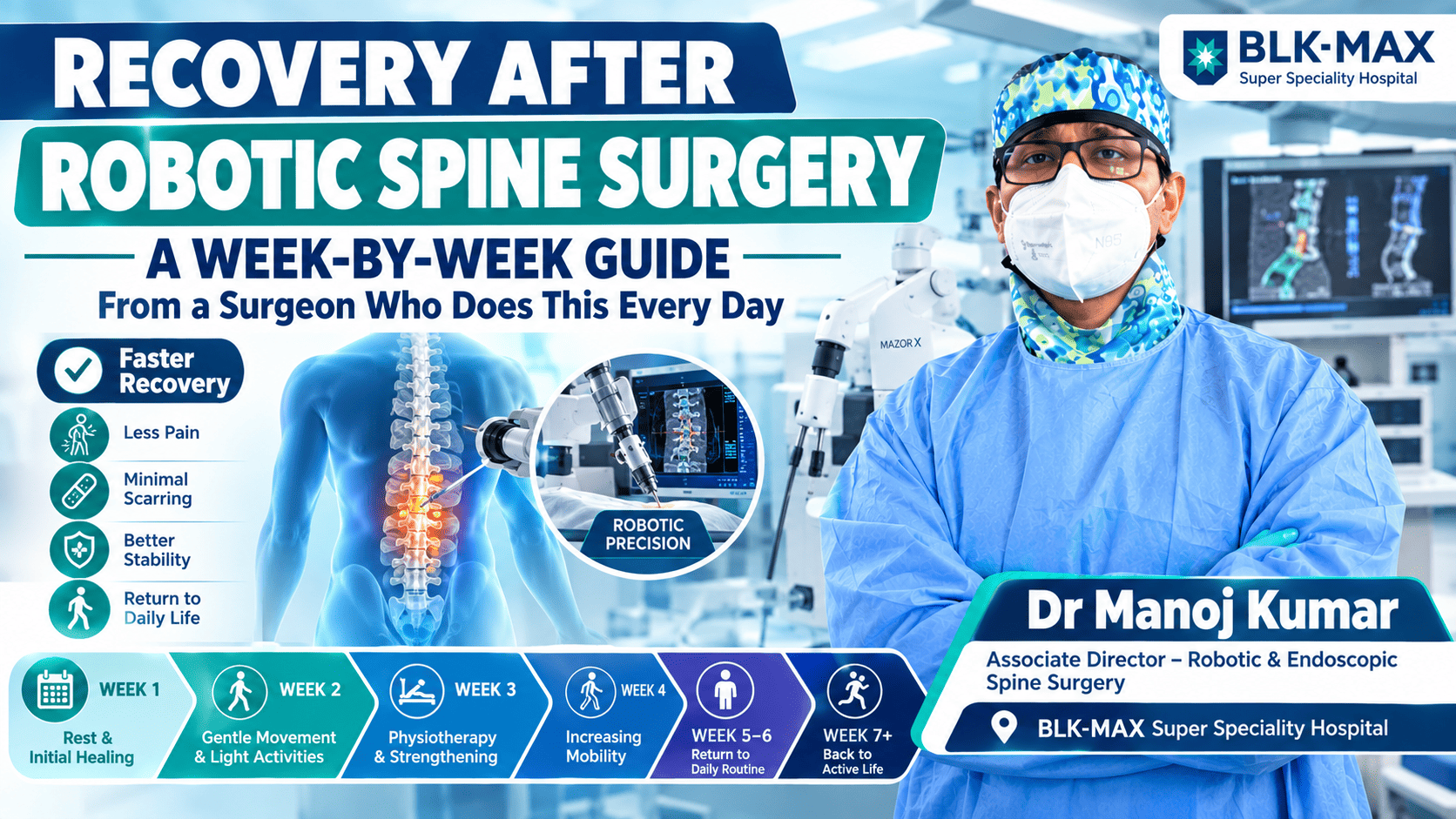
By Dr Manoj Kumar | Associate Director – Robotic & Minimally Invasive Spine Surgery, BLK-MAX Super Speciality Hospital, New Delhi
Last Tuesday, a patient sat in front of me three months after his robotic spine fusion and said something I have heard in some version dozens of times.
“Doctor, nobody told me recovery would feel like this.”
He has nothing negative to say about the surgery. His fusion was developing as it should. His sciatica, which had caused walking to his car to seem like an endurance test, had subsided. However, he had only a vague understanding of what the surgery would entail going into it, and he had virtually no idea how the days and weeks that followed would truly feel.
He had anticipated a straight line. In actuality, recovery flows more like a river, mostly forward, sometimes slower, and sometimes seemingly pausing before picking up speed again. The youngest or healthiest patients are not usually the ones who handle it the best. They knew in advance what to expect at each stage, so when the unexpected arrived, they weren’t frightened by it.
This is that guide. Written not from a textbook but from twelve years of watching patients go through this exact recovery, the ones who did it well and the ones who found it harder than it needed to be.
The Thing Most Patients Get Wrong Before Recovery Even Starts
Before we get into the week-by-week timeline, there is one thing I believe is more essential than any milestone or activity restriction, and it is something I wish every patient knew before their robotic spine surgery, rather than three months later.
Robotic spine surgery employs a highly precise guidance system to install the pedicle screws that secure the fusion construct. The robot’s task is completed when the final screw is inserted, and the wound is closed. Everything that follows, including the actual fusion of the vertebrae into a single stable unit, is solely controlled by the body.
Bone fusion is a biological opportunity. It runs on its own schedule, which prevents any doctor, any robot, or any patient from growing meaningfully. Minimum timeline for firm fusion after cutting instrumented surgery is three–6 months for initial consolidation and 9–three hundred and sixty-five days for complete maturation. In this biological window, patient work is special: shield the connection enough to bridge bone throughout it. They don’t go.
Too much restriction and the muscles waste. Too much activity and the screws are placed under forces the healing bone cannot yet support. The week-by-week recovery plan is the calibration of this balance, and it is not an arbitrary schedule. Every restriction and every milestone has a biological reason behind it.
Following the strategy is much simpler when you know why. To put it simply, during the first six to eight weeks, the screws hold the vertebrae together, but the bone does not. Metal is necessary for the construct. Any force applied to the operated level during this phase, such as rotational force, excessive flexion load, or compressive impact, is applied directly to the implants rather than the bone. This can be tolerated by the implants. However, people ultimately relax if they put up with it on a daily basis. Failure to fuse is indicated by a loose screw. Revision surgery is necessary if fusion fails.
This is why the brace exists. This is why the sitting restriction exists. This is why there is a specific walking prescription rather than a general instruction to “be active.” Every guideline in this recovery plan is protecting the window within which bone will grow, if the patient gives it the chance.
The Hours Before Recovery Begins
Recovery does not begin on the morning of discharge. It begins on the operating table.
When the robotic fusion is complete, typically 2 to three hours after the first incision, the patient is transferred to the recovery region. The anesthesia team monitors for vital signs and symptoms. The surgical team assesses the primary neurological reflex: Can the patient feel the examiner touch each of the toes? Can you bend your ankles against resistance? These assessments are not formalities. They are the baseline in opposition to which each subsequent assessment will be compared.
Within the first two hours, most patients are alert enough to hold a conversation. Patients who had the procedure under spinal anaesthesia are frequently entirely lucid, asking their family members to bring tea, wondering aloud how much longer before they can go back to the ward room.
In contrast to the nerve pain they had prior to surgery, patients in the healing area experience a deep, dull ache at the back. There is a strong, electric, radiating quality to nerve pain. The pain experienced after surgery is more akin to the soreness, heaviness, and localization of a major workout. The distinction is important because patients who confuse the two may come to the conclusion that the surgery was unsuccessful in the initial hours following the procedure. It has worked most of the time. The nerve discomfort has either completely disappeared or significantly decreased. All that’s left is typical tissue repair.
The First 24 to 48 Hours — In Hospital
The moment that resets every patient’s expectations about robotic spine surgery, without exception, is the first time they are asked to stand up.
This happens between 18 and 24 hours after surgery. A physiotherapist enters the room, introduces herself, and says it is time.
Most patients react with some version of: “Already?”
Already.
The initial operative protocol after robotic fusion surgery is not always a consolation measure. The studies behind it are long older and quite consistent: Victims who stand and walk within 24 hours of lumbar fusion surgery have less postoperative headache value, less medical institution stay, better early fusion indicators, and, contrary to every intuition, less pain in bed on the third day. You are allowed to stay
The first sustainable effort is supervised and careful. The body or the physical therapist’s arm provides a guide. The affected person may be up for ninety seconds before sitting back down. In ninety-one seconds there are two things that count very much. The patient discovers that the condition no longer causes the devastating pain they feared. And the spine reaches its first load-bearing mark after surgery, a mark that, at the cellular stage, begins to affect the initial segment of bone restoration.
By Day 2, most patients are walking to the bathroom independently. By Day 3, they are making short trips down the corridor. These are not dramatic distances. They are biological necessities.
Most patients are discharged between Day 2 and Day 4, depending on the degree of fusion, the patient’s age and medical history, and the particular standards the surgical team applies. The patient is examined by the physiotherapist before being discharged from the hospital, given written guidance for at-home exercises, fitted with a brace if not already, and given a date for a follow-up session. The ward stay concludes. The real healing process starts, which is a drawn-out, patient, and silent process.
Week 1 — The Week of Small Distances and Large Adjustments
The robot is exceptional in the first week of domestic life after spinal surgery, which is hard to explain to someone who didn’t do it well. The affected person is not always in the form of pain they fear. But they’re nowhere near normal right now. The hole between those things, between “no longer as I conceptualize” and “not anywhere near where I want to be,” is where the first week inhabits.
The chosen regimen of walking in the first week is: ten to fifteen minutes, on a flat floor, three to 4 instances per day. Not a park walk. Not the buying experience. A deliberate, measured circuit of a residence or building, wearing a brace, at a pace that feels cautious instead of reassuring. The reason is threefold: to reduce limb circulation to prevent clot formation, to keep rapid deconditioning of hip and calf muscle tissues beginning within seventy-two hours of inactivity, and to offer spinal recovery build with gentle axial loading that stimulates early bone-reset alerts.
Sitting is limited to twenty minutes at a stretch in the first week. This is the restriction that most professional patients struggle with most; they feel well enough to sit at their desk and respond to emails, and they see no reason why sitting should be a problem. The reason is biomechanical and specific: the intradiscal pressure in the lumbar spine in the seated position is significantly higher than in standing or walking. For a lumbar fusion construct that is currently being held together by metal screws with no bone support, repeated prolonged sitting applies compressive and shear loads at the operated level throughout the day. These loads are within the tolerance of the implants individually. Accumulated over eight hours of seated work, they are not.
Sleep is on the side with a pillow between the knees, or on the back with a pillow under both knees. The prone position, face down, places torsional stress on the lumbar fusion that serves no recovery purpose and is avoided until the surgeon specifically clears it, which is typically not until after Week 6.
Pain management in Week 1 involves oral medications, typically a combination of a mild opioid for the first few days, an anti-inflammatory where medically appropriate, and a nerve pain medication if residual radicular symptoms are present. The goal is comfort adequate for the walking prescription, not comfort adequate for a return to full activity. If medications are not achieving this and the patient is taking doses at the maximum frequency, the surgeon needs to know, not at the next appointment, but now.
Week 2 — The First Evidence of a Direction
Something shifts in the second week that patients describe, almost universally, as the moment recovery begins to feel real rather than theoretical.
Acute light-operative irritation begins to evolve into something that stays. The background pain on the moving stage that has become a constant companion in the first week will be interrupted. There are hours, then half days, when the affected person only knows about the surgery in case they go through the chosen way. Residual nerve marks, tingling, and altered sensation areas inside the foot that are everyday features of nerve recovery begin to behave more consistently and much less alarmingly
The first follow-up appointment is at week 2, typically between 10 and 14 days after the physician inspects the incisions; Minimally invasive robotic approaches with two or three small insertion points often treat cleanly with this method. Neurologic assessment compares contemporary images with a preoperative baseline. X-rays are reviewed to confirm screw locations and initial alignment of the connection.
Walking distances increase naturally in Week 2. Twenty to thirty minutes, twice daily, becomes achievable for most patients without significant post-exertion soreness. The gait improves; the cautious, protective shuffle of Week 1 begins to evolve toward a more natural stride.
Patients doing desk or knowledge-based professional work often begin working from home in Week 2. This is appropriate with a structured approach: a properly height-adjusted workstation, a lumbar-supported chair, a timer set to go off every twenty minutes as a prompt to stand and move briefly, and a commitment to stopping the working day before fatigue sets in. Working from home in Week 2 is not a return to normal work. It is a partial return, with the recovery schedule remaining the primary commitment.
Weeks 3 and 4 — Where Biology Takes Over From Instructions
Between Weeks 2 and 4, the patient’s relationship with the recovery protocol changes. In Week 1, every guideline feels like a rule imposed from outside. By Week 3, most patients have internalised the pattern; they know without being reminded when to walk, when to rest, when to stop sitting, and how to get out of bed without loading the spine in flexion.
This internalisation is itself a recovery milestone. It means the protective behaviours have become habit rather than effort.
Most patients start formal physical therapy around weeks three or four. Patients seldom anticipate the physiotherapist’s initial session. No strenuous exercise is done. A large amount of the session is spent by the physiotherapist observing the patient, including how they walk, get in and out of chairs, and determining where compensatory movement patterns have developed over the course of weeks of post-operative protection and months of pre-operative discomfort.
Early physical activity is small and distinct. Diaphragmatic breathing; somewhat activated pelvic floor. Affected individuals are taught to load through their hips rather than their lumbar spine by short-range hip valve motions. These games focus on the deep stabilizing muscle tissues of the lumbar spine that have been deactivated, first through the application of pain and then via the protective defense of a quick recovery. This is something that patients undergoing open surgery do not lose to nearly the same extent. Carefully and gradually rekindling them serves as the catalyst for everything that comes after.
Weeks 5 and 6 — The Brace Comes Off, and the Real Work Begins
The 6-week mark is the first major structural milestone in robotic spine surgery recovery, and it typically involves a decision that most patients have been quietly anticipating since Week 1: discontinuing the brace.
Because the brace was given for six weeks, it did not come off. It is eliminated because the patient’s active muscular stabilization is now sufficient to safeguard the link during ordinary daily play, as confirmed by physiotherapist evaluation, clinical examination, and frequent follow-up X-rays. The main protective mechanism is not the brace’s external guidance.
When the brace comes off, and the patient stands and walks without it for the first time, the experience is consistently described as both liberating and slightly alarming. The spine feels exposed. This sensation is entirely normal and resolves within days as confidence builds.
Most patients start swimming during Weeks 5 or 6. In addition to easing the strain of gravity on the spine, the water setting permits upper and lower body movement and cardiovascular conditioning that land-based exercise currently cannot safely provide. The specific guidelines for post-fusion swimming are breaststroke legs and freestyle arms rather than breaststroke arms, which place a significant rotational pressure on the lumbar spine. Patients should carefully confirm this point with their physiotherapist rather than assuming that “swimming is fine” relates to any stroke in any pool.
Weeks 7 to 12 — The Recovery Patients Did Not Expect to Feel This Good
By Week 8, something has happened that patients in Week 1 were not able to imagine. They have a normal day. Not a partially normal day, not a good hour in an otherwise limited day, a full, ordinary day in which the awareness of the surgery occupies maybe ten minutes of conscious thought rather than every waking moment.
This is not complete recovery. But it is the first reliable preview of it.
Physiotherapy in this phase becomes progressively demanding. Active core stabilisation is progressing to functional strengthening. Exercises that would have been entirely inappropriate in Week 4, because they would have placed compressive and rotational load on an unsupported construct, are now appropriate because the early fusion is underway and the muscular support system has been rebuilt sufficiently to share the load intelligently.
For the majority of patients, driving is safe during this window, which is usually weeks 6–8 for single-stage fusion patients and weeks 8–10 for multilevel cases. Medical norms are distinct: total elimination of any interventions that hinder reaction speed, absence of pain that could induce convulsions, and ability to carry out routine riding tasks. This willingness is determined in a comprehensive evaluation by a physician or physiotherapist; it’s not usually self-evaluation.
In this day and age, working entirely from home is becoming more common for the majority of specialized patients who were previously receiving treatment at home.
Month 3 — The Imaging That Changes the Conversation
CT is used at the three-month mark. Of all the searches within the robotic spine surgery recovery pathway, this is the one that includes the most weight, due to the fact that miles are the primary possibility to equate direct radiological evidence of what the patient’s frame formed within months after surgery.
What CT shows at three months is not always complete fusion; Bone fusion is usually not radiologically complete at this stage. What it does show is evidence that fusion progresses normally: early trabecular bone bridging within and across the interbody cage, no evidence of screw loosening or migration, suitable alignment of construct, and no evidence of pseudoarthrosis; failed fusion to show early signs at this point, if it arises, will start
When the CT at 3 months shows normal, progressing fusion, the recovery programme advances with confidence. When it shows less bridging than expected or early signs of implant stress, the protocol is modified, not with alarm, but with adjustment. Extended brace use. More conservative loading progression. A repeat CT at 6 months.
Most patients at 3 months feel approximately 60–70% of their expected full functional capacity. They are doing considerably more than they were at Week 6. They are doing considerably less than they will be at Month 9. This gap, between where they are and where they are going, is the source of most of the frustration I encounter at 3-month follow-up appointments.
Months 4 to 6 — The Phase That Decides the Long-Term Result
The period from Month 4 to Month 6 is where the robotic spine surgery recovery either consolidates into an excellent long-term outcome or begins to show the patterns that will limit it.
Patients who have taken their rehabilitation seriously for at least four to six months—not the most vigorously or critically—are nearly always the ones whose results after two years are satisfactory. The difference is crucial. Constant physiotherapy attendance, innovative but regulated strengthening, cardiovascular conditioning that loads the machine without overtaxing the construction, and gradual, methodical re-exposure to the physical demands of a typical lifestyle are all components of critical rehabilitation at this phase.
Victims who limit their personal results to this portion are typically those who feel 70% recovered and believe that the remaining 30% will be cleared with special effort. It happens occasionally. These days, it frequently doesn’t.
Light gym work is appropriate for most patients from Month 4 onward: elliptical trainers, recumbent stationary cycling, light resistance work for the lower limbs and posterior chain. The specific movements to avoid at this stage are still axial loading through the spine, heavy squats, deadlifts, overhead pressing, and any high-impact activity. These restrictions lift progressively after the 6-month CT confirms solid fusion.
Month 6 — Confirmation
The 6-month CT is the imaging that most patients have been waiting for since the day they left the hospital. Solid fusion, confirmed by radiological evidence of continuous bone bridging across the operated level, absence of implant loosening, and maintained construct alignment, is found in approximately 94–97% of robotic fusion patients at experienced centres in Delhi NCR at this time point.
When strong fusion is demonstrated, communication between surgeon and patient inevitably adjusts. The patient does not manage the medical association. They build on a solid foundation. The rules that governed the primary 6 months are routinely lifted. The return of recreation, vigorous exercise, and physically demanding activities is planned and executed in every way based on imaging, functional assessment, and patient-specific goals
Some nerve restorations are past the 6-month mark. Patients who had significant preoperative neurological deficit, foot drop, profound leg numbness, and hand weakness should know that while nerve regeneration is slower than bone recovery, it can continue to produce meaningful, useful growth up to 18 months post-surgery. A foot can be 70% recovered in 6 months. 90% can be recovered in 12 months. This late therapy is real, documented, and understood in advance to surprise the patient in a most welcome way.
The Honest Things That Slow Recovery Down
Over twelve years of performing robotic spine surgery and watching patients through recovery, certain patterns have proven themselves reliably. Here are the honest ones — not to criticise patients who encounter them, but because knowing them in advance is more useful than discovering them during recovery.
Any type of tobacco has a clear, substantial, and detrimental impact on bone repair. Nicotine narrows the tiny blood channels that give the repairing bone the oxygen and nutrients fusion needs. This is a precise method. The fusion rates of patients who smoke are significantly lower than those of patients who do not. It is not optional to cease prior to surgery and stay stopped during the fusion time. For elective fusion surgery, it is a clinical requirement in my practice.
Returning to sitting too soon and for too long, such as spending 6-8 hours at a desk in Week 2 because the pain is bearable, is one of the most frequently detrimental early recovery errors in professional patients. The pain being controllable does not imply that the burden on the construct is reasonable.
Expecting a straight line and becoming concerned or disappointed when it is not provided is a recovery roadblock in and of itself. Anxiety increases muscular tension in the operated areas, interrupts sleep, inhibits involvement in rehabilitation, and increases pain perception. Patients who were informed ahead of time that the line was not straight and chose to trust the process rather than resist the oscillations recover with the least amount of discomfort.
Stopping physiotherapy when feeling better, usually around Week 8-10 when improvement is most noticeable, is the single most prevalent reason robotic fusion patients only accomplish 80% of their possible recovery rather than 95%. Feeling better is the point at which physiotherapy becomes most useful, if not necessary.
Recovery Milestones — Week by Week at a Glance
|
Stage |
Milestone |
|
18–24 hours post-surgery |
First standing and walking attempt |
|
Day 2–4 |
Hospital discharge |
|
Day 10–14 |
First follow-up, wound check, X-ray review |
|
Week 2–3 |
Work from home begins (desk-based) |
|
Week 3–4 |
Formal physiotherapy starts |
|
Week 4–6 |
Driving cleared (single level) |
|
Week 5–6 |
Swimming introduced |
|
Week 6–8 |
Brace discontinued |
|
Week 6–10 |
Return to office |
|
Week 8–10 |
Driving cleared (multi-level) |
|
Month 3 |
CT scan — fusion progress assessment |
|
Month 4–5 |
Light gym work begins |
|
Month 4–6 |
Return to physical work (case by case) |
|
Month 6 |
CT scan — solid fusion confirmation |
|
Month 6–9 |
Return to sport and vigorous exercise |
|
Month 9–12 |
Complete recovery for most patients |
Frequently Asked Questions
How long does recovery take after robotic spine surgery?
Complete recovery, including confirmed bone fusion on CT and return to all physical activities, takes 9–12 months for most patients. The functional recovery that allows return to normal daily life and desk work is typically achieved by Month 3–4. Bone fusion is a biological process that cannot be shortened by any means, surgical or otherwise.
When can I walk normally after robotic spine surgery?
The first walking attempt happens within 18–24 hours of surgery. Walking with a brace over short distances is established in Week 1. Walking without a brace, over longer distances, with a natural gait, is typically restored by Week 6–8 after the brace is discontinued.
When can I drive after robotic spine surgery?
Driving requires specific clearance from the surgeon or physiotherapist; it is not a self-assessed decision. Single-level fusion patients are typically cleared at Week 4–6. Multi-level fusion patients are typically cleared at Week 8–10. Clearance requires that the patient is off all reaction-impairing medications and can perform an emergency stop without pain or hesitation.
How long must I wear the brace after robotic spine surgery?
The brace is worn during all upright activity, walking, standing, and any household movement for 6–8 weeks. Multi-level fusion patients and patients with low bone density may wear it for 10–12 weeks. The timing of brace discontinuation is confirmed by the surgeon or physiotherapist at a formal assessment, not determined by the patient independently.
When is bone fusion confirmed after robotic spine surgery?
A CT scan at 3 months assesses early fusion progress. Solid fusion is confirmed on CT at 6 months in approximately 94–97% of robotic fusion patients at experienced centres in Delhi NCR. Complete maturation of the fusion continues for up to 12–18 months post-surgery.
When can I return to work after robotic spine surgery?
Knowledge-based and desk work from home: typically Week 2–3. In-office desk work: typically Week 6–10. Physically demanding work, construction, heavy lifting, manual labour: Month 4–6, subject to CT fusion findings and physiotherapy clearance. These are general guides; the specific timeline for any individual patient is confirmed by their surgeon.
Can I sleep normally after robotic spine surgery?
Most patients sleep on their side with a pillow between the knees or on their back with a pillow under both knees. The prone sleeping position is avoided for 6–8 weeks. Sleep quality progressively improves through recovery as post-operative discomfort settles and the nerve pain that previously disturbed sleep is resolved.
What is the success rate of robotic spine surgery in Delhi NCR?
At experienced centres in Delhi NCR, 88–95% of patients achieve significant pain relief and functional improvement at one year. Confirmed solid fusion on CT at 6 months is achieved in 94–97% of cases. Revision surgery within 5 years is required in approximately 2–4% of patients, significantly lower than the 6–12% revision rate seen with traditional freehand fusion surgery.
The patients who recover best from robotic spine surgery are the ones who understood the recovery before they agreed to the surgery. If you are considering robotic spine surgery in Delhi NCR for spondylolisthesis, degenerative disc disease, spinal stenosis with instability, or revision of a previous spine procedure, the conversation you need is not just about the surgery. It is about what comes after.
Dr Manoj Kumar is a senior spine surgeon at BLK Max Hospital, Delhi NCR, with extensive experience in robotic spine surgery and minimally invasive spinal fusion. Every patient who undergoes surgery in his care leaves the pre-operative consultation with a specific, individualised recovery plan, because surgery without a clear recovery plan is an incomplete plan.
Book your consultation:
- Website: bestspinesurgeonindelhincr.com
- Available at: BLK Max Hospital, Delhi NCR
Written for patient education by Dr. Manoj Kumar, Senior Spine Surgeon, Delhi NCR. This article shares clinical experience and general guidance; it is not a substitute for an individualised assessment and recovery plan from a qualified spine surgeon.