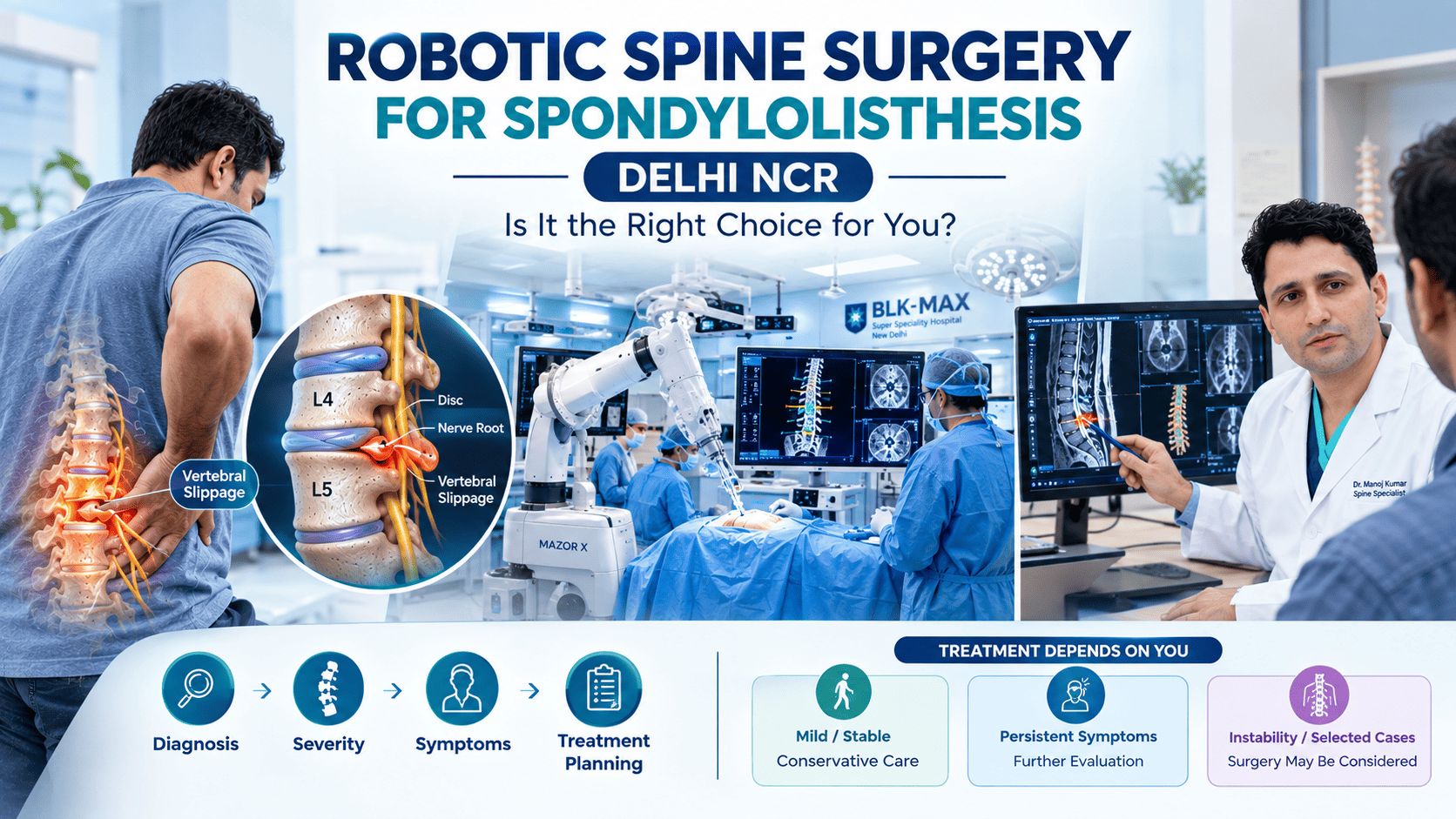
Robotic Spine Surgery for Spondylolisthesis in Delhi NCR - Is It the Right Choice for You?
By Dr Manoj Kumar | Associate Director – Robotic & Minimally Invasive Spine Surgery, BLK-MAX Super Speciality Hospital, New Delhi
Spondylolisthesis is one of the most common and most misunderstood causes of chronic lower back pain and leg pain in adults. If your MRI report has the word “spondylolisthesis” on it and your doctor has mentioned surgery, you are likely asking one very specific question right now:
“Is robotic spine surgery for spondylolisthesis the right choice, or is traditional surgery good enough?”
The simple answer is that for the vast majority of patients in Delhi NCR who have Grade 1 or Grade 2 spondylolisthesis and require surgical correction, robotic spine surgery is not only a decent option, but the superior one. It achieves much higher screw placement accuracy, reduced revision rates, faster recovery, and significantly less surgical trauma than normal open surgery for the same problem.
However, the fuller answer requires an awareness of what spondylolisthesis is, what surgery entails, and, most importantly, if you are a viable candidate for the robotic procedure. That is the goal of this article.
What Is Spondylolisthesis? (Understanding Your Diagnosis)
Spondylolisthesis is a spinal condition in which one vertebra slips forward over the vertebra directly below it. The word comes from the Greek, spondylos meaning vertebra and olisthesis meaning slippage.
This slippage narrows the spinal canal and the openings through which nerve roots exit the spine. The result is compression of the spinal cord or nerve roots, which causes the symptoms most patients experience: lower back pain, leg pain (sciatica), leg weakness, numbness or tingling in the legs, and in severe cases, difficulty walking or loss of bladder and bowel control.
Grades of Spondylolisthesis — Why It Matters for Treatment
Spondylolisthesis is classified into five grades based on how far the vertebra has slipped:
|
Grade |
Slippage |
Typical Treatment |
|
Grade 1 |
0–25% |
Conservative first; surgery if failed |
|
Grade 2 |
25–50% |
Surgery usually recommended |
|
Grade 3 |
50–75% |
Surgery required; complex approach |
|
Grade 4 |
75–100% |
Surgery required; high complexity |
|
Grade 5 (Spondyloptosis) |
Complete slippage |
Major reconstructive surgery |
The majority of patients presenting to spine clinics in Delhi NCR have Grade 1 or Grade 2 spondylolisthesis. These are the grades where robotic spine surgery delivers its clearest and most consistent advantages.
Types of Spondylolisthesis
Degenerative spondylolisthesis – the most common type, occurring due to age-related wear of the spinal joints and discs. Most common at the L4-L5 level. Predominantly affects patients above 50 years of age.
Isthmic spondylolisthesis – caused by a stress fracture in a small bony bridge connecting the joints at the back of the vertebra (the pars interarticularis). More common in younger patients and at the L5-S1 level.
Traumatic spondylolisthesis – caused by acute injury to the spine.
Post-surgical spondylolisthesis – vertebral slippage developing after a previous spine surgery.
When Is Surgery Needed for Spondylolisthesis?
Not every patient with spondylolisthesis needs surgery. The majority of Grade 1 patients can be managed successfully with a structured conservative programme, physiotherapy, core strengthening, activity modification, pain management, and in some cases, epidural steroid injections.
Surgery becomes the right recommendation when:
- Conservative treatment has been tried sincerely for 3–6 months without adequate pain relief
- Neurological symptoms are present, weakness, numbness, or difficulty walking that is worsening
- The grade of slip is Grade 2 or above
- There is progressive slippage confirmed on serial imaging
- Quality of life is severely impacted despite optimal non-surgical management
- Bladder or bowel involvement is present (this is a surgical emergency)
If you meet any of these criteria, the next conversation is not whether to have surgery; it is which type of surgery is best for your specific anatomy and condition.
What Surgery Is Performed for Spondylolisthesis? Understanding Spinal Fusion
The standard surgical treatment for spondylolisthesis is spinal fusion, a procedure in which the slipped vertebra is stabilised and fused to the vertebra below it using pedicle screws, connecting rods, and a bone graft or interbody cage. Once fused, the two vertebrae heal into a single solid unit, eliminating the instability and nerve compression caused by the slip.
The most commonly performed fusion procedure for spondylolisthesis in Delhi NCR is TLIF, Transforaminal Lumbar Interbody Fusion, which can be performed as either:
- Traditional open TLIF (large incision, extensive muscle retraction)
- Minimally invasive TLIF (small incisions, tubular retractors)
- Robotic-assisted minimally invasive TLIF (the most precise and least invasive approach available today)
Robotic Spine Surgery for Spondylolisthesis - How It Works
In robotic-assisted spinal fusion for spondylolisthesis, the surgical plan is created before the patient enters the operating theatre. Using a pre-operative CT scan of the spine, the robotic system creates a 3D digital model of the patient’s specific vertebral anatomy.
The surgeon plans the precise entry point, trajectory, depth, and size of every pedicle screw on this 3D model before a single incision is made. In the operating room, the robotic arm holds the surgical drill guide in the exact planned position, allowing the surgeon to place each screw along the precisely pre-planned trajectory.
The result is screw placement accuracy of 97–99%, compared to 85–92% with freehand traditional surgery.
For spondylolisthesis patients specifically, this accuracy matters more than in almost any other spinal condition, because slipped vertebrae have distorted anatomy. The pedicle positions are shifted from their normal location, making freehand screw placement significantly more challenging and risky.
Spondylolisthesis is, in many ways, the condition that robotic spine surgery was built for:
- More precision is required when working with deformed anatomy. When a vertebra slips, the surrounding anatomy is no longer in its proper position. Bony landmarks utilized by surgeons for freehand screw placement have been relocated, rotated, or disguised. Robotic navigation properly corrects for this distortion; the pre-operative plan is based on the patient’s actual CT anatomy rather than assumed normal landmarks.
- Confident repair is necessary to reduce slippage. Many spondylolisthesis surgeries involve reducing (correcting) the slip before fusing the vertebrae. Anchor points must be stable and appropriately set for this maneuver. A misplaced screw at this stage can fail due to reduced stress; robotic accuracy makes this operation safer and more reliable.
- Long-term reliability is vital. Spondylolisthesis surgery is a lengthy process, and fusion hardware should persist for decades, especially in younger patients. Screws with high cortical purchase (grip into the bone) are less likely to loosen, break, or require revision. Screw location is optimized for maximum long-term endurance by robotic installation.
- Older adults with osteoporosis benefit the most. Degenerative spondylolisthesis primarily affects persons between the ages of 55 and 65, and osteoporosis is a prevalent diagnosis. Screw purchase is fundamentally weaker in osteoporotic bone. Robotic guidance allows the surgeon to choose the ideal screw trajectory and size based on the CT density of the patient’s bone, maximizing grip even with low bone quality.
|
Factor |
Robotic Fusion (TLIF) |
Traditional Open Fusion |
|
Screw placement accuracy |
97–99% |
85–92% |
|
Incision size |
2–4 cm (2–3 small cuts) |
10–15 cm single incision |
|
Muscle damage |
Minimal (dilation) |
Significant (retraction) |
|
Blood loss |
100–300 ml |
400–1,000 mL |
|
Radiation to patient |
Low (pre-op CT + navigation) |
High (repeated fluoroscopy) |
|
Hospital stay |
2–4 days |
6–10 days |
|
Return to desk work |
4–6 weeks |
10–14 weeks |
|
Full recovery |
3–5 months |
8–12 months |
|
Revision surgery rate (5 yr) |
2–4% |
6–12% |
|
Suitable for osteoporosis |
Excellent |
Moderate |
|
Suitable for elderly |
Excellent |
Moderate |
|
Success rate |
88–95% |
78–88% |
At experienced robotic spine surgery centres in Delhi NCR, the success rate for robotic-assisted fusion for Grade 1 and Grade 2 spondylolisthesis, defined as significant reduction in back and leg pain, restored walking ability, and patient satisfaction at one year, is 88–95%.
Key outcome data from high-volume centres:
- Neurological recovery (improvement in leg weakness or numbness): 85–92% of patients show significant improvement within 3 months
- Pain relief (back and leg pain VAS score reduction of 50% or more): achieved in 88–94% of patients
- Return to independent ambulation: more than 95% of patients walk without assistance within 6 weeks
- Fusion rate (confirmed bone healing across the treated level at 12 months): 94–97% with robotic-assisted techniques, compared to 88–93% with traditional surgery
- Revision surgery within 5 years: 2–4% robotic vs 6–12% traditional
These outcomes reflect surgery performed by experienced robotic spine surgeons at adequately equipped centres. Results at low-volume centres or with less experienced surgeons will differ.
The cost of robotic spine surgery for spondylolisthesis in Delhi NCR depends on the grade of slip, the number of spinal levels requiring fusion, the specific implants used, the hospital facility chosen, and whether the procedure requires additional decompression.
Approximate cost guide, robotic spondylolisthesis surgery, Delhi NCR:
|
Procedure |
Approximate Cost Range |
|
Single-level robotic TLIF (Grade 1–2 spondylolisthesis) |
₹4,50,000 – ₹7,00,000 |
|
Two-level robotic fusion (L4-L5 + L5-S1) |
₹6,00,000 – ₹9,50,000 |
|
Robotic fusion with decompression (stenosis + spondylolisthesis) |
₹5,50,000 – ₹8,50,000 |
|
Revision robotic fusion (after failed previous surgery) |
₹7,00,000 – ₹12,00,000 |
Is the cost of robotic surgery for spondylolisthesis justified?
When you calculate the total cost of care over 3–5 years, factoring in the significantly lower risk of revision surgery (which itself costs ₹6–10 lakhs), shorter hospital stay, faster return to work, and less intensive post-operative physiotherapy, robotic spondylolisthesis surgery is economically comparable to or less expensive than traditional surgery for most patients.
Insurance coverage: Most group health insurance and cashless health policies in India now cover robotic spine surgery for spondylolisthesis when the procedure is medically indicated and pre-authorised. Your surgeon will provide all necessary clinical documentation for the pre-authorisation process.
Recovery after robotic fusion surgery for spondylolisthesis is structured and progressive. Here is a realistic week-by-week guide:
Days 1–3: Hospital
- A single-level treatment requires two to three hours and is carried out under general anaesthesia.
- On Day 2, a post-operative drain is usually removed.
- Under the guidance of a physiotherapist, the majority of patients sit up and take their first steps within 18 to 24 hours.
- Pain is managed with intravenous and oral medications. The majority of patients characterise their post-operative discomfort as mild and under control.
- Depending on the state of recuperation, discharge takes place on Days 2-4.
Weeks 1–3: Early Recovery at Home
- Walking is the most vital activity during the early stages of recuperation. Short, frequent walks of 10-15 minutes are advised at home beginning on the first day.
- For the first 6-8 weeks, all standing and walking require the use of a lumbar brace.
- In the first two weeks, sitting for more than 20-30 minutes at a time is strictly prohibited.
- During this time, no bending, lifting, or twisting is permitted.
- Most patients have a noticeable improvement in leg discomfort within the first 1-2 weeks as nerve swelling subsides.
Weeks 4–8: Building Strength
- Formal physiotherapy begins, supervised by a spine physiotherapist.
- Core strengthening, gentle flexibility work, and posture correction exercises are introduced progressively.
- Most desk-work patients return to professional activity at Week 4–6 with the brace.
- Driving is typically permitted from Week 6, subject to the surgeon’s assessment.
Weeks 8–16: Progressive Recovery
- Activity levels increase significantly. Patients feel 60–75% of their full expected recovery.
- Swimming and gentle yoga are introduced at Week 8–10.
- Follow-up X-rays at 8–12 weeks assess early fusion progress.
Months 4–6: Full Recovery
- The majority of patients achieve full functional recovery by Month 4–5.
- CT scan at 6 months confirms solid fusion at the treated level.
- Return to physically demanding work (manual labour, fieldwork) is assessed individually at 4–6 months.
Best candidates for robotic spondylolisthesis surgery:
- Grade 1 or Grade 2 spondylolisthesis with persistent symptoms despite 3–6 months of conservative treatment
- Patients with neurological symptoms, leg weakness, numbness, difficulty walking
- Elderly patients (above 60) with osteoporosis where screw precision is most critical
- Patients with obesity where traditional anatomical landmarks are harder to rely upon
- Patients wanting the fastest possible return to work or active life
- Revision surgery cases where previous implants or altered anatomy make freehand surgery higher risk
- Patients who want to minimise the likelihood of requiring a second surgery
Patients who may need a different approach:
- Grade 3 or Grade 4 spondylolisthesis may require additional open surgical steps alongside robotic guidance
- Patients with certain previous spinal hardware configurations that interfere with robotic navigation
- Active infection at or near the spine
- Severe uncorrected osteoporosis where even optimal screws may not hold — augmentation techniques are added in these cases
A thorough pre-operative assessment including MRI, CT scan, standing X-rays, bone density measurement, and clinical examination by an experienced robotic spine surgeon is always required before a treatment plan is finalised.
- Is my grade of slip and overall anatomy suitable for the robotic minimally invasive approach, or will open surgery be needed?
- How many robotic fusions for spondylolisthesis have you personally performed?
- Will my slip be partially or fully reduced during surgery, and what are the risks of that reduction?
- What is your personal revision surgery rate for robotic spondylolisthesis fusion at 5 years?
- Does my bone density support standard pedicle screws, or do I need cement augmentation?
- What is the complete cost, including surgeon, hospital, implants, anaesthesia, physiotherapy, and follow-up imaging?
- Is my insurance pre-authorisation likely to be approved for robotic surgery?
Frequently Asked Questions - Robotic Spine Surgery for Spondylolisthesis
Is robotic spine surgery the right choice for spondylolisthesis?
For most patients with Grade 1 or Grade 2 spondylolisthesis requiring fusion surgery, robotic spine surgery is the better choice over traditional open surgery. It offers 97–99% screw accuracy, less muscle damage, lower blood loss, faster recovery, and a significantly lower revision surgery rate of 2–4% versus 6–12% with traditional freehand surgery.
What is the success rate of robotic surgery for spondylolisthesis?
The success rate of robotic spine fusion for spondylolisthesis at experienced centres in Delhi NCR is 88–95% at one year, with a fusion rate of 94–97%. These outcomes are consistently better than traditional open fusion for the same condition.
What is the cost of robotic spine surgery for spondylolisthesis in Delhi NCR?
The cost of robotic spine surgery for spondylolisthesis in Delhi NCR ranges from ₹4,50,000 to ₹12,00,000 depending on the number of levels, procedure type, hospital, and implants. Single-level robotic TLIF for spondylolisthesis typically costs ₹4.5–7 lakhs.
How long is the recovery after robotic spondylolisthesis surgery?
Most patients walk within 24 hours of surgery and are discharged in 2–4 days. Return to desk work happens in 4–6 weeks. Full functional recovery is achieved in 3–5 months, significantly faster than 8–12 months for traditional open fusion.
Can Grade 2 spondylolisthesis be treated with robotic surgery?
Yes, Grade 2 spondylolisthesis is an excellent indication for robotic-assisted spinal fusion. The distorted anatomy at Grade 2 makes robotic guidance particularly valuable for precise screw placement and safe reduction of the slip.
Is robotic surgery for spondylolisthesis safe for elderly patients?
Yes, elderly patients are among the strongest candidates for robotic spondylolisthesis surgery. The minimally invasive approach reduces blood loss and physical stress, the robotic guidance optimises screw placement in osteoporotic bone, and early mobilisation reduces the risks of post-operative complications that are highest in older patients.
Can spondylolisthesis be cured with robotic surgery?
Robotic spine surgery for spondylolisthesis does not reverse the condition, the slipped vertebra is stabilised and fused in its corrected position, not restored to its original state. However, the vast majority of patients (88–95%) achieve significant or complete relief from back pain and leg pain, restored walking ability, and the ability to return to full normal life after successful robotic fusion.
Is robotic spondylolisthesis surgery covered by insurance in India?
Yes, most major health insurance policies in India, including group and individual plans, cover robotic spine surgery for spondylolisthesis when it is medically indicated and supported by clinical documentation. Pre-authorisation is required before surgery. Your spine surgeon will provide the necessary reports and imaging for the insurance pre-authorisation process.
If your MRI shows spondylolisthesis and you have been told that surgery may be needed, or if you are not sure whether surgery is necessary at all, the right first step is a thorough assessment by a spine surgeon experienced in both surgical and non-surgical management.
Dr Manoj Kumar is a senior spine surgeon at BLK Max Hospital, Delhi, with extensive experience in robotic spine surgery for spondylolisthesis, minimally invasive lumbar fusion, and complex revision spine surgery. He sees patients from across Delhi, Noida, Gurgaon, Faridabad, Greater Noida, and across India.
At your consultation, you will receive an honest assessment of your MRI and clinical condition, a clear explanation of all treatment options, including non-surgical options, and a specific recommendation based on your individual anatomy and life circumstances.
Book your consultation:
- Website: bestspinesurgeonindelhincr.com
- Available at: BLK Max Hospital, Delhi NCR