
Is Endoscopic Spine Surgery in Delhi Safe? Risks, Benefits, and Real Patient Outcomes
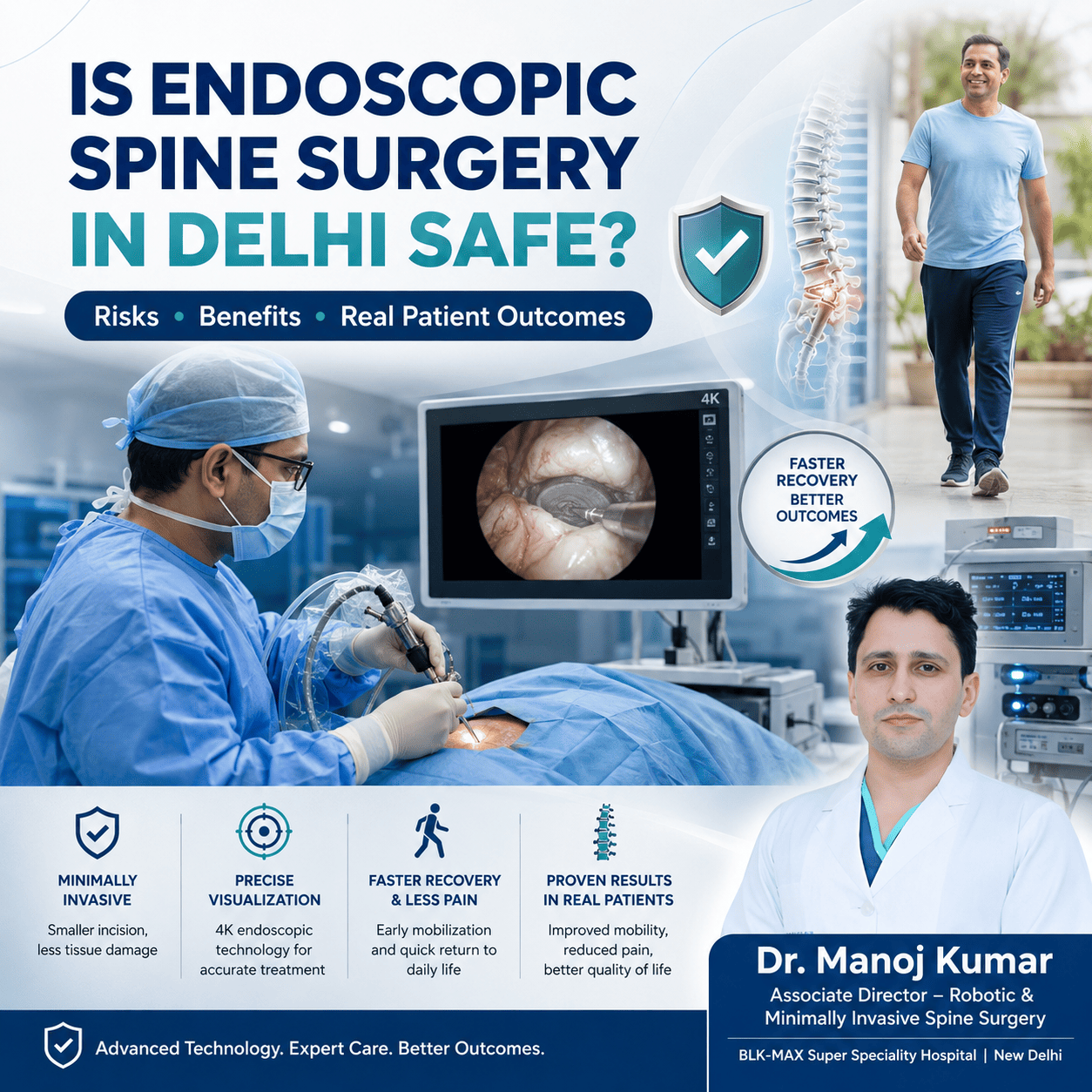
By Dr Manoj Kumar | Associate Director – Robotic & Minimally Invasive Spine Surgery, BLK-MAX Super Speciality Hospital, New Delhi
Endoscopic spine surgery in Delhi is safe, highly effective, and is now considered the gold standard for treating most spinal conditions, including slipped disc, sciatica, spinal stenosis, and spondylolisthesis. With a success rate of over 90% in well-selected patients and a recovery time that is 3–4 times faster than open surgery, it has replaced traditional spine surgery for thousands of patients across Delhi NCR every year.
However, patients ought to hear the word “safe” in context, not only as a reassurance. This page explains all you need to know before deciding on endoscopic spine surgery: how it works, what the real dangers are, what the advantages are (in numbers), what recuperation looks like, and what determines whether a patient is a good candidate.
If you are searching for a trusted endoscopic spine surgeon near you in Delhi, Noida, Gurgaon, Faridabad, or anywhere in the NCR, this guide is written specifically for you.
What Is Endoscopic Spine Surgery? (And How Is It Different From Traditional Surgery?)
Endoscopic spine surgery is a minimally invasive surgical technique in which a spine surgeon inserts a tiny tube called an endoscope through a 7-10 millimetre incision. The endoscope is outfitted with a high-definition camera and light source that sends a live, magnified view of the spine to a monitor, allowing the surgeon to see and work properly without having to open the back or neck.
Traditional open spine surgery, on the other hand, requires a large incision, sometimes 10 to 15 cm in width, through which muscles and tissues are removed to expose the spine. The larger the incision and tissue damage, the longer the recovery time and risk of complications.
Why Endoscopic Spine Surgery in Delhi Has Become the Preferred Choice
Delhi NCR is now one of the most advanced centres for endoscopic spine procedures in all of South Asia. Hospitals like BLK Max, Max Healthcare, Fortis, and Apollo Delhi are performing hundreds of successful endoscopic spine surgeries every month. The shift toward endoscopic techniques has been driven by three things: the availability of 4K ultra-HD endoscopic systems, better-trained surgeons, and patients who are better informed and demanding less invasive options.
Is Endoscopic Spine Surgery Safe? The Honest Answer
Yes, endoscopic spine surgery is safe. But how safe depends on two things: the surgical team performing it, and how appropriately the patient has been selected for the procedure.
Here is what the data shows:
- The overall complication rate for qualified surgeons performing endoscopic spine surgery is between 1% and 4%, which is significantly lower than the 5% to 15% complication rate observed in open spine surgery.
- Infection rates after endoscopic spine surgery are fewer than 0.5%, as opposed to 2-4% in open surgery. This is owing to the incision’s modest size, which results in much reduced tissue exposure.
- Dural tears (unintentional puncture of the membrane around the spinal cord) occur at a rate of 1-2%, which is comparable to or lower than that of open surgery.
- In well-selected patients, the five-year revision surgery rate is less than 5%, which is comparable to open surgery but with a far faster first recovery.
What Makes Endoscopic Spine Surgery Safe in Delhi NCR?
The safety of endoscopic spine surgery depends on three factors more than anything else:
- Surgeon experience – A spine surgeon who has performed more than 200–300 endoscopic procedures has a significantly lower complication rate than one who is still building experience. Always ask your surgeon how many endoscopic procedures they have performed.
- Patient selection – Not every patient is a candidate. Patients with extreme obesity, severe osteoporosis, multilevel complex disease, or certain deformities may need a different approach. A good surgeon will tell you this honestly.
- Hospital infrastructure – Endoscopic spine surgery requires specialised 4K endoscopic systems, a trained scrub team, and intraoperative fluoroscopy (live X-ray guidance). Not all facilities have these.
Ready to get expert clarity on your condition?
👉 Book an Appointment with Dr. Manoj Kumar to discuss your symptoms and treatment options.
Endoscopic Spine Surgery Benefits — Why Patients Choose This Over Open Surgery
The benefits of endoscopic spine surgery over traditional open spine surgery are substantial and well-documented.
1. Smaller Incision, Less Scarring
The incision in endoscopic spine surgery is 7–10 mm. In open surgery, the incision can be 8–15 cm depending on the levels involved. This single difference translates into less bleeding, less tissue damage, less pain, and a much smaller scar.
2. Faster Recovery After Endoscopic Spine Surgery
This is the benefit most patients care about most.
- Most patients undergoing endoscopic spine surgery in Delhi are walking within 4–6 hours of the procedure.
- Discharge from the hospital happens in 1–2 days, compared to 5–7 days for open surgery.
- Return to desk work typically occurs within 2–3 weeks.
- Return to physical activity and full function is usually achieved within 4–6 weeks.
- Open spine surgery patients typically need 3–6 months for equivalent recovery.
3. Performed Under Local or Spinal Anaesthesia (Safer for Elderly Patients)
Many endoscopic spine procedures can be performed under local or spinal anaesthesia, rather than general anaesthesia. This is a significant safety advantage, especially for patients above 60 years of age, patients with heart or lung conditions, or those with diabetes. The risks associated with general anaesthesia, particularly respiratory complications, are avoided entirely.
4. Minimal Blood Loss
Blood loss during endoscopic spine surgery is typically less than 20–30 ml, less than a small cup. Open spine surgery, particularly fusion procedures, can involve 200–500 ml of blood loss. There is rarely a need for blood transfusion after an endoscopic procedure.
5. Lower Infection Risk
Because the incision is tiny and the surgery is often performed in a closed irrigation system (fluid constantly flowing through the working tube), the risk of post-operative infection is dramatically reduced. This matters enormously for diabetic patients, patients on immunosuppressive medications, and elderly patients whose healing is naturally slower.
6. Preservation of Spinal Muscles and Anatomy
In open spine surgery, back muscles are aggressively retracted (pulled aside) for long periods to access the spine. This muscle retraction causes damage that contributes significantly to long-term back pain and prolonged recovery. In endoscopic spine surgery, muscles are gently dilated rather than cut, and the normal anatomy is almost entirely preserved. This is why many patients who undergo endoscopic spine surgery report far less post-operative back pain than those who have had open surgery.
7. Can Be Done as Day Surgery or Short-Stay Surgery
In appropriate patients, endoscopic spine surgery in Delhi NCR can be performed as day surgery; the patient comes in the morning and goes home the same evening. This significantly reduces the cost of hospitalisation and is psychologically easier for many patients.
What Are the Risks of Endoscopic Spine Surgery? (Complete and Honest)
No surgical procedure is without risk. Here is an honest and complete list of the risks of endoscopic spine surgery and how commonly they occur in experienced hands.
Risks Specific to Endoscopic Spine Surgery
- Incomplete Decompression (Most Common Concern): Because the working area in endoscopic surgery is smaller than in open surgery, there is a small risk that the nerve or disc is not fully decompressed in a single procedure. In 2–5% of cases, patients may require a repeat procedure. This risk is significantly higher with inexperienced surgeons.
- Dural Tear: The dura is the membrane that surrounds the spinal cord and nerve roots. A small tear in the dura can occur during any spine surgery. In endoscopic spine surgery, the rate is approximately 1–2%. Most small dural tears resolve on their own with bed rest. Larger tears may require a second procedure to repair.
- Nerve Root Irritation or Injury: Temporary nerve irritation, causing numbness, tingling, or weakness in the leg or arm, can occur after endoscopic spine surgery, usually because the nerve is being moved away from its compressed position. This is almost always temporary and resolves within days to weeks. Permanent nerve injury is very rare in experienced hands (less than 0.5%).
- Infection: Though rare (under 0.5%), a post-operative infection can occur. Signs include increasing pain, redness, swelling, or fever after surgery. If detected early, infections respond well to antibiotics. A deep infection requiring re-operation is extremely uncommon after endoscopic procedures.
- Recurrence of Disc Herniation:n After endoscopic discectomy (removal of a herniated disc), approximately 3–7% of patients may develop a re-herniation of the same disc, requiring repeat treatment. Smoking, obesity, and heavy physical work increase this risk.
- Failed Back Surgery Syndrome: A small percentage of patients (2–4%) do not achieve the expected pain relief after endoscopic spine surgery. This is usually because of incorrect patient selection, for example, operating on a disc level that was not actually the primary source of the patient’s pain.
General Surgical Risks (Common to All Surgeries)
- Anaesthesia-related complications (minimised by use of local/spinal anaesthesia)
- Deep vein thrombosis (blood clot in the leg veins), rare given early mobilisation
- Allergic reaction to medications
Endoscopic Spine Surgery Success Rate in India — What Are the Real Numbers?
The success rate of endoscopic spine surgery in India, particularly in high-volume centres in Delhi NCR, is excellent.
Here is a realistic breakdown by condition:
|
Condition Treated |
Success Rate (Endoscopic) |
Success Rate (Open Surgery) |
|
Lumbar Disc Herniation (Slip Disc) |
90–95% |
85–92% |
|
Sciatica due to Disc Compression |
88–94% |
82–90% |
|
Lumbar Spinal Stenosis |
85–92% |
80–88% |
|
Cervical Disc Herniation |
88–93% |
84–91% |
|
Foraminal Stenosis |
86–92% |
80–87% |
|
Spondylolisthesis (Grade 1–2) |
82–90% |
78–88% |
“Success” in these numbers means significant and lasting reduction in leg or arm pain (the primary complaint in most spinal conditions), ability to return to normal activities, and patient satisfaction scores of good or excellent.
It is important to note that success rates in any surgery depend heavily on proper patient selection. A patient who is not a good candidate for endoscopic surgery but undergoes it anyway will have a lower success rate, not because the technique failed, but because it was not the right technique for that patient’s anatomy or condition.
Endoscopic Spine Surgery Recovery Time — Week-by-Week Guide
One of the most common questions patients ask before endoscopic spine surgery in Delhi is: “How long will it take me to recover?”
Here is an honest, week-by-week guide:
Day 1–2: Hospital Stay
- Depending on the method, surgery lasts between 45 and 90 minutes.
- You will be urged to sit up and walk within 4-6 hours of surgery.
- Mild to moderate post-operative discomfort at the incision site is common.
- A urine catheter, if necessary, is removed the following day.
- The majority of patients are discharged within 24 to 48 hours.
Week 1: Early Recovery at Home
- Walking is suggested from the start: short, simple walks lasting 5-10 minutes, three to four times each day.
- The spine should not be bent, raised, or twisted.
- Oral medication is frequently beneficial for pain relief.
- Most patients report significant relief from leg or arm discomfort within a few days.
- Driving is not allowed during Week 1.
Weeks 2–4: Building Strength
- Most patients with desk jobs or who work from home can return to work by week 2-3.
- Walking distances and durations will gradually increase.
- Gentle physiotherapy exercises are taught, typically by a physiotherapist with experience in post-spine surgery rehabilitation.
- Bathing is usually allowed when the incision has healed (approximately 10-14 days).
Weeks 4–6: Return to Activity
- Most patients feel 70–80% recovered by Week 4.
- Light physical activity, including walking longer distances, gentle yoga, and swimming, is permitted.
- Driving is typically permitted from Week 4 onward, provided there is no significant pain.
Weeks 6–12: Full Recovery
- By Weeks 6-8, the majority of patients had returned to regular activity levels.
- Patients with physically demanding professions (construction, heavy lifting) may need 10-12 weeks to resume full work activities.
- Follow-up imaging is performed after 6-8 weeks to ensure that the nerve has fully decompressed.
Endoscopic Spine Surgery Cost in Delhi NCR — What to Expect
Endoscopic spine surgery cost in Delhi varies based on the hospital, the specific procedure, the number of spinal levels involved, and whether implants are required.
Here is a general guide to endoscopic spine surgery costs in Delhi NCR:
| Procedure | Approximate Cost Range (Delhi NCR) |
| Endoscopic Discectomy (Slip Disc / Sciatica) | ₹1,20,000 – ₹2,50,000 |
| Endoscopic Foraminoplasty (Foraminal Stenosis) | ₹1,50,000 – ₹2,80,000 |
| Endoscopic Laminectomy (Spinal Stenosis) | ₹1,80,000 – ₹3,50,000 |
| Biportal Endoscopic Spine Surgery | ₹2,00,000 – ₹4,00,000 |
| Endoscopic TLIF (with implants) | ₹3,50,000 – ₹6,00,000 |
Note: These are approximate ranges. Your surgeon will provide a specific cost estimate based on your MRI findings, the procedure required, hospital room choice, and insurance coverage. Most major health insurance policies in India now cover endoscopic spine surgery when it is medically indicated.
Is Endoscopic Spine Surgery Cost-Effective Compared to Open Surgery?
Yes, when you account for the total cost of care, endoscopic spine surgery is often equal to or less expensive than open surgery. Here is why:
- A shorter hospital stay (1-2 days versus 5-7 days) reduces ICU and hotel expenses.
- A quicker recovery means fewer days of lost productivity or paid leave.
- Reduced complications imply fewer additional treatments and hospital stays.
Is Minimally Invasive Spine Surgery Safe for Elderly Patients?
Yes, in fact, minimally invasive endoscopic spine surgery is often the safest option for elderly patients, and it is preferred over open surgery in patients above 65 years of age for several reasons:
- It can be performed under local or spinal anaesthesia, avoiding the cardiovascular and respiratory risks of general anaesthesia.
- Minimal blood loss means patients with anaemia, clotting disorders, or cardiac conditions face far less physiological stress.
- Early mobilisation (walking within hours) dramatically reduces the risk of deep vein thrombosis and pulmonary embolism, serious complications that are more common in elderly surgical patients confined to bed.
- Less post-operative pain means less reliance on strong painkillers (opioids), which cause confusion, constipation, and falls in elderly patients.
- Shorter hospital stays reduce the risk of hospital-acquired infections.
Who Is a Good Candidate for Endoscopic Spine Surgery in Delhi?
Endoscopic spine surgery is suitable for most patients with disc-related or nerve-compression spinal conditions. The best candidates are:
- Patients with a single-level or two-level disc herniation causing leg pain (sciatica) or arm pain (cervical radiculopathy)
- Patients with lumbar or cervical spinal stenosis causing nerve compression
- Patients whose pain has not responded to 6–12 weeks of conservative treatment (physiotherapy, medications, injections)
- Patients who wish to avoid open surgery and have a relatively healthy MRI picture for minimally invasive intervention
- Elderly patients or those with significant medical comorbidities (heart disease, diabetes, lung disease) who cannot safely undergo open surgery under general anaesthesia
Who May Not Be Suitable for Endoscopic Spine Surgery
- Patients with severe multi-level degenerative disease requiring fusion across many levels
- Patients with high-grade spondylolisthesis (Grade 3–4)
- Patients with severe spinal deformity (scoliosis)
- Patients with significant instability requiring instrumented fusion
- Patients with certain tumours or infections requiring more extensive open resection
A good spine surgeon will assess your MRI, clinical examination, and medical history and tell you honestly whether you are a candidate for the endoscopic approach or whether another technique would serve you better.
Endoscopic Spine Surgery vs Open Spine Surgery - A Clear Comparison
|
Factor |
Endoscopic Spine Surgery |
Open Spine Surgery |
|
Incision size |
7–10 mm |
8–15 cm |
|
Anaesthesia |
Local / Spinal / General |
General |
|
Hospital stay |
1–2 days |
5–7 days |
|
Blood loss |
Less than 30 ml |
200–500 ml |
|
Post-op pain level |
Mild to moderate |
Moderate to severe |
|
Return to work |
2–4 weeks |
6–12 weeks |
|
Infection risk |
Under 0.5% |
2–4% |
|
Muscle damage |
Minimal |
Significant |
|
Overall complication rate |
1–4% |
5–15% |
|
Success rate |
88–95% |
82–92% |
|
Suitability for elderly |
Excellent |
Moderate |
Why Choose an Endoscopic Spine Surgeon in Delhi NCR?
Delhi NCR has emerged as one of the most advanced regions in Asia for endoscopic and minimally invasive spine surgery. Patients from across India, from Lucknow, Agra, Patna, Jaipur, Chandigarh, and even from overseas, regularly travel to Delhi for endoscopic spine procedures that are not available at their local hospitals.
Key reasons Delhi NCR stands out:
- Availability of the latest 4K UHD endoscopic spine systems and intraoperative navigation
- Spine surgeons with dedicated training in endoscopic techniques, including in Germany, South Korea, and the USA, where endoscopic spine surgery is most advanced
- Multi-disciplinary spine teams involving neurosurgeons, orthopaedic spine surgeons, pain management specialists, neurologists, and rehabilitation physiotherapists
- Major tertiary care hospitals with complete infrastructure for complex spine cases
- High case volume leading to better outcomes, surgeons who perform more cases achieve better results
What to Ask Your Endoscopic Spine Surgeon Before the Procedure
Before consenting to any spine surgery, ask your surgeon these questions:
- How many endoscopic spine surgeries have you performed personally?
- What is your personal complication rate for this procedure?
- Am I the right candidate for endoscopic surgery, or would open surgery serve me better?
- What will recovery look like for my specific condition?
- What is the expected success rate for my particular diagnosis?
- What happens if the endoscopic approach needs to be converted to open surgery during the procedure?
- What does the total cost include — hospital, surgeon fees, anaesthesia, implants, physiotherapy?
A surgeon who answers these questions openly, with specific numbers and honest assessment, is a surgeon you can trust.
Frequently Asked Questions - Endoscopic Spine Surgery in Delhi
Is endoscopic spine surgery safe or not?
Endoscopic spine surgery is safe when performed by an experienced surgeon in a well-equipped hospital. The overall complication rate is 1–4%, which is significantly lower than the 5–15% complication rate seen with open spine surgery.
What is the success rate of endoscopic spine surgery in India?
The success rate of endoscopic spine surgery in India, at high-volume centres like those in Delhi NCR, ranges from 88–95% for conditions like lumbar disc herniation, sciatica, and spinal stenosis. Success rates vary by condition and depend heavily on proper patient selection.
Is endoscopic spine surgery dangerous?
No, endoscopic spine surgery is not dangerous. It is one of the safest forms of spine surgery available. The combination of a tiny incision, minimal blood loss, local/spinal anaesthesia option, and early mobilisation makes it safer than open surgery for the majority of patients.
How long is the recovery time after endoscopic spine surgery?
Most patients are walking within 4–6 hours of endoscopic spine surgery and are discharged in 1–2 days. Return to desk work happens in 2–3 weeks, and full activity is restored in 4–8 weeks, depending on the procedure performed.
What is the cost of endoscopic spine surgery in Delhi?
Endoscopic spine surgery cost in Delhi NCR ranges from approximately ₹1,20,000 to ₹6,00,000 depending on the specific procedure, hospital, and whether implants are required. Endoscopic discectomy for slip disc or sciatica typically costs ₹1,20,000 to ₹2,50,000.
Can endoscopic spine surgery be done for all spine problems?
No, not all spine problems are suitable for the endoscopic approach. Single or two-level disc herniations, foraminal stenosis, and spinal stenosis are ideal. Complex deformities, high-grade instability, and multi-level fusion requirements may need open or robotic-assisted surgery.
How do I find the best endoscopic spine surgeon near me in Delhi NCR?
When searching for an endoscopic spine surgeon near you in Delhi, Noida, Gurgaon, or Faridabad, look for a spine surgeon with dedicated endoscopic training, a high volume of endoscopic procedures performed, and clear communication about risks and expected outcomes. Checking credentials, hospital affiliations, and patient reviews is also recommended.
Is endoscopic spine surgery covered by insurance in India?
Yes, most group health insurance policies and individual health insurance plans in India now cover endoscopic spine surgery when it is medically necessary, as documented by your spine surgeon and supported by MRI findings and clinical assessment. Confirm with your insurer before surgery.
Is endoscopic spine surgery better than robotic spine surgery?
Endoscopic and robotic spine surgery are not competing technologies, they are different tools for different problems. Endoscopic surgery is primarily used for decompression procedures (removing a disc or bone pressing on a nerve). Robotic surgery is used for implant-based fusion procedures requiring precise screw placement. In many complex cases, both are used together.
Can elderly patients undergo endoscopic spine surgery?
Yes, elderly patients are often the best candidates for endoscopic spine surgery. The procedure can be performed under local or spinal anaesthesia, causes minimal blood loss, and allows for walking the same day, all of which reduce the risks that are highest in elderly patients undergoing major open surgery.
Book a Consultation for Endoscopic Spine Surgery in Delhi NCR
If you are dealing with persistent back pain, leg pain, neck pain, or nerve-related weakness or numbness, and conservative treatment has not given you lasting relief, endoscopic spine surgery may be the solution that gives you your life back.
Dr Manoj Kumar is a senior spine surgeon based at BLK Max Hospital, Delhi, with extensive experience in endoscopic spine surgery, robotic spine surgery, and minimally invasive spinal procedures. He has helped thousands of patients from across Delhi NCR and India return to a pain-free, active life through precisely planned and expertly executed endoscopic spine procedures.
To book a consultation:
- Visit: bestspinesurgeonindelhincr.com
- Call/WhatsApp: +91-7048942106
- Available at: BLK Max Hospital, Delhi | Clinic appointments available in Delhi NCR